TL;DR: Short-term rental in Croatia requires legal compliance, registration, and co-owner consent. New regulations introduce registration numbers for each accommodation unit, meaning owners who fail to establish full legal compliance risk ad removal, fines, and legal complications.
Short-term rental of properties in Croatia is no longer an unregulated zone where it's enough to publish an ad and wait for guests. In legal terms, short-term rental refers to renting accommodation to tourists for a period shorter than 30 days. EU Regulation 2024/1028, which applies from May 20, 2026, and the draft of the new Hospitality Industry Act, planned to be implemented from January 1, 2027, introduce registration numbers for each accommodation unit. Owners who fail to establish full legal compliance risk the removal of their listings on platforms like Airbnb and Booking.com, fines, and legal complications.
Croatia is one of the most active short-term rental markets in Europe — Split and Zadar are EU record holders with about 24,000 apartments for tourist rental, and Adriatic Croatia recorded 27.7 million overnight stays booked through OTA platforms in 2025. This guide covers all key steps: from registration and co-owner consent, to comparing tax models and reviewing actual costs for properties in Zagreb, Split, Dubrovnik, Zadar, and Istria.
If you are just considering purchasing a property with the aim of renting it out, start with our guide to investment properties by the sea.
Contents
- Legal Framework and Registration Process for Short-Term Rental
- Co-owner Consent and Special Conditions for Multi-Apartment Buildings
- Tax Obligations in Short-Term Rental: Flat-Rate vs. Actual Method
- Practical Overview of Costs and Common Owner Mistakes
- Why Legal Compliance is Key to Successful Short-Term Rental
- How Regent Real Estate Agency Can Help You with Short-Term Rental
- Frequently Asked Questions (FAQ)
Key Insights
Registration Number — Every accommodation unit must have its own registration number for legal advertising and renting in Croatia. This obligation applies from June 2026.
Co-owner Consent — In multi-apartment buildings, the consent of two-thirds (2/3) of co-owners by ownership share is mandatory for short-term rental, in accordance with the Act on Building Management and Maintenance (NN 152/2024).
Tax Models — Owners choose between flat-rate taxation (fixed amount per bed) and taxation based on actual costs.
Penalties — Penalties for unregistered short-term rental range from 1,000 to 15,000 EUR for individuals.
Legal Framework and Registration Process for Short-Term Rental
The Hospitality Industry Act is the foundation for everyone engaged in renting out apartments and flats to tourists in Croatia. It defines who may provide short-term accommodation services, under what conditions, and how they must register their activity. Alongside it, from May 20, 2026, EU Regulation 2024/1028 comes into force, obliging all platforms to collect and verify the registration data of renters.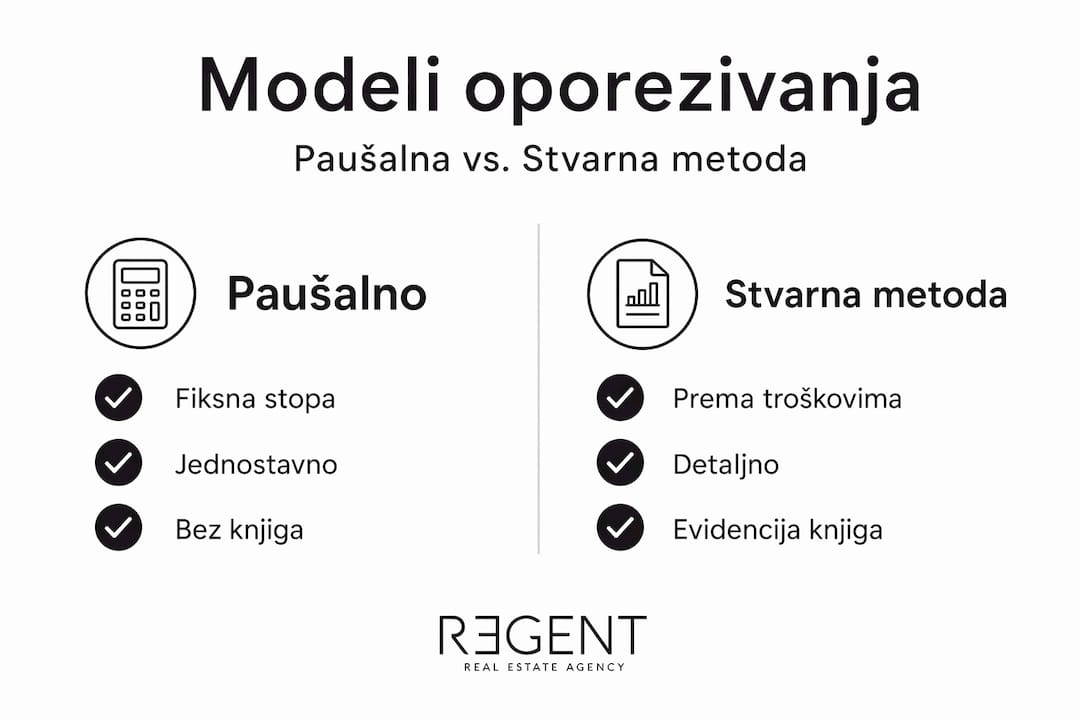
The most important new feature is the digitalization of the process. The eTourism system of the Ministry of Tourism and Sports of the Republic of Croatia is being introduced, along with a unique registration number for each accommodation unit, without which advertising on platforms becomes illegal according to EU Regulation 2024/1028. This means that an owner who rents three apartments should have three separate registration numbers. The registration number is mandatory from June 2026, while the new Hospitality Industry Act, currently in draft form, is planned to be applied from January 1, 2027.
Key obligations under the new legal framework for short-term rental include:
- Categorization of the accommodation unit (apartment, holiday home, room) with the competent office
- Obtaining a decision on approval for providing hospitality services in a household
- Registration in the eTourism system and obtaining a registration number
- Harmonized data on capacity and address in all systems
- Registering every guest with the tourist board via the eVisitor system of the Ministry of Tourism and Sports of the Republic of Croatia
- Displaying the registration number in all advertisements on platforms
- Paying tourist tax for each guest
- Regular status of tax obligations towards the Croatian Tax Administration
Owners who ignore these obligations not only risk financial penalties — fines for unregistered short-term rental range from 1,000 to 15,000 EUR for individuals. According to EU Regulation 2024/1028, platforms are obliged to remove listings without valid registration, which means a direct loss of income. This is the biggest change compared to previous periods when supervision was mainly based on inspection visits.
In addition, it is worth following the new legal framework for real estate in Croatia, which covers broader changes relevant to all property owners and investors.
Co-owner Consent and Special Conditions for Multi-Apartment Buildings
Owning an apartment in a residential building and owning a holiday home are not the same situation when it comes to short-term rental. Apartment owners in buildings face an additional requirement that many overlook.
For legal short-term rental in multi-apartment buildings, the consent of two-thirds of the building's co-owners (2/3) by ownership share is required, in accordance with the Act on Building Management and Maintenance (NN 152/2024). Without this consent, it is not possible to obtain a categorization decision, and thus no registration number. It is also important to know that the consent cannot be shorter than 5 years and can be revoked in cases of repeated violation of house rules.
In addition, proposed amendments to the Hospitality Industry Act foresee the recategorization of accommodation units every 10 years — meaning owners must also keep track of this deadline, not just initial registration.
The process of obtaining consent is carried out in several steps:
- Convene a co-owners' meeting or collect signed consents from each owner separately
- Ensure the consent of at least two-thirds of co-owners by ownership share
- Draw up written minutes from the meeting or certified statements from co-owners
- Attach documentation to the application for accommodation unit categorization
- Store original documentation as authorities may request it later
It is important to understand that consent can also be withdrawn. If relationships with neighbors deteriorate in the future, the owner may find themselves in a situation where they are legally renting, but then lose co-owner support when renewing registration.
Professional advice: It is recommended that co-owner consent be an integral part of a notarized document, and not just informal email communication. Such documentation has greater legal force in potential disputes or inspection checks. Owners living in buildings with active management and good neighborly relations complete this step faster. For those who have just purchased a property, it is useful to check in advance the rules of coexistence in buildings and the sentiment of co-owners towards short-term rental.
Tax Obligations in Short-Term Rental: Flat-Rate vs. Actual Method
Once the property is registered and categorized, the most common question investors ask follows: how and how much tax to pay? According to the Croatian Tax Administration, there are two basic models for taxing income from short-term rentals in Croatia: flat-rate taxation and taxation based on actual costs.
The choice between these two models can significantly affect the final earnings, and both models have their advantages and disadvantages depending on the type and location of the property.
Flat-rate tax vs. actual method — comparison:
- Tax Calculation: Flat-rate tax — fixed amount per bed annually / Actual method — based on actual income minus expenses
- Administrative Complexity: Flat-rate tax — low, suitable for beginners / Actual method — higher, requires expense record-keeping
- Suitability: Flat-rate tax — smaller investments, simple property / Actual method — high renovation costs, loans
- Possible Deduction of Expenses: Flat-rate tax — no deduction / Actual method — yes: utilities, depreciation, loan interest
- Tourist Tax: With both models, it is paid separately according to valid decisions of tourist boards
The flat-rate model is chosen by most small renters because it does not require keeping business books. The Croatian Tax Administration determines the tax amount based on the number of beds and the group of local self-government units (JLS) where the property is located — in Group I (Zagreb, Split, and the most developed tourist areas), the amount ranges from 100 to 300 EUR per bed annually (default 200 EUR), and in Group II from 70 to 200 EUR per bed annually. The owner pays a fixed annual amount regardless of whether the season was good or bad.
The actual method offers greater flexibility for investors who have invested significant funds in renovation or who have an ongoing loan. All justifiable expenses, including loan interest, utility services, equipment depreciation, and property management costs, are deducted from income. Tax is paid only on net income.
Several important points for choosing a method:
- Flat-rate is more cost-effective if income is high and costs are low
- Actual method is more cost-effective if annual costs exceed 30% of income
- Once chosen, the method applies for the entire calendar year
- Changing the method is possible every year, but requires timely notification to the Tax Administration
For a broader insight into tax obligations related to properties in Croatia, see our detailed guide on real estate taxes.
Practical Overview of Costs and Common Owner Mistakes
Below is an overview of what short-term accommodation means financially for a typical apartment in the most popular destinations. The same legal framework applies to all destinations — Zagreb, Split, Dubrovnik, Zadar, Istria, and the entire Adriatic coast.
Typical Annual Costs — Zagreb (50 m², 2 stars, 2 beds):
- Annual flat-rate tax: 200–400 EUR (depending on the number of beds, Group I)
- Tourist tax: depends on the number of overnight stays and season — up to 2.00 EUR per guest/overnight stay during season, up to 1.30 EUR off-season (according to tourist board decisions for 2026)
- Utility services (annual): 700 to 1,000 EUR
- Basic maintenance and minor repairs: 500 to 800 EUR
- Platform fees: 3–17% of revenue depending on the platform (Airbnb: ~3% for host; Booking.com: 15–17%)
- Categorization and registration (one-time): 100 to 200 EUR
Typical Annual Costs — Split (45 m², 3 stars, 2 beds):
- Annual flat-rate tax: 200–600 EUR (depending on the number of beds and micro-location, Group I)
- Tourist tax: up to 2.00 EUR per guest/overnight stay during season, up to 1.30 EUR off-season
- Utility services (annual): 600 to 900 EUR
- Basic maintenance and minor repairs: 500 to 800 EUR
- Platform fees: 3–17% of revenue depending on the platform
- Categorization and registration (one-time): 100 to 200 EUR
Short-term apartment rental is not passive income in its pure form. It requires continuous cost management and an active approach to legal changes. Every property must be legally registered and categorized to be advertised and rented out — this is not just a formality, but a prerequisite for the entire system to function.
Most common owner mistakes that lead to problems:
- Unregistered property: Advertising without a registration number becomes a reason for ad removal on all platforms according to EU Regulation 2024/1028
- Skipping co-owner consent: Categorization without proper documentation can be invalidated
- Failure to register guests: Every guest must be registered through the eVisitor system, otherwise penalties follow
- Neglecting tax declarations: Missed deadlines mean penalties and legal problems
- Ignoring regulatory changes: The law changed in 2024 and 2025, and many owners only learned about the changes when inspectors visited them
Professional advice: It is recommended to perform a so-called "compliance check" of the property once a year: verify if the categorization is still valid, if the registration number has expired, and if tax declarations are in order. For properties that have undergone renovation, it is also useful to check if everything has been carried out according to regulations through the guide on renovation and legalization.
Short-term vs. Long-term Rental: Basic Comparison
Investors considering short-term property rental in Croatia often ask: what is more profitable — short-term or long-term rental? The answer depends on the location, type of property, and management capacity.
Short-term rental — higher potential yield per night, especially on the coast and during the tourist season, but requires active management, continuous communication with guests, and compliance with tourist regulations.
Long-term rental — more stable and predictable income, less administrative burden, but lower yield per square meter in tourist destinations.
Property owners in Zagreb often choose long-term rental due to more consistent year-round demand. Property owners on the coast, in Split, Dubrovnik, Zadar, and Istria, generally achieve higher yields through short-term rentals during the season. Read more about rights and obligations in long-term rental in the guide to long-term property rental and the guide on how to properly draft a lease agreement.
Why Legal Compliance is Key to Successful Short-Term Rental
Investors who established proper documentation and clear cost records from the start achieve more stable and long-term higher income than those who started without the necessary registration or neglected details.
Digitalization through the eTourism and eVisitor systems of the Ministry of Tourism and Sports of the Republic of Croatia is not just a legal imperative — it is also a protection for registered owners. Transparent systems mean that every registered owner is protected from unfair competition that does not pay taxes or fees.
There's also a practical argument that is overlooked. A property with proper documentation, valid categorization, and clean tax records is worth more on the market. When an owner decides to sell, a buyer planning to continue short-term rental of the apartment to tourists in Croatia will pay a premium for a property that is immediately ready for operation without legal complications.
The third dimension is reputation. A platform that notices irregularities not only removes the listing but can also permanently block the user. Recovering from such a situation takes months and entails direct financial losses during the season.
Regular monitoring of regulatory changes and annual compliance checks are the most effective protection against unexpected costs and penalties. Read more about current changes in the real estate market in the overview of the new legal framework for real estate in Croatia.
Frequently Asked Questions
What is the mandatory registration number for short-term rental?
It is a unique number assigned to each accommodation unit and is essential for advertising and legal rental in Croatia. Without it, platforms are obliged to remove the listing according to EU Regulation 2024/1028. This obligation applies from June 2026.
When do the new short-term rental rules start to apply?
EU Regulation 2024/1028 enters into force on May 20, 2026, and obliges platforms to verify registration data. The draft of the new Hospitality Industry Act is planned to be applied from January 1, 2027, but is still in the legislative process.
How many co-owners must give consent for short-term rental in a residential building?
Consent of two-thirds (2/3) of co-owners by ownership share is required, in accordance with the Act on Building Management and Maintenance (NN 152/2024). Consent cannot be shorter than 5 years.
What are the penalties for unregistered short-term rental?
Penalties for renting without registration range from 1,000 to 15,000 EUR for individuals, with the possibility of ad removal on all platforms.
Can a foreigner rent out property short-term in Croatia?
Yes, foreign nationals who legally own property in Croatia can rent it out short-term under the same conditions that apply to domestic owners — registration, categorization, and tax obligations. Read more about purchasing property for foreign nationals in the guide for foreign buyers.
Do I need an OIB (Personal Identification Number) or a company for short-term rental?
Individuals with an OIB can rent out as private renters in a household. Purchasing and renting through a company has different tax and administrative implications — read more about this in the guide to purchasing property through a company.
What is the deadline for obtaining a registration number?
The registration number must be obtained by June 2026 for all who already rent or plan to rent. New owners must obtain it before the first advertisement.
Recommended
- Investor Guide | Regent Real Estate
- When to Buy Property: Market Analysis Guide
- Guide to Long-Term Property Rental – Rights and Obligations of Lessee and Lessor
- How Renting a Luxury Property Can Become Passive Income: A Guide for Investors