
TL;DR: When selling real estate in Croatia, you pay a capital gains tax of 24% on the realized profit — but only if you have not lived in and been registered at that property for at least two years. The buyer pays a real estate transfer tax (RETT) of 3% (or VAT of 25% for new constructions) when purchasing. Young people under 45 who are buying their first property can receive a refund of 100% RETT or 50% VAT. Understanding both taxes is crucial for all parties in a real estate purchase and sale transaction in Croatia.
Key Information
- Real Estate Transfer Tax (RETT): paid by the buyer, amounts to 3% of the market value of the property; for new constructions, the buyer pays VAT of 25% instead of RETT
- Capital Gains Tax: paid by the seller, rate of 24% on the realized profit from the sale; not paid if you have lived in and been registered at the property for at least two years
- Deadline for RETT: the buyer is obliged to report the acquisition of the property within 30 days, and to pay within 15 days of the delivery of the Tax Administration's decision; in practice, the application for the buyer is submitted by a public notary
- Deadline for Capital Gains Tax: the tax is declared in the annual tax return (Form DOH) by the end of February for income earned in the previous calendar year
- Tax Refund for Young People: Croatian citizens up to 45 years old who are buying their first property can receive a refund of 100% RETT or 50% VAT, subject to conditions regarding size and price
- Annual Real Estate Tax: there is also a separate annual real estate tax (from 0.60 to 8 euros/m²) paid by owners — it is not the same as RETT or capital gains tax
What is Capital Gains Tax and When Does It Arise?
When it comes to taxes on real estate purchases and sales in Croatia, there are two different taxes that are often confused. Real Estate Transfer Tax (RETT) is paid by the buyer at the time of property acquisition. Capital Gains Tax is paid by the seller on the realized profit from the sale. Two different taxes, two different tax bases, two different taxpayers.
In addition to these two taxes, there is a third category: the annual real estate tax, introduced in 2025, which is paid by all property owners regardless of purchase or sale. This tax ranges between 0.60 and 8 euros per square meter depending on the category and location of the property. To avoid confusing these categories, this guide clearly distinguishes which tax is paid by the buyer and which by the seller.
There is also a third common confusion: gifting or inheriting real estate to persons outside the first line of inheritance is subject to a special inheritance and gift tax at a rate of 4% of the market value. Inheritance within the first line of inheritance (spouse, children, parents, adoptees) is exempt from this tax.
More about the complete tax framework for buying and selling real estate in Croatia: https://regent.hr/blog/porezi-detaljno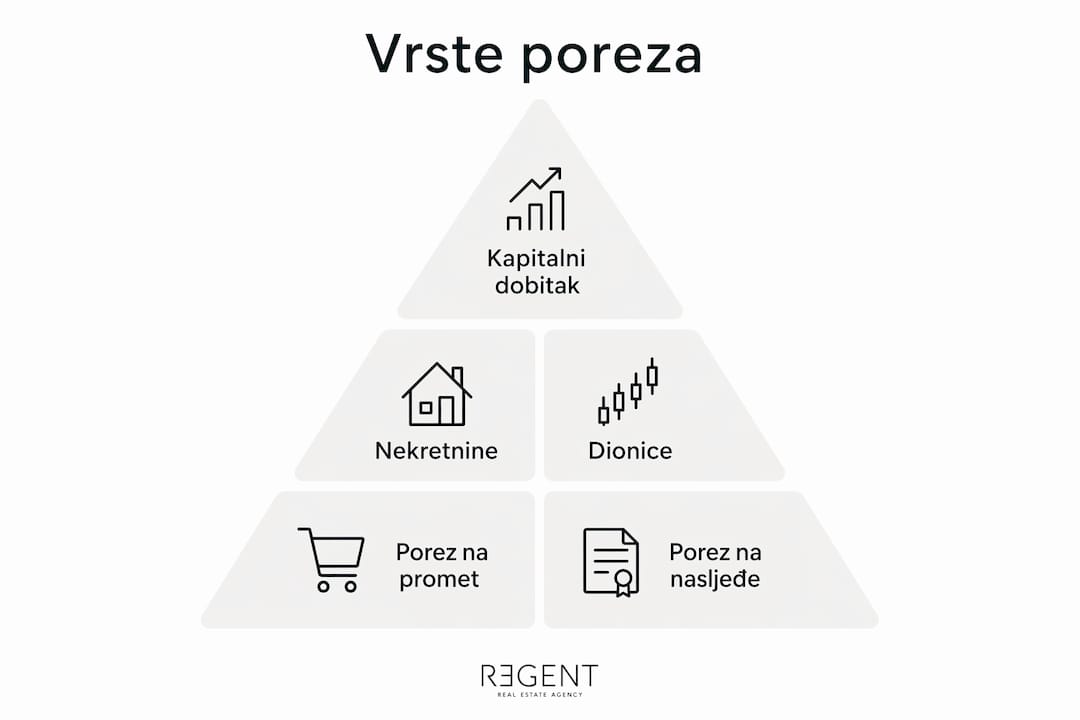
Real Estate Transfer Tax: What the Buyer Pays
Real Estate Transfer Tax (RETT) is paid by the buyer for every purchase of a property on the secondary market and amounts to 3% of the market value of the property as stated in the purchase agreement. The tax base is determined by the Tax Administration based on the contractual price, and if it assesses that the contractual price is lower than the market price, it can adjust it.
In practice, the RETT application for the buyer is submitted by the public notary who certified the purchase agreement — the public notary has a legal obligation to submit the agreement to the Tax Administration. The buyer does not have to submit the application personally but is obliged to pay the tax within 15 days of the delivery of the tax decision.
When RETT is Not Paid
Exempt from RETT are:
- Buyers of new constructions from entrepreneurs — VAT of 25% is paid instead of RETT
- Acquisition by inheritance or gift within the direct line of inheritance (spouse, children, parents, adoptees, adoptive parents, grandchildren, great-grandchildren, grandparents)
- Former spouses when settling property relations due to divorce
- Protected tenants who buy the apartment they live in
- Persons who acquire separate parts of a property through the dissolution of co-ownership
- Persons who acquire properties in the process of returning confiscated property (restitution)
Important note: siblings are not exempt from RETT and pay the full amount of 3% — this is a common misconception. Gifting between siblings is subject to tax.
RETT for Property Exchange
When two individuals exchange properties with each other, both participants pay RETT — each on the value of the property they acquire. Exchange is not a tax-neutral transaction.
More about the purchase and sale process and costs: https://regent.hr/blog/kako-funkcionira-kupoprodajni-proces-nekretnine-u-hrvatskoj-korak-po-korak
Tax Refund for Young People When Buying Their First Property
As of January 1, 2025, citizens of the Republic of Croatia up to 45 years of age who purchase their first residential property are entitled to a refund of the paid tax. The measure is implemented by the Agency for Legal Transactions and Real Estate Brokerage (APN), and the application must be submitted within 24 months from the date of concluding the purchase agreement.
Refund amount:
- 100% RETT — for properties on the secondary market on which RETT is paid
- 50% VAT — for new constructions on which VAT is paid
Conditions for Refund
This measure is not available to everyone — the following conditions apply:
- Exclusively citizens of the Republic of Croatia (foreigners from EU and non-EU countries cannot claim the refund)
- The buyer has not previously owned residential property
- Buyer's age up to 45 years at the time of purchase
- Size limitation: for 1 person up to 50 m² (with a tolerance up to 75 m²), for 2 persons up to 65 m² (tolerance up to 97.5 m²), with an additional 10 m² per child
- Price per m² must not exceed 50% of the local average price — which in practice excludes more expensive properties in the center of Zagreb and on the Adriatic coast
Detailed information on tax refunds and the application procedure: https://regent.hr/blog/povrat-poreza-na-prvu-nekretninu-gdje-podnijeti-zahtjev-koji-su-dokumenti-potrebni-koji-iznos-ocekivati
Capital Gains Tax: What the Seller Pays
Capital gains tax is a tax that the seller pays on the profit realized from selling a property at a price higher than the acquisition cost. If you bought an apartment for 150,000 euros and sold it for 200,000 euros, you realized a capital gain of 50,000 euros. On this amount — with certain deductions for proven expenses — you pay tax.
The tax liability arises when the property is alienated with a profit.
Alienation includes:
- Sale of property to a third party at a price higher than the acquisition cost
- Gifting property to persons outside the exempt circle of relatives, where the market value at the time of the gift is compared to the acquisition cost
- Exchange of property for other assets, if a positive difference in value is determined — in case of exchange, determining the acquisition and sale price is complex and consultation with a tax expert is recommended
If you sell a property for a price lower than the acquisition cost, no tax liability arises. Unlike financial assets, capital losses from real estate sales cannot be offset against gains or carried forward to subsequent tax years.
Inheriting property by itself is not subject to capital gains tax. A tax liability may arise only when the heir sells or gifts the property further — in that case, the value determined in the probate procedure is taken as the acquisition cost. If the market value is not determined in the probate decision, consultation with the Tax Administration or a tax advisor is recommended.
More about the probate procedure and inheriting property: https://regent.hr/blog/ostavinski-postupak-i-nasljedivanje-nekretnine-koraci-troskovi-i-rokovi
Documentation You Must Keep
Preparation for a potential tax declaration begins from the moment of property purchase.
It is necessary to keep:
- Purchase agreement with the clearly stated purchase price
- All invoices for construction works and property improvements
- Confirmations of agency commission paid upon purchase (only the commission paid upon acquisition is deductible, not upon sale)
- Proofs of costs incurred upon acquisition (notary fees, registration fees)
Professional advice: Store all property-related expenses in physical and digital form. The Tax Administration can request documentation several years after the transaction, and every proven expense reduces your tax base.
More about documents to check when buying: https://regent.hr/blog/dokumenti-koje-morate-provjeriti-prilikom-kupnje-nekretnine
Exemptions and Reliefs from Tax
Croatian tax regulations foresee several situations in which capital gains tax on real estate does not arise at all.
Two-Year Registered Residence
The most important and most frequently used exemption refers to a property where you have lived and been registered. Selling a property where you have been registered and actually resided for at least two years before the sale completely exempts you from paying capital gains tax — regardless of the amount of profit realized.
The condition is cumulative: you must both live in the property and be registered at it. A mere formal registration without actual residence is not sufficient — the Tax Administration can verify actual residence, and vacation homes where only an address is registered without actual stay do not meet the condition.
The two-year period runs from the date of actual registration of residence and moving in, not from the date of property purchase. Someone might buy an apartment and register only a year after the purchase — the two-year period then starts from the date of registration.
Overview of situations:
Sale of an apartment where you have lived for 2+ years → no tax is paid; condition: both registration and actual residence
Sale of an investment apartment → tax is paid; rate 24% on realized profit
Inheritance of property → no capital gains tax is paid; tax may arise upon later sale
Gifting property to persons within the exempt circle → not paid; depends on kinship
Sale of property where you were not registered for 2 years → tax is paid; regardless of the amount of profit
Sale of property at a price lower than the acquisition cost → not paid; no tax liability
Professional advice: If you are planning to sell a property where you are currently not registered, but you meet other conditions, consider the possibility of registering your residence at that address. The two-year period begins from the moment of actual registration and residence.
Tax Rate and Calculation of the Tax Base
What is the Capital Gains Tax Rate
The tax rate for capital gains from real estate is 24%. This is different from the rate applied to capital gains from financial assets (stocks, funds), where the rate is 12%. When reading general information about capital gains tax, be careful not to confuse these two categories as the rules and rates are not the same.
In addition to the calculated 24% tax, a surtax on income is also calculated, which depends on the seller's city of residence. The surtax rate varies by municipalities and cities — Zagreb has one of the highest rates. This means that the total tax liability for a seller residing in Zagreb is slightly higher than the 24% rate itself.
How the Tax Base is Calculated
Capital gains are calculated as the positive difference between the income from the sale and the acquisition costs, with deductions for justifiable expenses:
- Sale price (amount received from the buyer)
- Minus acquisition cost (amount paid upon purchase)
- Minus acquisition expenses (notary fees, agency commissions paid upon purchase, registration fees)
- Minus improvement costs (documented construction works that increased the value of the property)
- The result is the tax base to which the 24% rate is applied, increased by surtax
Illustrative Calculation Example
You bought an apartment in 2021 for 180,000 euros. You paid 3,000 euros in acquisition costs (public notary, registration) and 15,000 euros for documented bathroom and kitchen renovation. You are selling the apartment in 2026 for 240,000 euros.
Tax base = 240,000 − 180,000 − 3,000 − 15,000 = 42,000 euros
Tax = 42,000 × 24% = 10,080 euros (increased by surtax depending on the city of residence)
Without documented expenses, the tax base would be 60,000 euros, and the tax 14,400 euros. The difference of 4,320 euros clearly shows why keeping receipts is so important. Note: the amounts are illustrative — the actual tax liability depends on the specific situation and surtax.
How to Declare Capital Gains Tax
Individuals who have sold real estate and realized capital gains are obliged to declare it in their annual tax return via Form DOH to the Tax Administration. The deadline for submitting the declaration is by the end of February, or by March 2 if February 28 falls on a non-working day, for income earned in the previous calendar year.
Declaration procedure:
- Gather all documentation: purchase agreements, expense invoices, payment confirmations
- Calculate the tax base according to the described formula
- Fill out Form DOH with accurate transaction data
- Submit the form electronically via the ePorezna system or in person at the competent branch of the Tax Administration
- Pay the calculated tax by the deadline
What Happens If You Don't Declare Tax
The Tax Administration can determine the tax liability and charge statutory default interest along with a monetary penalty. Real estate transactions are publicly recorded through the Tax Administration and land registries, making the declaration transparent and verifiable.
Common errors in declaration:
- Forgetting improvement costs because invoices were not kept
- Incorrect determination of the acquisition cost for inherited property
- Confusing rules for financial assets with rules for real estate — losses from stock sales cannot be offset against gains from real estate sales
- Missing the deadline because the owner thinks the deadline runs from the date of money receipt, not from the calendar year of sale
- Not including surtax in addition to the basic 24%
Professional advice: Immediately after selling a property, store all contracts, invoices, and confirmations. The tax declaration will be significantly simpler, and you will reduce the risk of missed deductions.
More about the new legal framework for real estate in Croatia: https://regent.hr/blog/novi-zakonski-okvir-za-nekretnine-u-hrvatskoj-sto-se-mijenja-za-kupce-i-prodavatelje
Regent Helps You with Property Sales
Selling real estate is a complex process that involves legal, administrative, and tax aspects. Regent offers legal services that include documentation preparation, tax obligation verification, and support throughout the entire purchase and sale process.
Our team of experts can help you understand your tax obligations, appraise the property, and conduct the transaction safely and transparently. If you are considering buying or selling, browse property listings on Regent.hr and contact us for a personalized consultation tailored to your situation.
Frequently Asked Questions (FAQ)
What is the capital gains tax rate on real estate?
The capital gains tax rate on real estate in Croatia is 24%, applied to the positive difference between the sale price and the acquisition cost, with deductions for proven expenses.
When do I not have to pay capital gains tax?
You do not pay tax if you have actually lived in and been registered at the sold property for at least two years before the sale. The two-year period runs from the date of registration and moving in, not from the date of property purchase.
I inherited a property — do I have to pay tax?
Inheriting property within the first line of inheritance (spouse, children, parents, adoptees) is not subject to RETT or capital gains tax. A tax liability may arise only when the heir sells or gifts the property further.
How is capital gains tax on real estate declared?
The tax is declared in the annual tax return via Form DOH to the Tax Administration, with a deadline by the end of February for income earned in the previous calendar year.
Can I deduct renovation costs from the tax base?
Yes, documented property improvement costs with invoices reduce the tax base and directly decrease the amount of tax you pay. Costs without invoices are not acceptable as deductions.
What is the difference between real estate transfer tax and capital gains tax?
Real estate transfer tax is paid by the buyer upon purchase and amounts to 3% of the market value. Capital gains tax is paid by the seller on the profit realized from the sale. Two different taxes with different taxpayers and different tax bases.
Recommended
- Real Estate Tax - Detailed
- When to Buy Property: A Market Analysis Guide
- Real Estate Taxes in Croatia and Europe: Where We Stand and What Awaits Us?
- First Property Tax Refund: First Payments Already Started!