
TL;DR: Home loans in Croatia are available to foreign buyers, but require thorough preparation. Banks apply strict creditworthiness criteria (DSTI and LTV), require extensive documentation with certified translations, and additional legal restrictions apply to non-EU buyers. The key to success is early preparation - ideally 60 days in advance - and cooperation with an agency familiar with the local process.
Home loans in Croatia for foreign buyers are not impossible - but they are far more complex than most foreigners assume. This guide covers all key stages: from legal frameworks and prerequisites to interest rates, documentation, and macroprudential measures that directly affect your creditworthiness.
Table of Contents
- Are you even allowed to buy property in Croatia?
- Basics of home loans in the Croatian context
- Specific challenges and documentation for foreign buyers
- Financial conditions and interest rates: what to expect?
- How much can you borrow - and why Croatian rules might surprise you
- Practical steps for foreign buyers: how to prepare and what to expect
- What most often surprises foreign buyers?
- Taxes when buying property in Croatia
- How Regent Real Estate Agency can help you
- Frequently Asked Questions
Key Insights
Legal status — EU citizens buy without restrictions — Non-EU citizens need consent from the Ministry of Justice or buy through a company registered in HR
Lending conditions — Legal limits banks must adhere to — DSTI max. 45% for home loans, LTV max. 90%
Documentation — Certified translations of all foreign documents — Apostille only for non-EU countries
Interest rates — Compare based on APR, not nominal interest rate — The difference can be €20,000 over the loan term
Preparation — Start at least 60 days in advance — Sign a pre-agreement only after creditworthiness is confirmed
Are you even allowed to buy property in Croatia?
Before talking to a bank, one fundamental question needs to be clarified: are you actually allowed to buy property in Croatia? The answer depends on where you are from.
EU citizens have the same rights as Croatian citizens - they can freely buy all types of residential properties without any additional permits or restrictions. The same applies to legal entities registered in the EU.
Citizens from outside the EU (non-EU buyers) must meet one of two conditions:
1. Obtain consent from the Ministry of Justice to purchase property in Croatia
2. Be from a country with which Croatia has the principle of reciprocity - meaning, if a Croatian citizen has the right to buy property in that country
3. If neither condition is met, the only option is to buy through a company registered in the Republic of Croatia.
Professional Advice: Checking legal status and reciprocity should be the first step - before viewing properties, before contacting banks. The Regent team checks this for every client at the very beginning of the collaboration.*
Basics of home loans in the Croatian context
After the introduction, it's important to understand the basic rules and legal frameworks that affect home loans in Croatia. Without this foundation, any conversation with a bank can become confusing and unproductive.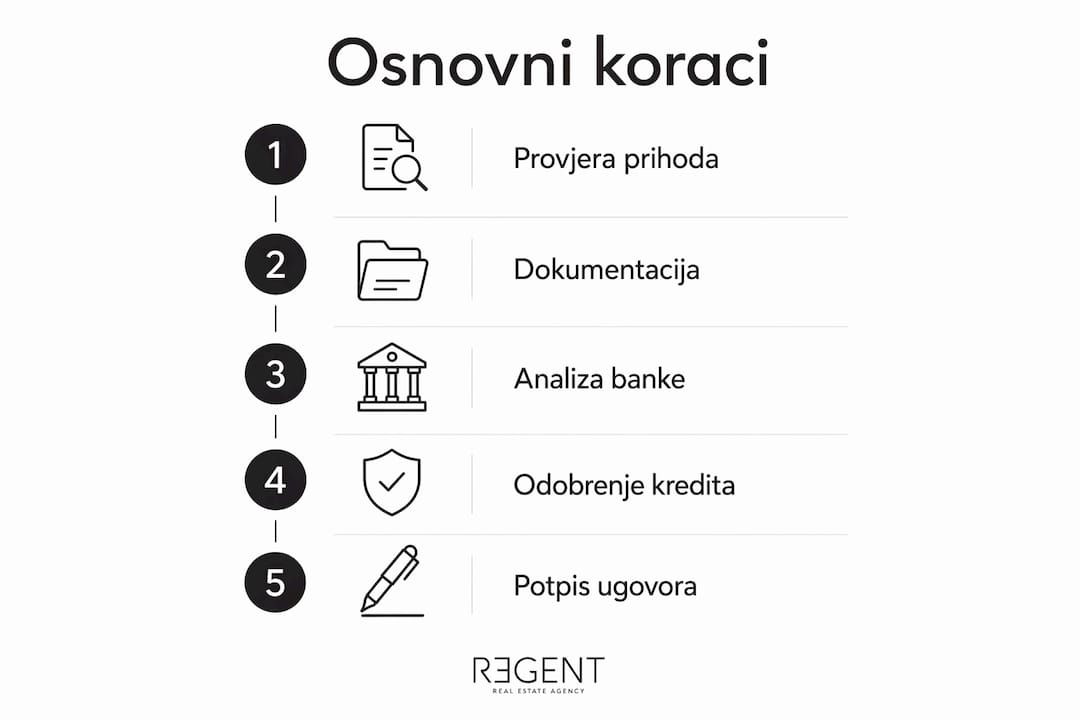 Two acronyms determine almost everything you need to know about home lending in Croatia: DSTI and LTV.
DSTI (Debt Service to Income) is the ratio between the total monthly loan repayment obligations for all your loans and your net income.
LTV (Loan to Value) is the ratio between the loan amount you are seeking and the estimated value of the property.
According to the Croatian National Bank's (HNB) macroprudential measures, which came into effect on April 1, 2025, both indicators have legally defined upper limits that banks must not exceed - without exception.
Specifically, the legal limits for home loans are:
- Maximum DSTI of 45% of net income
- LTV up to 90% of the estimated property value
- Repayment period up to 30 years
- Provable, stable income from a legitimate source
For non-residential loans (consumer, car, cash loans), the DSTI limit is stricter - it is 40%, and the repayment period is limited to 10 years.
The buyer's financial profile plays a crucial role. Banks look not only at income levels but also at their stability, source, and duration. Employees of foreign companies with indefinite contracts are in a better position than self-employed or seasonal workers.
Professional Advice: Reduce or close all existing loans and overdrafts on current accounts before submitting an application. Every active obligation reduces your DSTI space and thus directly reduces the maximum amount of the home loan you can get.*
Specific challenges and documentation for foreign buyers
Croatian banks require a standard set of documents for all buyers, but for foreigners, there are additional steps. According to the documentation requirements for foreign buyers, the list of key documents includes:
- Valid ID card or passport
- Land registry extract (ZK extract) for the property being purchased
- Energy certificate of the property
- Property valuation by a certified appraiser
- Proof of income (salaries, tax decisions, employment contracts)
- Credit history report from the country of origin
- Proof of tax residency
- OIB (Personal Identification Number - obtained in Croatia)
- Pre-purchase agreement
A special challenge is translations and certifications. All foreign documents must be translated into Croatian by a court interpreter. For documents from non-EU countries, an apostille certification is also mandatory - for documents from EU countries, apostille is not required since the EU Regulation on Public Documents came into force.
Banking requirements related to credit history are particularly strict. Foreign buyers do not have a history in the HROK system (Croatian Registry of Credit Obligations), so banks request appropriate confirmations from your home bank or credit bureau. Lack of credit history in Croatia is not an automatic disqualifier, but it can slow down the process.
Additionally, all security instruments (endorsed insurance policy, notarized statement) must be obtained within the Republic of Croatia - foreign equivalents are not acceptable.
Professional Advice: Prepare all documents in original and with certifications at least 30 days before the planned application submission. Banks often return applications due to one missing document, which can delay the entire process by several weeks.*
Financial conditions and interest rates: what to expect?
Interest rates for home loans in Croatia are divided into fixed and variable. A fixed rate ensures an unchanged installment throughout the entire fixed period, while a variable rate follows market indices (most commonly Euribor). According to the guide on financing apartment purchases, the choice between these two types has long-term consequences on the total loan cost.
Interest rates of Croatian banks:
- HPB — from 3.29% nominal / from 3.77% APR — Fixed for 5 or 10 years, variable thereafter
- Erste banka — from 2.50% nominal / from 3.53% APR — EKO home loan, fixed for 5 years
- OTP banka — from 2.99% nominal / from 3.58% APR — OTPrvi dom, fixed, promotion until 30. 6. 2026.
- PBZ, ZABA, Raiffeisen — individual nominal / individual APR — Depends on client profile, variable
Key points when comparing offers:
- The nominal interest rate only tells you about the interest, not the total cost
- APR includes all fees and gives a real picture of the loan cost
- The length of the fixed period affects security: a longer period means fewer surprises, but often a higher interest rate
- The conditions for changing the interest rate after the fixed period must be clearly defined in the contract
Professional Advice: Always request a loan simulation showing the total amount you will pay over the entire loan term, not just the monthly installment amount. The difference between offers with an APR of 3.20% and 3.80% on a €200,000 loan over 25 years is more than €20,000 in total.*
How much can you borrow - and why Croatian rules might surprise you
From April 1, 2025, the Croatian National Bank has obligated all banks to apply macroprudential measures. The goal is to reduce systemic risk, but for buyers, this means a stricter approach to lending - and this is not a bank's discretionary decision, but a legal obligation.
The DSTI framework specifically means: if your total monthly credit obligations - including the new home loan - exceed 45% of your net income, the bank is legally prevented from approving the loan.
DSTI Categories
- Home loan only — Average DSTI 38% — Low risk, bank approves without issues
- Home + non-residential loan — Average DSTI 44% — High risk, close to the legal limit
- Total obligations above 45% — Above the legal limit — Loan not possible
What a 90% LTV means in practice:
The bank can finance up to 90% of the estimated property value - not the purchase price. The difference is key:
- Agreed purchase price — €200,000 — The price agreed with the seller
- Bank's property appraisal — €180,000 — The bank estimates a lower value
- Maximum loan (90% of appraisal) — €162,000 — The maximum the bank can approve
- The difference the buyer must cover — €38,000 — Own funds or other financing source
Read more about the differences and types of property valuations on our blog: Property Valuation: What Market, Mortgage, and Tax Value Mean for Buyers and Sellers?
In addition, the 10% down payment is not the only cost - you also need to cover real estate transfer tax (3%), notary fees, appraisal costs, and agency commission. Realistically, foreign buyers need to secure 15–20% of the purchase price with their own funds.
Note: for foreign buyers from outside the EU, some banks approve loans of only 50–60% of the property value, meaning the down payment can be higher.
Key points related to macroprudential measures:
- The DSTI limit of 45% is legal, not negotiable
- Non-residential loans (car loans, cash loans) reduce the space for a home loan
- Multiple credit obligations increase risk and reduce the chances of approval
Practical steps for foreign buyers: how to prepare and what to expect
Document preparation and understanding procedures are crucial for a successful application. Here are the steps in order:
- Check your legal status - whether you are an EU or non-EU buyer and if you need consent from the Ministry of Justice
- Calculate your creditworthiness - sum all monthly credit obligations and divide by net income; if the result is close to 45%, consider repaying part of existing obligations
- Visit a bank for an informational interview - most banks offer a free preliminary calculation; do this before signing a pre-agreement
- Gather all documentation - income, credit history, personal identification, all with certified translations
- Choose a property that meets banking criteria - clear ownership structure, energy certificate, no encumbrances in the land registry
- Order a valuation from a certified appraiser accepted by the bank - check the validity of the appraisal with the bank
- Submit a formal application with complete documentation and actively follow up
- Prepare for the endorsement of the property insurance policy in favor of the bank - obtain it in Croatia
Professional Advice: Never sign a pre-purchase agreement until you have bank confirmation that you are creditworthy. A pre-agreement obliges you to buy - if you lose your deposit due to a rejected loan, there is no refund. Preparation of documents for foreign buyers should begin at least 60 days in advance.*
Beyond the numbers and rules: what most often surprises foreign buyers?
Beyond the official rules and numbers, there are a number of practical challenges that statistics don't show, and which in reality determine whether a foreign buyer will successfully get a home loan in Croatia.
The first and most common misconception is that Croatia, as an EU country, is automatically an "easy" market for lending. It is not. EU accession has not standardized banking procedures - each Croatian bank has its own internal criteria that are often stricter than the legal minimum. Foreign buyers who have easily obtained mortgages in Germany or Austria may be rejected in Croatia due to how local banks assess foreign income.
The second unexpected challenge is the endorsement of the insurance policy. The bank requires the property to be insured, and the policy must be endorsed in favor of the bank - and obtained in Croatia. This step sounds simple, but in practice, it can take a week or more, especially if the insurance company requires additional documentation about the foreign buyer. Many do not factor this step into their timeline.
The third factor that surprises many: foreign buyers who have a mortgage or lease in their home country often come with a DSTI ratio that is already 25–30%, without realizing it. When they add a new home loan in Croatia, they easily exceed the 45% limit - meaning automatic rejection, no exceptions.
The combination of documentation requirements, translations, appraisals, and banking procedures can easily take three to four months. Buyers who planned a quick purchase and move are often surprised by this timeframe.
Taxes when buying property in Croatia
The tax aspect of buying property in Croatia is worth highlighting specifically because it brings good news for foreign buyers.
Real estate transfer tax is 3% of the property's market value - the same for domestic and foreign buyers, residents and non-residents. It is paid by the buyer, and the Tax Administration has the right to disregard the agreed price if it estimates it to be below the market value.
Exception: when buying new construction from an investor who is in the VAT system, instead of transfer tax, VAT (25%) is paid, which is already included in the price.
Good news: Croatia has no annual property tax - unlike most Western European countries. This makes buying property in Croatia a financially attractive option for long-term holding.
Foreign buyers should also account for the following costs:
- Notary fees
- Land registry fees
- Certified translation costs for documentation
- Property appraisal costs
How Regent Real Estate Agency can help you with buying and lending
If you are considering buying property in Croatia as a foreign buyer, Regent Real Estate Agency offers support that covers the entire process - from the initial legal status check to the finalization of loan documentation.
Our property offerings include properties that meet banking criteria, with clear ownership structures and necessary documentation. Legal services cover the review of title deeds, contracts, and appraisals, thereby reducing the risk of surprises during the loan approval process. Administrative support includes assistance with document preparation and translation, and coordination with banks - which is especially valuable for buyers unfamiliar with local procedures.
Contact us and schedule a free informational meeting.
Frequently Asked Questions (FAQ)
Can foreign citizens get a home loan in Croatia?
Yes, foreign citizens can get a home loan in Croatia, but with stricter conditions than domestic buyers. EU citizens have the same rights as Croatians, while buyers from non-EU countries must meet additional legal requirements. Loans for foreign buyers in Croatia are offered by PBZ, Zagrebačka banka, Erste banka, Raiffeisen, and OTP banka.
What are the basic conditions for obtaining a home loan in Croatia for foreign buyers?
Basic conditions include stable and provable income, a clear credit history, a legally sound property, and complete documentation with certified translations. Banks apply a DSTI limit of 45% of net income and an LTV of up to 90% of the estimated property value as legal upper limits.
How does the DSTI limit affect a foreign buyer's loan in Croatia?
DSTI limits total monthly credit obligations to a maximum of 45% of net income. It is crucial that all active loans from abroad - mortgages, car loans, consumer loans - are included in this calculation. Buyers who come with already high foreign obligations may have too little DSTI space for a new home loan in Croatia.
Is an apostille required for documents when buying property in Croatia?
Apostille certification is only required for documents from countries outside the EU. For documents from EU countries, apostille is not required thanks to the EU Regulation on Public Documents. All foreign documents must be translated into Croatian by a court interpreter.
How much own funds does a foreign buyer need to purchase property in Croatia?
A minimum of 10% of the estimated property value (90% LTV limit), but realistically 15–20% of the purchase price when factoring in real estate transfer tax (3%), notary fees, appraisal costs, and agency commission.
Is there an annual property tax in Croatia?
No - Croatia does not have an annual property tax. Upon purchase, a 3% real estate transfer tax is paid (the same for domestic and foreign buyers), and when purchasing new construction from an investor in the VAT system, VAT is paid, which is included in the price.
Recommended
- Home Loans and Buying an Apartment: Everything You Need to Know
- Guide to Buying Property in Croatia for Foreign Nationals
- Buying a Home with a Loan: A Guide to Costs, Interest, and Taxes
- New Lending Measures in Croatia: How Will They Affect Home Loan Realization?