TL;DR: Energy renovation of multi-apartment buildings in Croatia in 2026 means a set of technical and organizational measures that reduce energy consumption for heating and cooling, improve living comfort, and increase the market value of the property. The process relies on the new Law on Energy Efficiency in Buildings (NN 155/25), energy audits, design, co-owner consent, and implementation of works with expert supervision. With available co-financing models from the NPOO and other funds, co-owners often finance a smaller part of the total costs themselves, and energy and utility savings can be manifold compared to the initial state.
In Croatia, this process is regulated by the Law on Energy Efficiency in Buildings, which has been in force since the beginning of 2026 and defines deep renovation as measures that achieve a saving of at least 50% of annual thermal energy for heating.
What is building energy renovation and how does it differ from apartment renovation
Building energy renovation is a set of measures that improve the energy properties of the entire building – thermal insulation of the envelope, efficiency of heating and cooling systems, ventilation and lighting, and living comfort. In Croatia, the field of energy efficiency in buildings is regulated by the Law on Energy Efficiency in Buildings (NN 155/25), which, among other things, defines the goals of decarbonization of the building stock by 2050.
The building sector is one of the largest energy consumers – approximately half of the final energy consumption in the EU is used for heating and cooling, and a large part of that is attributed to buildings – so the energy renovation of old multi-apartment buildings is considered a key tool for reducing emissions and housing costs. For apartment owners, building co-owners, and investors, the difference between a passive utility cost and an active investment in renovation lies precisely in how well they understand this process.
Professional advice: Energy renovation should not be viewed solely as a "facade cost". It is a technical, legal, and financial project that changes how a building consumes energy, how much utilities cost, and how the property is valued on the market.
Renovation of an entire multi-apartment building: what it includes
When co-owners talk about "real" energy renovation, they usually mean integral or deep renovation of the entire multi-apartment building. In practice, this means that several key elements are addressed simultaneously: facade, roof, carpentry, common installations, and, if necessary, additional safety measures.
Integral renovation most often includes:
- thermal insulation of exterior walls (facades) and roof
- replacement or improvement of carpentry in common areas
- modernization of the heating substation and heating system (e.g., more efficient boiler rooms, apartment-level regulation)
- improvement of ventilation and, if necessary, smoke extraction systems
- if necessary, installation of solar collectors or photovoltaic panels on the roof, depending on the project
Deep renovation in current co-financing programs implies that the project achieves savings in annual required thermal energy for heating of at least 50% compared to the initial state, often with additional requirements for primary energy savings. Such projects combine interventions on the building envelope and technical systems, with clear verification of savings through energy certificates before and after renovation.
Such a project requires the consent of a simple majority of co-owners by ownership share and a formally established co-owner community with an OIB (Personal Identification Number). The advantage is that the greatest energy savings and the most significant jump in the property's energy class are achieved, and all tenants share the costs and benefits.
Renovation of an individual apartment
An apartment owner considering a "small energy renovation" often wonders what they can do themselves, without a large project for the entire building. Options exist, but they are limited compared to integral renovation:
In an apartment, it is possible to:
- replace windows and balcony doors with more energy-efficient carpentry
- install a more efficient heating system (e.g., condensing boiler, heat pump in a smaller system)
- improve thermal insulation of the floor or ceiling from the inside
- install smart thermostats and room-by-room heating control

These measures can significantly reduce energy consumption and improve comfort in the apartment, but they do not change the energy class of the entire building. An apartment's energy certificate may show improvement, but without the renovation of the facade, roof, and common systems, building-level savings remain limited.
Professional advice: If you are undertaking interventions only in your apartment, focus on carpentry, heating regulation, and local insulation – these are the measures with the most impact for an individual owner, but it is good to coordinate them with any potential future project for the entire building.
What are the main steps of the energy renovation process?
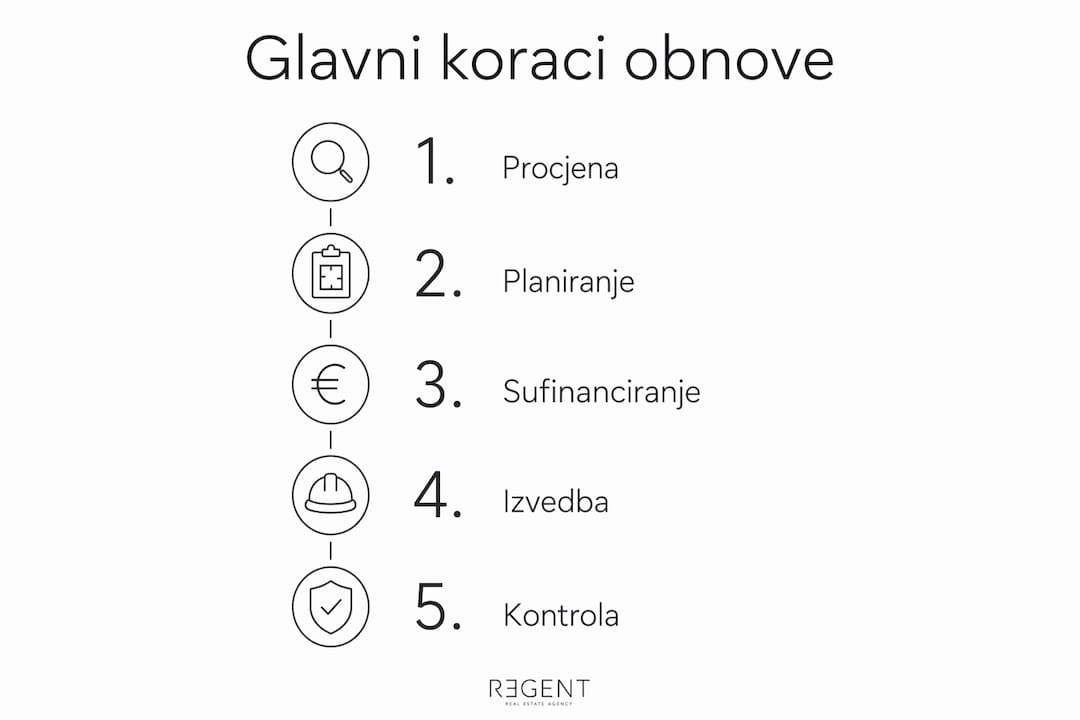
The process of energy renovation of a multi-apartment building follows a relatively clear sequence of steps. Skipping any of them most often results in poorer preparation, rejection of co-financing applications, or worse renovation outcomes.
- Energy audit and energy certificate of the building. An authorized energy certifier conducts a building inspection, collects data on energy consumption, and calculates the current energy class (A+ to G), in accordance with energy certification rules. The certificate identifies the main "weak points" – losses through walls, roof, carpentry, and heating systems.
- Preparation of preliminary and main renovation projects. An authorized designer prepares a project that defines specific measures, materials, insulation thicknesses, methods of intervention on the roof, carpentry, and heating systems, as well as estimated costs. The project must be in accordance with the Law on Energy Efficiency in Buildings and subordinate legislation (e.g., regulations on energy certification).
- Co-owner organization and consent. The co-owner community, most often through the co-owner representative and property manager, conducts a vote on initiating the project. Current calls for co-financing require at least a simple majority of co-owners by ownership share, as stipulated in the call documentation (UzP).
- Application for co-financing. The co-owner community submits an application for national or EU funds. For 2026, applications for the facade renovation program run from April 15 to August 31. The application includes project documentation, proof of establishment of the co-owner community, and proof of financial capability.
- Execution of works and expert supervision. After contractor selection, works are carried out according to the project – facade and roof insulation, carpentry replacement, modernization of heating systems, potential installation of renewable sources. Expert supervision of the works ensures that the interventions are performed in accordance with regulations, the project, and the contract.
- New energy certificate and verification of savings. Upon completion, an authorized certifier issues a new energy certificate confirming the building's new class and achieved savings. This is a key document for proving project success and is often a condition for the final disbursement of grants.
Professional advice: Energy renovation also includes safety measures such as fire protection, for example, the installation of mineral wool and smoke extraction systems. These measures are often overlooked in the initial design phase, and their subsequent inclusion increases project costs.
What are the concrete benefits of energy renovation?
The benefits of energy renovation are visible in utility costs, comfort, and market value. Data from real projects show that deep renovation of multi-apartment buildings can reduce annual thermal energy consumption for heating by 50–80% compared to the initial state, with a significant reduction in CO₂ emissions.
Energy savings and CO2 emission reduction
The example of the Sjenjak 5 building shows that energy renovation can reduce annual thermal energy consumption for heating by as much as 85.75%, with a reduction in CO2 emissions of nearly 80%.
In the example of the Vukovarska building, thermal energy savings amount to 76.52%, and CO2 reduction is 62.99%. These figures are not theoretical. They have been measured and verified by energy certificates after the completion of works.
Impact on property market value
A better energy class directly increases the market value of an apartment or building. The difference in energy consumption between poor (E, F, G) and good (A, B) energy classes can be tenfold.
Buyers and investors are increasingly looking for properties with low maintenance costs, and an apartment in a class B or C building achieves a higher market price than a comparable apartment in a class E or F building. The rise in apartment prices in Croatia, which in Zagreb reached 24 percent, further emphasizes the importance of energy efficiency as a value factor.
Cost-effectiveness and co-financing in 2026.
The cost-effectiveness of energy renovation depends on the investment amount, the level of co-financing, and the achieved savings. In current calls from the NPOO and the Environmental Protection and Energy Efficiency Fund, the co-financing intensity for energy renovation works on multi-apartment buildings ranges from approximately 60 to 80% of eligible costs, with higher rates for project documentation preparation and project management.
In practice, this means that co-owners do not bear most of the cost themselves, but rather through a combination of EU and national funds. The remaining cost is most often financed from reserves, additional payments from co-owners, or loans repaid through future utility savings.
The speed of reaction from the co-owner community is crucial due to limited budgets – for example, in one of the latest calls, 565 projects were received, with the requested grant amounts significantly exceeding the available fund. Buildings that start preparation late often end up on reserve lists or do not receive co-financing in that cycle.
The indicative payback period for integral renovation, with high levels of co-financing, typically ranges from approximately 5 to 12 years, depending on the building size, scope of work, and local energy prices. Without co-financing, the payback period is significantly longer, making timely application for calls an important financial decision.
Professional advice: The biggest "loss" is not just missing out on savings, but also missing out on favorable co-financing conditions. Communities that prepare documentation on time have significantly better chances of receiving funds with higher co-financing rates.
Regent as a partner in the energy renovation and property purchase process
Regent monitors energy renovation regulations and trends as they directly impact the real estate market. Our expert team can help you understand how the energy class, certificate, and renovation potential affect the value of your apartment or building. In cooperation with energy certifiers and designers, it is possible to assess the cost-effectiveness of planned interventions and connect them with buying or selling goals.
For investors looking for properties with high energy standards, Regent offers selected apartments in new constructions and projects that already meet nZEB requirements, along with advice on how energy efficiency affects long-term rental yield. In combination with financial advice, owners and buyers can get a clearer picture of when it is more advantageous to invest in an existing building and when to look for a new property with already integrated high standards.
Professional advice: When considering buying or selling a property, always check the energy certificate in addition to classic documents (land registry extract, building and occupancy permit) – it becomes one of the key parameters in negotiations.
Frequently asked questions
What is a building energy certificate and why is it mandatory?
An energy certificate is a document that shows the energy class of a building or its separate part on a scale from A+ to G, according to energy certification rules, and is mandatory for the sale, rental, or issuance of an occupancy permit for most residential and commercial properties larger than 50 m². Its purpose is to transparently show buyers and tenants the energy efficiency of the property and expected utility costs.
How much does energy renovation of a multi-apartment building cost?
The total cost depends on the size of the building, the scope of work, chosen materials, and local labor prices, but in current NPOO calls, co-financing of energy renovation works usually covers 60–80% of eligible costs, while project documentation and project management are financed at even more favorable rates. The remaining cost is borne by co-owners, most often through reserves, additional contributions, or a loan.
Can one co-owner block the renovation of the entire building?
For most co-financing programs, at least a simple majority of votes of co-owners by ownership share is required, as defined by the call documentation and inter-owner agreement. This means that an individual co-owner, as a rule, cannot single-handedly block a project that has received the necessary majority of votes and meets the call criteria.
How long is the payback period for energy renovation?
With high levels of co-financing, the indicative payback period for integral renovation ranges from approximately 5 to 12 years, depending on the scope of work and energy prices. Without co-financing, this period can be significantly longer, making timely application for calls and good project planning a key element of cost-effectiveness.
Can the owner of one apartment get co-financing for renovating only their apartment?
Most national and EU co-financing programs are aimed at multi-apartment buildings as a whole, through the co-owner community, so individual apartments generally cannot independently receive grants for interventions such as facade or roof renovation. An apartment owner can implement certain measures (carpentry, local insulation, heating regulation) at their own expense, but the details should always be checked in the specific call conditions.
Recommended
- What to pay attention to when viewing a property
- Property Energy Class: what do A–G ratings mean and how do they affect value and costs?
- Apartment Renovation: what requires a permit, what doesn't, and how to legalize already completed work
- Trešnjevka - North, Trešnjevka, apartment 135m² for sale | Regent Real Estate