
Land partitioning in Croatia is a geodetic-legal procedure by which one cadastral parcel is divided into several new ones, or multiple parcels are merged into one, with changes implemented in the cadastre and land registry. In practice, it is most often important when you want to sell a part of the land, form a building plot, resolve co-ownership relationships, or harmonize the actual situation on the ground with official records. For construction land, parcelation must be aligned with the spatial plan and building conditions, while for agricultural land outside the construction area, additional legal restrictions apply, including the rule that parcels generally cannot be smaller than 1 ha, except in exceptions prescribed by law. For the buyer, it is especially important to check whether the new state has been implemented in both the cadastre and the land registry, as without this, the new parcel is not fully legally regulated.
Land partitioning is one of those topics that at first glance seem technical, but in reality, often determine whether you can safely buy, sell, or plan construction on land. When the boundaries, area, and legal status of a parcel are not clearly regulated, every subsequent phase – from concluding a purchase agreement to designing and obtaining permits – becomes slower, more expensive, and legally riskier.
This is especially important in markets such as Zagreb, Split, and Rijeka, where the same area of land can have significantly different values depending on the zone, access to roads, building conditions, and consistency of records. In practice, it often turns out that the problem is not just that the land is "too small" or "irregular," but that the buyer is actually purchasing a part of a larger parcel that has not yet formally been created as a separate property.
In this guide, we explain what land partitioning is, when it is needed, how it is carried out, what are the key restrictions for construction and agricultural land, and what buyers and investors must check before signing a contract.
Table of Contents
- Key Insights
- What is Land Partitioning
- When is Partitioning Needed
- Partitioning of Construction Land
- Partitioning of Agricultural Land
- How Partitioning is Carried Out
- What Documents are Needed
- Most Common Mistakes of Owners and Buyers
- What Partitioning Means for Buyers and Investors
- How Regent Real Estate Agency Can Help You
- Frequently Asked Questions
- Recommended
What is Land Partitioning?
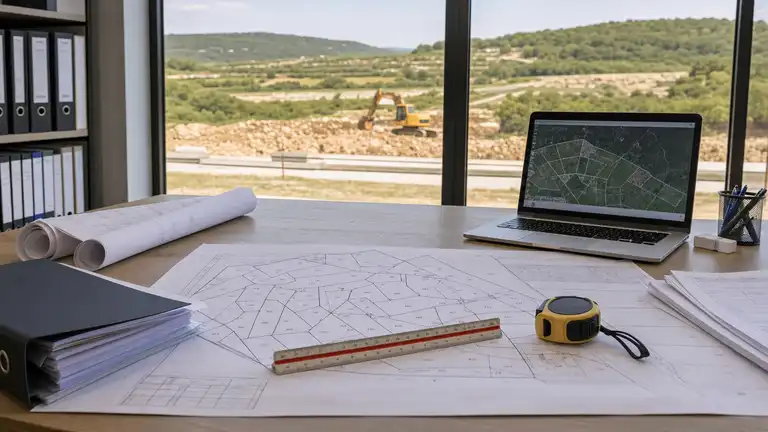
Land partitioning is a geodetic-legal procedure that changes the shape and area of an existing cadastral parcel. In practice, this means that one parcel can be divided into two or more new parcels, but also that several smaller parcels can be merged into one when required by ownership, investment, or urban planning reasons.
It is important to understand that parcelation is not just an administrative action. It changes the officially recorded state of a property and directly affects what can be sold, bought, encumbered with a mortgage, or used as a basis for future construction. This is precisely why parcelation most often occurs when an owner wants to sell part of the land, form a building plot for a house or project, resolve co-ownership relationships, or align the on-site situation with the data in the cadastre and land registry.
Professional tip: If you are buying only a part of a larger parcel, do not rely on a sketch, verbal agreement, or wording from an advertisement. For a secure purchase, it is important that the new parcel is officially formed and registered in the records.
When is Partitioning Needed
Partitioning is needed when an existing parcel no longer corresponds to the planned legal or functional use of the land. This is typical in situations where an owner wants to sell only part of a parcel, when co-owners want to separate joint land, or when an investor needs to form a building plot that meets the conditions of the spatial plan.
In practice, it is also common before the construction of a family house, semi-detached house, or a smaller residential building, as a new building plot must have adequate area, shape, and access to a public road. In continental and rural parts of Croatia, parcelation often occurs during inheritance or division of agricultural land, where stricter legal restrictions apply.
Professional tip: It is best to initiate parcelation only when the purpose is clear. Selling, building, dissolving co-ownership, and harmonizing records do not require the same sequence of steps or the same documentation.
Partitioning of Construction Land
For construction land, parcelation must be aligned with the valid spatial plan and building conditions for the specific zone. This means that every newly formed parcel must satisfy the rules regarding minimum area, parcel width, access to roads, and other conditions arising from the local plan or the act of the competent authority.
Precisely why the first step is not a geodetic survey, but rather checking whether the desired division can even be carried out according to spatial planning rules. Location information and spatial plan analysis play an important role here as they show whether the new parcel can indeed function as a building plot for a house, semi-detached object, or a smaller investment project. In practice, the minimum areas of building plots depend on the spatial plan and can vary significantly from municipality to municipality.
This is especially important in markets such as Zagreb, Split, and Rijeka, where the same area of land can have very different values depending on the zone, access to infrastructure, and building possibilities. A buyer who does not check these conditions might purchase land that is within the construction area, but after parcelation, does not allow for the construction of the planned object.
Professional tip: Construction land is not automatically the same as a building plot. Only a properly formed parcel, aligned with the spatial plan and local building conditions, can be a secure basis for a project.
Partitioning of Agricultural Land
Partitioning of agricultural land is subject to stricter rules than partitioning of construction land. It is especially important to know that agricultural land outside the construction area, in accordance with the Agricultural Land Act, generally cannot be divided into cadastral parcels smaller than 1 hectare, except in legally stipulated exceptions, for example, in certain cases of inheritance or infrastructural interventions.
This restriction in practice often creates problems for co-owners and heirs who wish to physically divide a smaller parcel into multiple parts. This is precisely why, when buying agricultural land, it is important to check whether the parcel is located within or outside the construction area, what its actual purpose is, and whether regulations permit the desired form of parcelation.
A buyer who does not check these rules in advance may agree to purchase a part of the land that cannot later be formed as an independent cadastral parcel. This is one of the more expensive mistakes when buying land for agricultural, tourist, or future investment purposes.
Professional tip: For agricultural land, never assume that division can be carried out just because there is interest among co-owners or buyers. Here, rules often prevent what seems logical on the ground.
How Partitioning is Carried Out
The parcelation procedure usually begins with checking basic documentation and analyzing the spatial plan. It is necessary to determine the cadastral parcel number, cadastral municipality, ownership status, land purpose, and all special conditions that may affect the possibility of division or merger.
After that, an authorized geodesist is engaged who goes to the field, records the existing situation, and prepares a parcelation elaborate. The content, method of preparation, review, and confirmation of geodetic elaborates are regulated by the Rulebook on Geodetic Elaborates. For construction land, the elaborate may, depending on the case, be submitted for confirmation or harmonization with the competent spatial planning authority, and then submitted to the cadastral office for the implementation of the change. After implementation in the cadastre, changes are also entered into the land registry.
Practically speaking, the sequence most often looks like this:
- Checking documentation and spatial plan
- Engaging an authorized geodesist
- Field survey and preparation of the parcelation elaborate
- Review and implementation of the elaborate in the cadastre
- Entry of the new status into the land registry
Professional tip: Partitioning is not finished when the geodesist has completed the elaborate, but when you can verify the new status in both the cadastre and the land registry.
What Documents are Needed
The exact list of documents depends on the type of land and the purpose of parcelation, but in practice, the most commonly prepared are the title deed, a copy of the cadastral plan, basic identification data about the parcel, and documents of the owner or co-owners. For construction land, additional documents confirming compliance with the spatial plan are often required, such as location information or another act of the competent authority.
If the land has multiple co-owners, the consents of all persons whose rights are affected by the parcelation must also be considered. In practice, it is also important that the documents are up-to-date, as old or unharmonized data can slow down the preparation of the elaborate and the entire procedure.
Most often prepared are:
- title deed
- copy of the cadastral plan
- cadastral parcel number and cadastral municipality
- personal documents of owners and co-owners
- if necessary, location information or land purpose certificate
Professional tip: Before initiating the procedure, check whether the documents are up-to-date and correspond to the status in official records. Inconsistent data at the outset prolongs the entire process.
Most Common Mistakes of Owners and Buyers
One of the most common mistakes is the belief that it is sufficient to privately agree on the division of land among owners without actual implementation of parcelation. Such an agreement may have practical value among parties but does not create a new independent parcel that can be safely sold, encumbered, or used as a basis for construction.
Another common mistake is initiating parcelation without prior checking of the spatial plan. An owner might divide the land on site in a way that seems logical, but the new parcel might not have sufficient road access, the required width, or the minimum area for planned construction. A third major mistake is the assumption that the process is complete as soon as the change is visible only in the cadastre or only in the land registry. For full legal security of purchase and future disposition of the land, data must be harmonized in both registers.
Professional tip: When buying a parcel created from the division of a larger plot, always compare the advertisement, cadastre, land registry, and spatial plan. The most expensive mistakes occur when only one version of the data is trusted.
What Partitioning Means for Buyers and Investors
For a land buyer, parcelation means the difference between a clearly defined, legally regulated parcel and an undefined "part of a parcel" that has yet to be formally created. Properly implemented parcelation reduces risk during purchase, facilitates ownership registration, and provides a better basis for planning future construction or further sale.
For investors, parcelation is often part of a broader project preparation. Before building a house, villa, smaller residential building, or other intervention, it is often necessary to properly form a building plot, which is not possible without harmonizing the geodetic, urban, and legal status of the land. This is precisely why parcelation should be viewed as part of a broader property check, along with an analysis of the spatial plan, the status in the cadastre and land registry, and the infrastructural possibilities of the parcel.
Professional tip: When evaluating the investment potential of land, do not look only at the location and area. Equally important are the status of the parcel, consistency of records, and the possibility that the planned parcelation can actually be implemented.
How Regent Can Help You
When buying land, parcelation is often not an isolated issue, but part of a broader legal and investment property check. Regent real estate agency can help you with initial land analysis, spatial plan review, consistency of data in the cadastre and land registry, and coordination with geodesists, designers, and other experts when parcelation is needed before purchase or project development.
If you are buying construction land in Croatia, it is important that before signing the contract, you clearly understand what you are actually buying – a separate parcel, part of a larger plot, or land that still needs to be regulated through parcelation. You can find more about this on the property purchase, contact, and administrative services pages.
Frequently Asked Questions
Do I need partitioning if I want to sell only part of my parcel?
In most cases, yes, because selling only a part of existing land in practice relies on that part becoming a separate cadastral parcel registered in official records. Without this, the buyer usually does not purchase a fully defined new parcel but enters into a legally and technically much more complex relationship.
Can any land be divided into as many parcels as I want?
No, it cannot. Partitioning must be aligned with the spatial plan, and for agricultural land, additional restrictions apply regarding the minimum area of newly created parcels. This means that the same desire of the owner does not yield the same result for construction and agricultural land.
Who is allowed to carry out parcelation?
Parcelation is carried out by an authorized geodesist who prepares a parcelation elaborate as a basis for implementing changes in the cadastre and land registry. Without professional geodetic processing and official implementation, parcelation does not have the legal effect required for secure purchase and sale or construction.
When is parcelation complete?
Parcelation is complete only when the new status has been implemented in both the cadastre and the land registry. If the change is visible in only one record, legal certainty is still not complete.
Is parcelation important even if you don't plan to build immediately?
Yes. Proper parcelation affects the legal security of purchase, the market value of the land, and the possibility of later sale, financing, or construction. Even when construction is not an immediate goal, a properly regulated parcel reduces future risks and costs.
Recommended
- Buying Land in Croatia: how to check the spatial plan and avoid mistakes
- What are the title deed, land registry, and cadastre – and how to read them?
- Condominiumization: what it is, why it's important, and how it's done?
- Legalization of buildings: why it is important for buying and selling