Summary
The purchase of agricultural land in Croatia is subject to a special legal regime because it is an asset of interest to the state. For investors, two rules are crucial: who is allowed to buy — citizens of the European Union and the European Economic Area can from July 1, 2023, while restrictions still apply to third countries — and the state's pre-emption right for larger areas. Additionally, agricultural land generally cannot be built upon without a change of purpose, and olive groves and vineyards also carry the value of the plantation itself. In this guide, we go through the rules, pitfalls, and costs.
Key facts
- Agricultural land is regulated by a special Agricultural Land Act, not just a spatial plan.
- EU and EEA citizens can purchase from July 1, 2023; for third countries, restrictions generally apply.
- The state has the right of first refusal for areas larger than 10 ha (continental) and 1 ha (coastal).
- Construction is generally not possible without a change of land use designation, which is not guaranteed.
- With olive groves and vineyards, you also purchase a permanent plantation, which represents part of the value.
The purchase of agricultural land in Croatia is subject to a special legal regime as it is a public interest asset. For investors, two rules are crucial: who is allowed to buy — citizens of the European Union and the European Economic Area can do so from July 1, 2023, while restrictions for third countries still apply — and the state's pre-emption right for larger areas. Furthermore, agricultural land generally cannot be built upon without a change of purpose, and olive groves and vineyards also carry the value of the plantation itself. In this guide, we cover the rules, pitfalls, and costs.
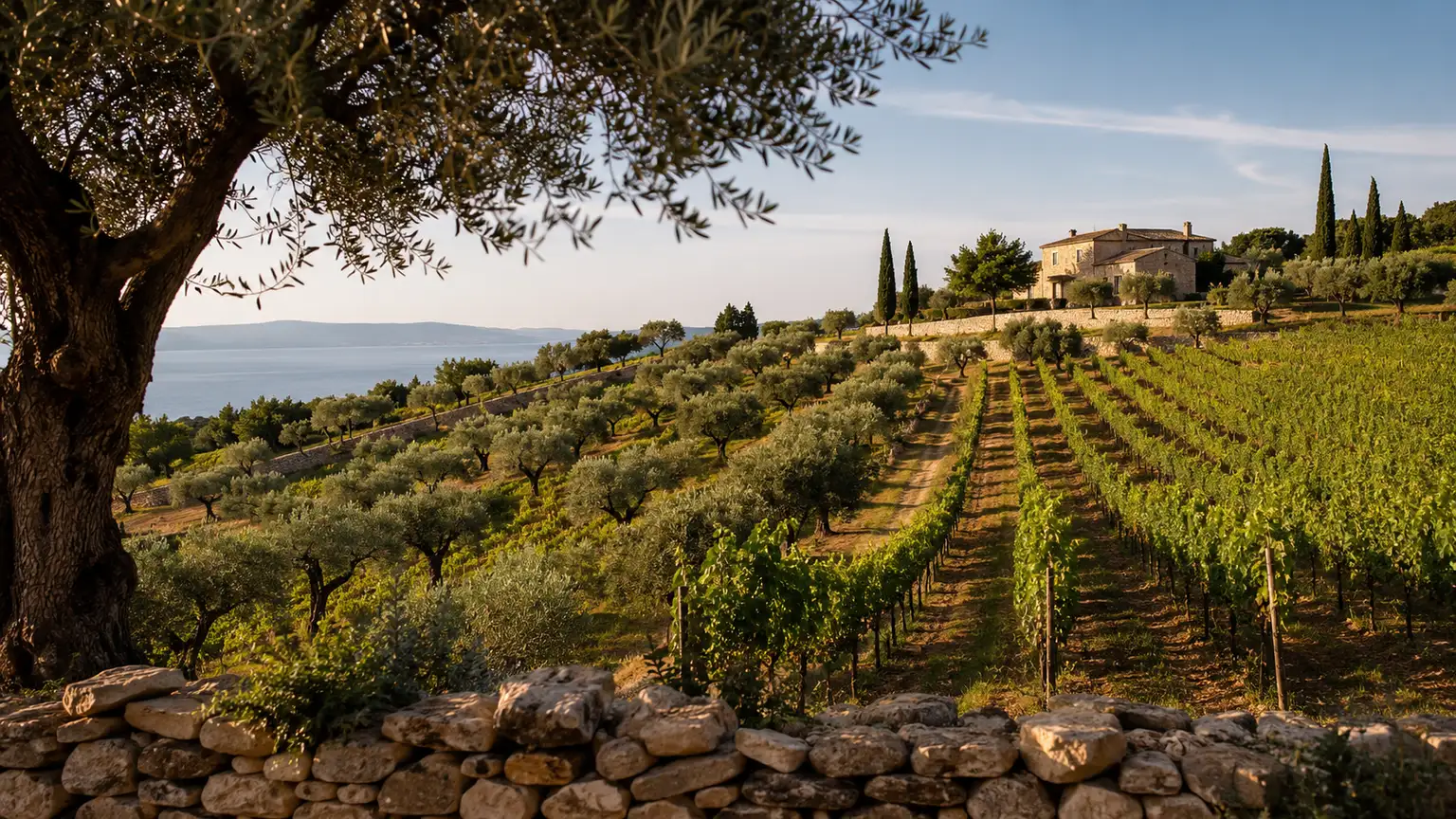
Olive groves in Istria, vineyards on Pelješac, or arable land in Slavonia are increasingly attractive to investors seeking tangible, long-term assets with income and a special ambiance. However, buying agricultural land is not the same as buying an apartment or a building plot — it is governed by a separate law and a series of restrictions that need to be known before falling in love with the sight of olive rows. From working with clients, we see that this is where the biggest disappointments arise: buyers assume they will build on the land or that the process will be as simple as any other purchase, only to encounter the state's pre-emption right or the fact that a change of purpose is not guaranteed. Below, we explain what you need to know about buying agricultural land, based on the Agricultural Land Act.
Contents
- What is agricultural land and why does it have a special regime
- Who can buy: rules for foreign buyers
- State's pre-emption right and purchase restrictions
- Olive grove and vineyard: what you buy with the land
- Purpose, construction, and taxes
- Frequently Asked Questions
Key Insights
- Agricultural land is regulated by a special Agricultural Land Act, not just by spatial planning.
- EU and EEA citizens can buy from July 1, 2023; for third countries, restrictions generally apply.
- The state has a pre-emption right for areas larger than 10 ha (continental) and 1 ha (coastal).
- Construction is generally not possible without a change of purpose, which is not guaranteed.
- With olive groves and vineyards, you also purchase a permanent plantation, which holds part of the value.
What is agricultural land and why does it have a special regime
Agricultural land refers to areas designated for agricultural production — arable land, gardens, meadows, pastures, orchards, olive groves, and vineyards. According to the Agricultural Land Act, it is an asset of interest to the Republic of Croatia and enjoys its special protection (Article 2). It is precisely from this protection that a special regime arises, differentiating the purchase of agricultural land from buying an apartment or a building plot. In practice, this means that the parcel you are looking at is not just "land" but land with a precisely defined purpose and associated restrictions. The first step, therefore, is not the price, but verification: what is the purpose of the parcel in the cadastre and spatial plan, who is the owner, and is the registration in order. Only when the legal status is clear does it make sense to discuss the value. How to read fundamental documents is explained in our guide on title deeds, land registers, and cadastre.
Professional tip: Before any serious intention, verify the purpose of the parcel in the spatial plan of the local self-government unit. Seller's words that the land is "like construction land" or that it will "easily become construction land" have no legal weight — only what is written in the plan is valid.
Who can buy: rules for foreign buyers
For foreign buyers, a key rule applies: according to the Agricultural Land Act, foreign natural and legal persons generally cannot own agricultural land, unless otherwise stipulated by an international treaty or special regulation (Article 2). It is this exception that opened the doors to buyers from the European Union. After the expiration of the seven-year transitional period, from July 1, 2023, citizens and legal entities from the European Union and the European Economic Area can purchase agricultural land in Croatia under the same conditions as domestic buyers. For citizens of third countries, restrictions generally still apply and can only be changed by an international treaty or a special state decision; the equalization of conditions for certain groups (e.g., OECD members) is tied to special regulations, so be sure to check the current status before purchasing. Therefore, foreign buyers must first determine if they can acquire ownership at all, and only then look for property — we assist you through our services for foreign buyers.
Professional tip: If you are not an EU or EEA citizen, verify the possibility of acquisition before any down payment or pre-contract. With agricultural land, the buyer's status can be an insurmountable obstacle later on, so it's better to make it the first, not the last, question.
State's Pre-emption Right and Purchase Restrictions
The most important restriction that surprises buyers is the state's pre-emption right. According to the Agricultural Land Act, the Republic of Croatia has a pre-emption right at market price for areas larger than 10 hectares in the continental part and larger than 1 hectare in the coastal part (Article 71). This means that the seller of such land is obliged to first offer it to the competent ministry. If the ministry does not respond within 30 days, the land can be sold on the market, but not at a price lower than that offered to the state, and legal transactions concluded contrary to these provisions are null and void. Proof that the pre-emption right was offered is also submitted during registration in the land register. There is also an additional restriction for land acquired from the state: it cannot be alienated for ten years from the conclusion of the contract, and after that period, the state again has a pre-emption right. Due to these rules, purchasing agricultural land requires patience and proper documentation, so it is advisable to conduct a thorough check, just like with any purchase — we describe it in the text on property inspection before purchase.
Professional tip: For larger parcels, factor in the time for the pre-emption procedure in your plan in advance. The 30-day deadline for the ministry's response is not a formality that can be skipped, and non-compliance with the procedure renders the purchase and sale null and void.
Olive grove and vineyard: what you buy with the land
With olive groves and vineyards, you don't just buy the land, but also the permanent plantation — olive trees or grapevines — which inherently hold value. Therefore, such parcels are generally valued more highly than bare agricultural land; when selling state land in a public tender, the initial value is even increased when permanent plantations are established on the parcel. The age, varietal composition, and maintenance of the plantation directly affect the price, as well as how much you will invest to keep it productive. Before purchasing an olive grove or vineyard, therefore, check the actual condition of the plantation on site, its productivity and any neglected areas, as well as registrations in the relevant agricultural registers. Special conditions and records apply for registered production and possible incentives, so check current possibilities with the competent ministry and the agency for payments in agriculture. A permanent plantation is an asset that requires work — without maintenance, it loses value faster than it seems.
Professional tip: Visit the olive grove or vineyard outside the harvest season, when the true condition of the plantation is harder to conceal. A neglected plantation might look romantic, but its restoration can cost more than the land itself — factor this into your calculations before, not after, the purchase.
Purpose, construction, and taxes
The most common misconception among buyers is that they will build on agricultural land. As a rule, this is not possible without a change of purpose, because agricultural land is not construction land. The change of purpose is regulated by the Agricultural Land Act, is carried out with a fee, and depends on whether the parcel is even foreseen for construction by the spatial plan — meaning it is neither automatic nor guaranteed. If your goal is construction, agricultural land is almost never the right starting point. Regarding taxes, general rules for real estate transactions apply: when buying from a natural person, real estate transfer tax is paid at a rate of 3% on the market value, while when buying from a VAT payer, VAT is calculated. In addition to tax, expect costs for notary public certification, registration in the land register, and possible value appraisal; how value is determined is explained in our guide on real estate valuation. If you engage in registered agricultural production, some tax obligations and reliefs may differ, so confirm tax treatment with the Tax Administration or an advisor.
Professional tip: Assess the value of agricultural land based on what it is — its agricultural purpose and the income the plantation can yield — and not on the hope that it will someday become construction land. The market rarely rewards decisions based on such hope.
How Regent can help you
We help buyers of agricultural land avoid the most expensive mistakes — from verifying purpose and ownership to the pre-emption procedure and foreign buyer status. Beyond finding an olive grove, vineyard, or arable land, we conduct legal due diligence and connect you with the next steps, so you enter the transaction with a clear picture, not assumptions. See what buying with Regent looks like or contact us to discuss your plans.
Frequently Asked Questions
What is considered agricultural land?
Agricultural land refers to areas designated for agricultural production — arable land, gardens, meadows, pastures, orchards, olive groves, vineyards, and similar. According to the Agricultural Land Act, it is an asset of interest to the Republic of Croatia and enjoys special protection, thus a special legal regime applies, which differs from that for construction land. Check the purpose of a particular parcel in the cadastre and spatial plan before purchasing.
Can foreigners buy agricultural land in Croatia?
It depends on citizenship. Citizens and legal entities from the European Union and the European Economic Area can purchase agricultural land in Croatia from July 1, 2023, under the same conditions as domestic buyers, as the transitional moratorium expired then. For citizens of third countries, restrictions generally still apply and can only be changed by an international treaty or special regulation, so verify your status with the competent ministry before purchasing.
Does the state have a pre-emption right for agricultural land?
Yes, in certain cases. According to the Agricultural Land Act, the Republic of Croatia has a pre-emption right at market price for areas larger than 10 hectares in the continental part and larger than 1 hectare in the coastal part. The seller is then obliged to first offer the land to the competent ministry; if it does not respond within 30 days, the land can be sold on the market, but not at a price lower than the one offered. Legal transactions concluded contrary to these provisions are null and void.
Can I build a house on agricultural land?
As a rule, not without a change of purpose. Agricultural land is not construction land, and construction presupposes that the parcel is designated for building by the spatial plan. The change of purpose for agricultural land is regulated by the Agricultural Land Act, is carried out with a fee, and is not guaranteed, so do not plan to buy agricultural land with the assumption that you will build on it.
What do I buy when I purchase an olive grove or vineyard?
You buy the land together with the permanent plantation — olive trees or grapevines — which inherently hold value. For this reason, olive groves and vineyards are valued more highly than bare agricultural parcels, and the condition of the plantation, its age, and maintenance directly affect the price and future costs. Before purchasing, check the condition of the plantation, registrations in relevant registers, and maintenance obligations and potential incentives.
What taxes and costs are involved in buying agricultural land?
When buying from a natural person, real estate transfer tax is paid at a rate of 3% on the market value, while when buying from a VAT payer, VAT is calculated. In addition to tax, expect costs for notary public certification, registration in the land register, and potential appraisal. If you are engaged in agricultural production, some costs and obligations may differ, so check the tax treatment with the Tax Administration or an advisor.
Recommended
- What are title deeds, land registers, and cadastre and how to read them
- Property inspection before purchase: legal due diligence, technical appraisal, and handover
- Property valuation: market, mortgage, tax
- How the real estate purchase and sale process in Croatia works step by step