Summary
A stone house in Istria or Dalmatia offers what cannot be imitated: walls that remember, wood darkened by time, and light that behaves differently than in new constructions. Its renovation, therefore, is not demolition and rebuilding, but careful refurbishment — deciding what to keep, what to reveal, and where to introduce modern comfort in such a way that its arrival goes unnoticed. This text is primarily about how to envision such a home: about stone and lime, about light and color, about furniture that suits thick walls, and finally, about what needs to be checked before you sign.
Key facts
- A stone house already has character — good design reveals it, it doesn't create it anew.
- The most beautiful result comes from an honest blend of old and new, in which stone and beams are the main protagonists.
- Lime instead of cement, a palette drawn from the house itself, and light walls provide harmony and bring back light.
- Light is the biggest challenge — it is addressed with careful openings, deep reveals, and layered warm lighting.
- Before buying, prioritize the roof, structure, and moisture, and only then the floor plan and aesthetics.
- Paperwork, conservation status, and energy solutions tailored for stone determine what is even possible.
There is a moment, usually sometime in August, when you understand why these houses were built exactly like this. It's unbearably hot outside, and you're looking for a light sweater on the ground floor of an old stone house in the Istrian hinterland. The half-meter-thick wall absorbs the sun all day and only slowly releases it in the evening when it cools down — this is thermal mass that no modern insulation panel can imitate. Light enters in narrow, sharp beams through deep window reveals and glides across the rough stone, revealing every shadow. A house like this already possesses everything that new construction vainly yearns for: scale, texture, and a patina that cannot be bought. That's why you don't approach it with the question of what to demolish and add, but with a completely different one — what is already valuable here, and how not to spoil it. This is the difference between building and decorating, and it changes everything. In this text, we approach a stone house as a home to be composed, not as a construction site to be filled: how to read the existing space, work with stone, lime, and wood, tame the light, and assemble a palette that looks as if it has always been there. Only at the very end, because that too is part of the story of a beautiful home, do we soberly look at what lies beneath the charm — the roof, moisture, papers, and conservation conditions that can determine the fate of the entire project.
A house that already has a soul
The most expensive mistake in renovating a stone house is rarely a wrongly chosen tile; much more often, it is impatience. The buyer walks in, already has a finished picture in mind, and imposes it within three months on a space that has never truly been listened to. Experienced designers do the opposite: for the first few days, they touch almost nothing. They sit in the house at different times of the day, observe how light travels through the rooms, note which wall has the most beautiful structure, which beam is worth freeing from subsequent plaster, where drafts occur, where moisture appears, and where the best view opens up. The house, it turns out, speaks quite clearly about what it wants to be — you just need to listen to it before you start speaking for it.
From that listening, the only decision that truly holds the interior together is born: who is in charge. In a stone house, this is almost never new furniture or effective lighting, but the shell itself — stone, beams, stone portals, the worn path of an old staircase. Everything modern in the house exists to set the stage for these elements, not to compete with them. The best renovations do not hide this clash of two eras but consciously emphasize it: a minimalist kitchen without handles placed under darkened oak beams, a polished concrete surface touching unplastered stone, a thin steel railing alongside a centuries-old staircase. It works because it is honest. As soon as the new starts pretending to be old — fake styrofoam beams, artificially aged catalog furniture — next to real stone, it is instantly recognized, and the entire illusion collapses.
Stone, lime, and wood
These houses live by touch, so their design typically boils down to the relationship of four or five materials that blend well and age beautifully. The first rule concerns the stone itself: less is more. One or two exposed walls are a treasure, but an entire house in visible stone quickly becomes dark and gloomy, more like a cave than a home. The rest of the walls are traditionally finished with lime plaster, and this is not merely an aesthetic whim. Lime is vapor-permeable, allowing the wall to release moisture that stone inevitably draws from the ground, while cement plasters trap it, causing moisture to find an exit through the stone itself and salt to start appearing on the surface.
Lime plaster also ages softly, with gentle stains and tonal transitions, instead of flaking in sheets like modern dispersion paints. If you leave stone exposed, also pay attention to the joints: a deeply recessed, dark joint gives the wall a rough, rustic weight, while a shallower joint in the stone's tone calms the wall and makes it more elegant. Wood is a natural partner to stone because it brings warmth where stone is cold and hard — a ceiling with visible beams, window shutters, a massive oak table, an old plank floor or terrazzo. It is worth choosing wood that shows its natural character, with visible grains and a matte finish, as high gloss and perfectly smooth surfaces seem too new for this context.
The third layer consists of soft materials that make all this massiveness suitable for living: linen, wool, hemp, rattan, knitwear. As for color, you almost don't need to choose it because the house itself offers it. Draw a palette from what you see through the window and under your feet — sand and limestone, ocher and grayish beige, the dark brown of beams, the whiteness of plaster. On this serene base, one accent borrowed from the landscape is enough: olive green on the joinery, the deep blue of the sea on the entrance door, terracotta in ceramics. As soon as too many accents accumulate, the quietness that makes breathing easier in such houses is lost.
Light, the eternal challenge
If a house like this has an Achilles' heel, it's light. Openings were once deliberately small — against summer heat and winter cold, and historically for safety — so the interior can be darker than modern taste might desire. The first answer is natural light, but with moderation: piercing the facade with large glass surfaces means taking away from the house precisely what you chose it for. It's smarter to introduce light where it doesn't disrupt the house's face — a skylight above the staircase or in the attic, a glass wall facing an enclosed courtyard, a wider opening towards a back terrace. There's also a small but powerful trick inherited from the very construction: bevel deep window reveals and paint them white, so they start acting like a reflector, spreading what little light there is deeper into the room.
Where daylight objectively doesn't reach, artificial lighting takes over, but in layers, never as a single bulb in the middle of the ceiling. A good scheme has at least three layers: soft general light for the basic level, accent lighting that washes the stone wall and brings out its texture, and low, warm points — wall sconces, floor lamps, candles — for an evening ambiance. Light temperature is more important than intensity. Warm, slightly yellowish light, around 2700 Kelvin, warms stone and wood, while cool white light instantly drains all warmth from them and makes the space feel clinical. The greatest effect is achieved by so-called grazing light: a spotlight placed right next to the wall, which casts light almost parallel to the surface, transforming an ordinary stone wall into a relief full of shadows and suddenly making it the most interesting element of the room.
Professional tip: Before buying any lamp, walk through the house at dusk with a simple portable lamp and move it along the walls and beams. You'll see exactly where light creates drama and where it merely illuminates, so you'll plan your lighting based on those spots, rather than the symmetry of the ceiling.
Rooms for living: furniture, kitchen, bathroom
Furniture in a stone house requires a certain weight. Thick walls, often low ceilings, and massive beams carry a visual mass that small, thin-legged furniture simply doesn't suit — it gets lost, appears temporary, as if it flew in from another apartment. Pieces with presence fare better: a long wooden table, a deep armchair in leather or linen, a solid wood wardrobe, an occasional wrought-iron detail. Equally important is what is absent. A stone house breathes when spaces are left empty, so a few carefully chosen pieces almost always outperform a space cluttered with furniture and decorations. Antique and inherited pieces are particularly valuable here because they share the same patina as the walls, thus connecting new and old effortlessly.
The kitchen and bathroom are spaces where modernity is inevitable, making them the most rewarding places for a dialogue of eras. In the kitchen, a combination of clean, simple handleless elements, stone or concrete countertops, and quality appliances, placed in a space with exposed stone and beams, works beautifully; the former ground-floor tavern, by nature cold and dark, is often transformed into an effective kitchen or wine nook precisely thanks to its constant coolness. In the bathroom, authenticity and comfort perhaps combine most beautifully — stone or microcement on the walls, a freestanding tub, brass or black faucets — but it is precisely here that moisture needs to be considered. Stone and lime prefer vapor-permeable finishes and good ventilation; if you enclose a damp bathroom in vapor-impermeable materials, the problem you thought you had hidden will return as mold.
Professional tip: In every thoroughly renovated room, leave at least one original element exposed — a piece of unplastered wall, a beam, a stone threshold. This single gesture, almost without cost, distinguishes a home with history from a beautifully furnished new build.
Life moves outdoors here
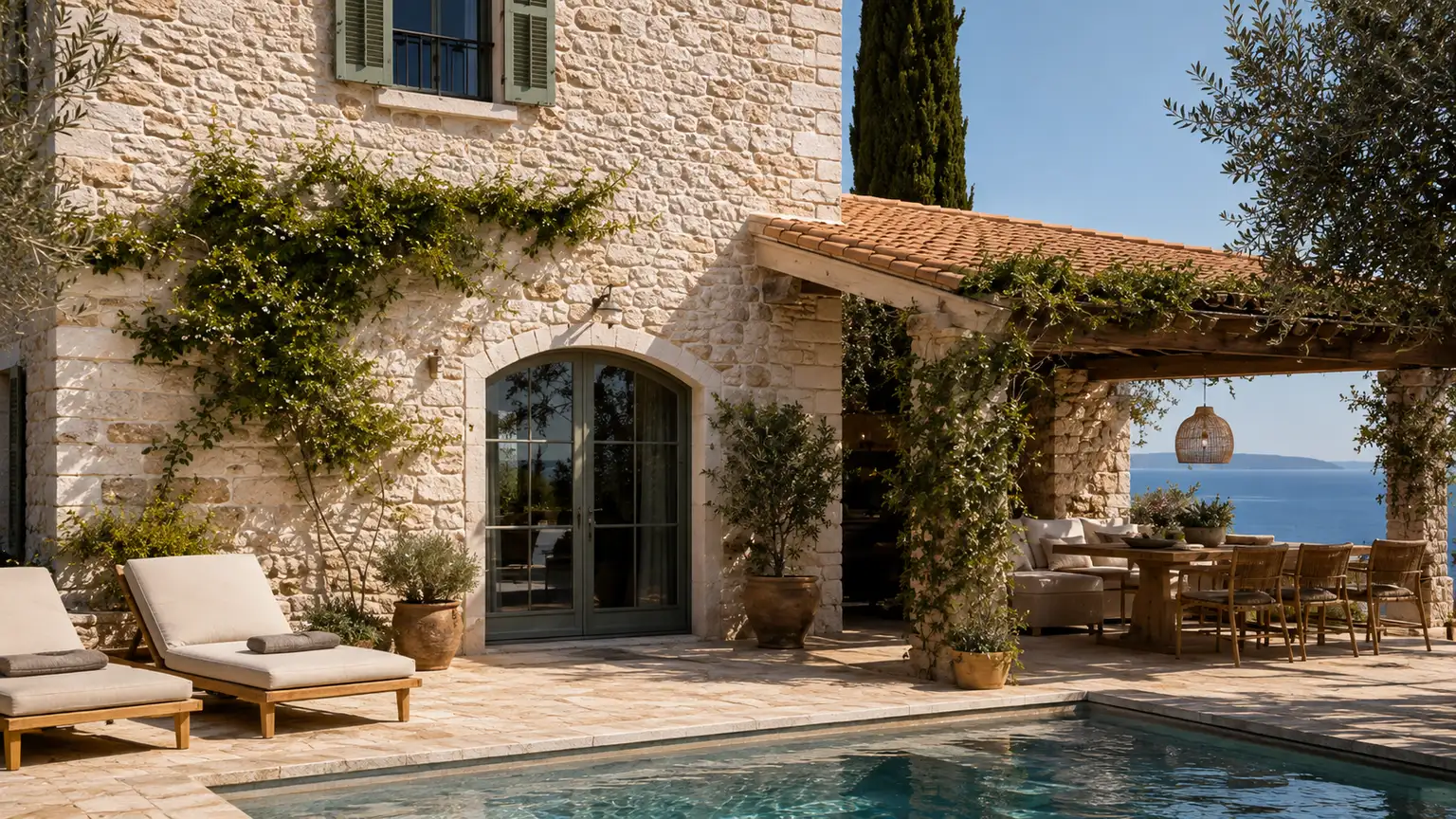
In the Mediterranean, outdoor space is not a reward for good weather, but the main living room from May to October, and thus deserves as much thought as the interior. The heart of this life is usually a covered transition between the house and the garden: an Istrian "balatura", a shaded Dalmatian terrace, a pergola under which grapevines or wisteria provide shade in summer, and in winter, when they lose their leaves, let the sun through. Orientation is crucial here. A well-placed terrace is oriented to avoid the midday sun and catch the softer light of late afternoon and evening, when people spend most of their time outdoors anyway. When interior materials extend outdoors — the same stone floor flowing from the living room to the terrace, the same color of joinery — the house suddenly feels larger and more cohesive, as if outside and inside belong to the same idea.
Indigenous Mediterranean plants — olives, lavender, rosemary, immortelle, an occasional citrus tree — belong to this soil, smell fragrant, tolerate drought, and require little, unlike exotic species which, despite constant care, still feel like a guest who has never quite settled in. A dry stone wall, an irregular stone path, a little gravel, and a single shade-giving tree often do more than a lush, demanding garden. The goal is not a scene from a catalog, but an environment that looks as if it grew together with the house.
Before you fall in love
All this talk about light and materials only makes sense if the charming house truly stands, and old stone houses can very charmingly hide expensive problems. Therefore, before buying, a sober look is in order, best through an expert experienced specifically in stone construction. First, the roof is inspected, because leakage quietly and systematically destroys everything beneath it — beams, ceilings, plaster. Then the structure: cracks in load-bearing walls, foundation condition, sagging ceiling beams, and traces of woodworm. Moisture is a separate story and is almost always present in some form; capillary moisture from the ground and precipitation ingress can be more extensive than it seems, and directly determine which finishes you will even be allowed to use. From experience with clients renovating stone houses, we know that for an amateur, the boundary between cosmetic renovation and the remediation of a load-bearing wall is often not visible — and that is precisely what separates reasonable from excessive costs.
What a thorough inspection looks like, we described in the guide on property inspection before purchase: legal check, technical assessment, and handover. Besides the walls, the paperwork also needs to be sorted out, as old houses rarely come with proper documentation. Unregulated ownership, discrepancy with the land registry, and parts built without permits are more the rule than the exception here. There is also a specificity that directly shapes your freedom in decorating: if the house is a protected cultural asset or stands in a protected historic core, the competent conservation department may have a say in permissible materials, colors, and even the shape of windows and the roof. This is not an obstacle, but a framework, and it is far cheaper to find out at the beginning than when the project has already been drawn.
Finally, entrust the energy renovation to someone who understands old construction: wrong external insulation that covers the stone or a vapor-impermeable layer that traps moisture can harm both the appearance and the structure here, while vapor-permeable internal insulation, a renovated roof, and good wooden joinery in the spirit of the original provide comfort without sacrificing the house's soul. We write about modern standards in the guide Green Building and nZEB Standard.
Professional tip: The order is always the same: first the roof and structure, then the papers and conservation status, and only then the floor plan and tiles. If you fall in love with the aesthetics before checking the foundations, it's easy for the renovation budget to consume the dream.
How Regent real estate agency can help you
A stone house is a dream that, however romantic, rests on one very down-to-earth decision — a good purchase. This is our role: to find a house with real potential, not just a beautiful photograph, to check ownership and land registry papers, and to realistically assess its condition before you embark on a renovation that can escalate. If you dream of a stone home with character, see what buying with Regent looks like or contact us.
Frequently Asked Questions (FAQ)
How to approach decorating an old stone house?
Start with what the house already has and highlight it, instead of imposing a completely new character. Before making any decisions, spend time in the space and observe where the light is most beautiful and which walls tell a story. The best result comes from an honest blend of old and new: stone, beams, and portals as the main actors, with modern touches quiet and restrained, serving as their backdrop.
Should all stone walls be exposed in the interior?
No. An entire house with exposed stone quickly becomes dark and heavy; it's more beautiful to retain stone as an accent on one or two walls, and finish the others with light lime plaster. Lime is not just an aesthetic choice — it is vapor-permeable and allows the wall to release moisture, while light surfaces bring much-needed light back into the space.
How to solve the lack of light in a stone house?
By combining carefully added natural light and layered artificial lighting. Where permitted, a skylight or a glass wall facing the courtyard can help, without disrupting the facade, and deep window reveals painted white spread light deeper into the room. Inside, layers of warm light should be used instead of a single ceiling bulb, and side, grazing illumination of a stone wall further brings out its texture.
What to check before buying a stone house for renovation?
First, inspect the roof and load-bearing structure, as well as the moisture level, along with the condition of wooden beams and installations. In terms of paperwork, check ownership, compliance with the land registry, legality of construction, and any potential need for legalization. Also, find out if there is conservation protection, as this directly determines what you are allowed to change on the house.
Am I free to change an old stone house as I wish?
Not always. If the house is a protected cultural asset or located in a protected historic core, the competent conservation department may prescribe permissible materials, colors, and even the shape of openings and the roof. This is not necessarily an obstacle, but some decisions are then not entirely free, so be sure to check the status before purchasing, not when the project is already finished.
How to energetically renovate a stone house without losing its character?
With solutions adapted to stone, not standard packages for new construction. This means internal insulation with vapor-permeable materials, a remediated and insulated roof, quality wooden joinery in the spirit of the original, and efficient heating. It is crucial to avoid vapor-impermeable layers and external insulation over stone, as they trap moisture and can harm both the appearance and the structure itself.
Recommended
- Property inspection before purchase: legal check, technical assessment, and handover
- Legalization of structures
- Green building and nZEB standard
- Apartment renovation: what requires a permit