TL;DR: Buying a holiday property on the Adriatic coast brings a series of obligations that are important to know before investing. The difference between personal use and short-term rental directly affects tax obligations, utility fees, and legal requirements. Real gross yields range between 4 and 7% annually, and the net yield after costs and taxes is usually 30 to 40% lower. A successful investment requires a thorough check of documentation, spatial plan, and building regulations before signing the contract.
Contents
- Key Points
- Investment Property: Personal Use or Rental
- What to Check Before Buying
- Taxes and Utility Fees
- Short-Term Rental: Legal Obligations
- Real Yields in Dalmatia, Istria, and Kvarner
- Ownership Costs and Property Management
- Regent: Buying an Investment Property by the Sea
- FAQ
Key Points
The purpose of a property determines its tax treatment, utility fees, and registration obligations — the difference between personal use and rental has direct legal and financial consequences.
Short-term rental through platforms like Airbnb or Booking requires object categorization, registration in the e-Turizam system, and income reporting to the Tax Administration. As of May 20, 2026, new EU rules (EU Regulation 2024/1028) on the mandatory provision of lessor data to competent authorities will be in force, and as of January 1, 2027, the introduction of a registration number for all accommodation units is planned — without which advertising on Airbnb and Booking will not be possible.
Income from short-term rentals is taxed either on a lump-sum basis (a fixed amount per bed according to the tourist place category) or at a rate of 12% on 70% of income (with a deduction of 30% lump-sum costs) for natural persons who keep business books.
The return of real estate transfer tax (PPnN) and VAT for young people does not apply to investment holiday properties — the measure is intended exclusively for the purchase of a first residential property.
Gross yields range between 4 and 7% annually, depending on location and property management. The net yield, after deducting taxes, maintenance, and management costs, is usually 30 to 40% lower than the gross amount.
Checking the spatial plan, building regulations, property subdivision (etažiranje), and legalization of the property are mandatory steps before any purchase of an investment property by the sea.
Investment Property: Personal Use or Rental
The difference between buying for personal holiday use and buying for rental purposes is not just a matter of intent — it has direct legal and financial consequences that affect the overall profitability of the investment.
A property intended exclusively for personal use carries less administrative burden. You do not need to register as a provider of tourist services, you do not register guests in the e-Turizam system, and you do not pay tax on rental income. You do, however, pay a utility fee for holiday homes — which is higher than the fee for properties with registered permanent residence — and an annual property tax. The utility fee is paid regardless of whether you use the holiday home or not.
Short-term rentals through Airbnb, Booking, or similar platforms bring potential income, but also a series of obligations described below. Flexibility is one of the advantages — you can also use the property yourself during periods when it is not rented out.
If you plan to use the property for both personal needs and rental, calculate in advance how personal use affects income. The season on the Adriatic is short, with peak demand lasting only 8 to 10 weeks — every week of personal use in August directly reduces rental income.
The tax treatment of mixed-use (part of the year personal, part for rental) is not specifically regulated — rental income is taxed in full regardless of the proportion of personal use.
A loan for an investment property is treated as a non-residential loan with different terms than a residential loan. According to HNB guidelines, the maximum DSTI for non-residential loans is 40%, the repayment period is shorter, and the LTV (loan-to-value ratio) can be up to 70%. This is important information for buyers planning to finance their purchase with a loan. More on lending to foreign buyers: https://regent.hr/blog/stambeni-kredit-u-hrvatskoj-za-strane-kupce-vodic
What to Check Before Buying
This is the most important step that many buyers skip in their excitement about finding a property. A thorough check of documentation can prevent a costly mistake.
Spatial Plan and Zone Purpose
Before buying, it is mandatory to check whether the property is in a zone where tourist activity is permitted. Properties in zones without permitted tourist use limit short-term rental possibilities or completely prevent them. Spatial plans are available in the spatial planning offices of local self-governments or on their websites.
Pay special attention to properties in protected areas or special use zones. Even if the property is in a tourist area, a specific zone within the plan may have restrictions that prevent short-term rental.
Building Regulations and Co-owner Consent
If you are buying an apartment in a residential building, it is mandatory to check the building regulations. As of June 2025, a new Law on Building Management and Maintenance will be in force, which has strengthened the legal basis for prohibiting short-term rentals within residential buildings. Building regulations may prohibit short-term rentals or require co-owner consent.
To engage in short-term rental in a residential building, the consent of at least two-thirds of the co-owners is required. A buyer might purchase an apartment only to find out later that they cannot rent it out.
Subdivision
Many properties on the coast — especially older stone houses and apartments — are not subdivided. Without subdivision, it is not possible to register a separate part of the property or obtain an ownership deed (vlastovnica), which prevents the registration of ownership and complicates the sale or pledging of the property. Before buying, check whether the property is subdivided and has proper registration.
Legalization of the Property
Many older properties on the coast have parts that are not legalized. Illegal construction directly prevents the categorization of the object and registration in the e-Turizam system — which blocks short-term rentals. Checking for legalization is a mandatory step when buying older properties on the coast. Read more about legalization on our blog: Legalization of Objects: why it is important for sale and purchase.
Right of First Refusal on Islands
If you are buying a property on a Croatian island, be aware that the Republic of Croatia has a right of first refusal for certain categories of properties according to the Islands Act. The state must respond within 30 days — only after that period expires or a written waiver can the transaction be finalized.
Foreign Buyers
EU citizens can freely purchase properties within the building area in Croatia. Citizens of third countries must obtain consent from the Ministry of Justice (reciprocity principle), with certain restrictions on islands. Read more about buying for foreign buyers here: How can foreign citizens buy property in Croatia?
Checklist: What to Check Before Buying
- Is tourist activity permitted in the spatial plan at that location
- Is there a short-term rental prohibition in the building regulations or is co-owner consent (⅔) required
- Is the property subdivided and registered
- Is the property fully legalized
- Is there a right of first refusal for the Republic of Croatia (islands)
- What are the total costs of purchase: Real Estate Transfer Tax (3%) or VAT (25% for new construction), agency commission (2–3% + VAT), notary fees, registration costs
- Is the property suitable for categorization (minimum requirements: separate bathroom, kitchen elements, proper installations)
Taxes and Utility Fees
VAT or Real Estate Transfer Tax upon purchase
When buying a property from a natural person on the secondary market, the buyer pays real estate transfer tax (PPnN) of 3% of the market value. When buying new construction from an entrepreneur, VAT of 25% is paid instead of PPnN. For an investment property, VAT is not a refundable expense (unlike PPnN for young people when buying a first residential property) and significantly increases the total cost of purchase.
Important warning: the return of real estate transfer tax (PPnN) and VAT for young people does not apply to investment holiday properties — the measure is intended exclusively for the purchase of a first residential property.
Tax Treatment of Short-Term Rental Income
For natural persons, there are two ways to tax short-term rental income:
Tourist lump sum — natural persons who do not keep business books pay a fixed annual amount per bed according to the tourist place category. Amounts for 2026 range from 20 to 300 euros per bed annually, depending on the local self-government unit (JLS) category. It is administratively the simplest method for owners of a single property.
Income tax — natural persons who keep business books pay 12% on 70% of realized income (30% is automatically recognized as a lump-sum expense). In addition to tax, surtax is also calculated depending on the owner's city of residence. This method can be financially more favorable with higher incomes as actual documented expenses can also be deducted.
Sole proprietorship or LLC (d.o.o.) — a registered business pays profit tax at a rate of 10% for incomes up to 1,000,000 euros annually or 18% above that. More suitable for owners of property portfolios or high incomes.
Annual Property Tax
Owners of properties in Croatia will pay annual property tax from 2025, ranging from 0.60 to 8.00 euros per m² of usable area, depending on the location and purpose. Holiday homes and properties for short-term rental fall into taxable categories. Properties actually used for permanent residence are exempt from this tax — mere registration of residence without actual living is not sufficient for exemption.
Utility Fee for Holiday Homes
Owners of holiday homes pay a utility fee according to local tariffs, which is higher than for properties with registered permanent residence. Local self-governments on the Adriatic coast often set higher rates for unused holiday homes and tourist rental properties. The utility fee is paid regardless of whether you use the holiday home or not.
Tourist Tax
Owners who rent accommodation to tourists are obliged to pay a tourist tax. For 2026, amounts range from 1.00 to 2.50 euros per person per night depending on the tourist place category and season, or an annual lump sum of 50 to 65 euros per bed depending on the place category.
Capital Gains upon Sale
If you sell an investment property at a price higher than the acquisition cost, and you have not been registered and lived in it for at least two years, you pay capital gains tax at a rate of 24% on the realized profit, plus surtax.
Short-Term Rental: Legal Obligations (briefly)
Short-term rental in Croatia is regulated by the Hospitality Industry Act and a series of sub-legal acts. Here are the key steps.
Key Legal Obligations for Short-Term Rental:
Obtaining a categorization decision — the application is submitted to the competent office or online through the eTurizam system. Minimum requirements include a separate bathroom, kitchen elements (stove, sink, refrigerator), proper furniture, and proper installations. A higher category (more stars) opens up the possibility of higher prices per night.
Registration in the e-Turizam system — mandatory for all lessors, essential for tax records and legal operation.
Guest registration — every guest must be registered in the system within 24 hours of arrival.
Income reporting to the Tax Administration — regardless of the amount of income.
Deadline for permanent categorization decision — lessors with a temporary decision must obtain a permanent decision by December 31, 2026.
Current regulatory change — as of May 20, 2026, EU Regulation 2024/1028 will be in force, obliging Airbnb and Booking to provide data on all lessors to the competent authorities. As of January 1, 2027, the introduction of a mandatory registration number for all accommodation units is planned — without which advertising on platforms will not be possible. Buyers who are purchasing an investment property today should plan to obtain a registration number as part of the overall preparation for renting.
Insurance for short-term rental — a standard household insurance policy generally does not cover short-term rentals. A special policy or an add-on to a standard insurance policy is required for renting to tourists.
Ownership Costs and Property Management
Costs incurred after purchase are rarely sufficiently represented in investor calculations. A realistic picture of the investment must include all one-time and annual expenses.
One-time purchase costs:
- Real Estate Transfer Tax (3% of market value) or VAT (25% for new construction from an entrepreneur)
- Agency commission — usually 2 to 3% of the purchase price + VAT
- Notary fees
- Registration and land registry entry fees
Annual operating costs:
- Annual property tax (0.60 to 8.00 euros/m²)
- Utility fee (according to local tariffs, higher for holiday homes)
- Electricity, water, and internet (even when the property is empty)
- Property insurance (special policy for short-term rental)
- Cleaning between stays and minor repairs
- Booking platform fees — Airbnb charges 3 to 5% per reservation
- Tourist tax
Management costs:
Owners who do not live near the property or cannot manage it personally hire a property management agency. A typical property management fee ranges from 15 to 30% of the total rental income — this item significantly reduces the net yield and must be included in every profitability calculation.
Digital alternatives (key-box, digital check-in, automated guest communication) can reduce management costs but require initial investment and technical preparation of the property.
Experience shows that investors who have not thoroughly planned costs underestimate annual expenses by 20 to 30% compared to actual amounts. Planning for the first five years of ownership — including occasional major renovations and repairs — provides a realistic picture of the total investment.
Real Yields in Dalmatia, Istria, and Kvarner
Understanding yields in the Adriatic markets requires realistic assumptions.
Seasonality: Key Factor Affecting Yield
The season on the Adriatic is structurally limited. High season (July and August) lasts only 8 weeks. Pre-season (June and September) and post-season (May and October) bring reduced demand and lower prices per night. Low season (November to April) is almost nonexistent for short-term rentals in most Adriatic locations. The real occupancy rate for a premium property in a good location is 60 to 70% during the season — not on an annual basis.
Yields by Region (gross, illustrative)
Dalmatia (Split, Makarska, Dubrovnik) — average price per m²: 4,000 to 7,000 euros; season: 18 to 22 weeks; approximate gross yield: 5 to 7%
Istria (Rovinj, Poreč) — average price per m²: 4,500 to 7,000 euros; season: 20 to 24 weeks; approximate gross yield: 5 to 6%
Kvarner (Opatija, Cres, Lošinj) — average price per m²: 3,500 to 5,500 euros; season: 16 to 20 weeks; approximate gross yield: 4 to 6%
Note: gross yield does not take into account taxes, management costs, property management fees, and utility fees. Net yield is usually 30 to 40% lower than the gross amount.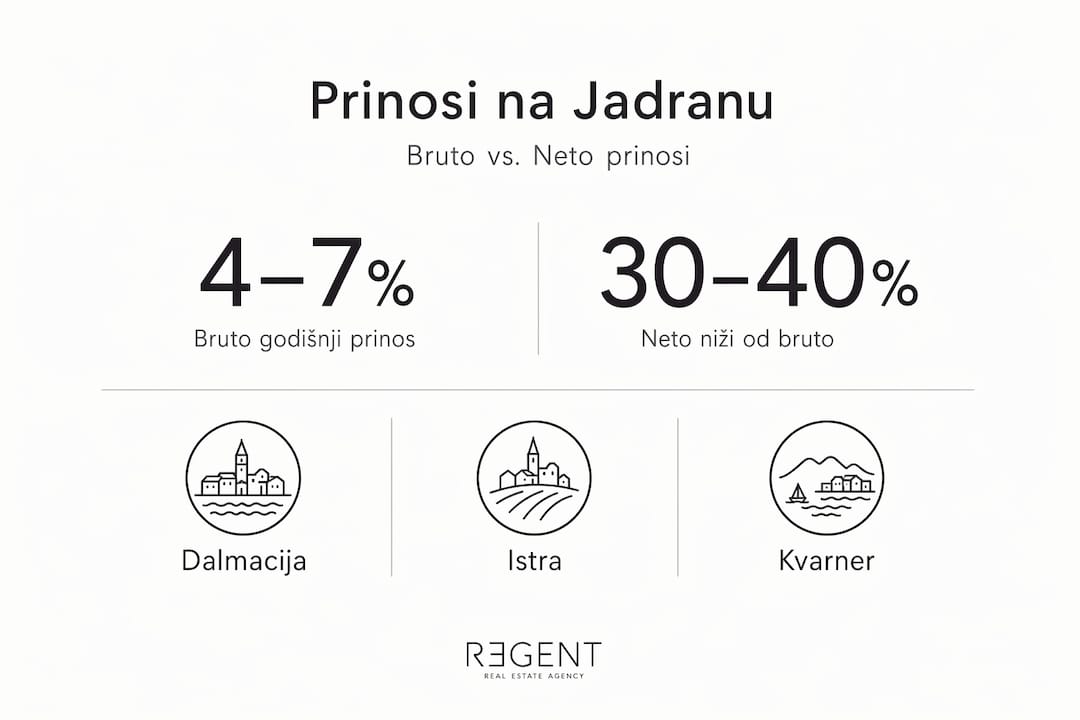
Regent: Buying an Investment Property by the Sea
Regent provides full support to buyers looking for an investment property on the Adriatic coast. Our team covers legal documentation checks, spatial plan and subdivision verification, advice on obligations and financing, and ownership registration.
We assist foreign buyers in understanding the legal conditions for purchasing in Croatia and obtaining necessary consents. We help domestic investors find locations with the best ratio of yield and growth potential.
Browse properties by the sea here.
Contact us.
Frequently Asked Questions (FAQ)
What is a holiday investment property?
A holiday investment property is a property purchased with the aim of generating income from short-term rentals and long-term value growth, rather than for permanent residence. The owner can also use it for personal needs during periods when it is not rented out.
What taxes does a holiday home owner on the coast pay?
The owner pays annual property tax (0.60 to 8.00 euros per m² annually), a utility fee according to local tariffs (regardless of whether the holiday home is used or not), and, if renting, income tax from rentals — either a lump sum or 12% on 70% of income. A tourist tax is paid for each guest.
Is e-Turizam registration mandatory for short-term rentals?
Yes, registration in the e-Turizam system is mandatory for everyone who rents accommodation to tourists. Without property registration and guest check-in, short-term rental is not legal and can result in inspection fines. As of January 1, 2027, the introduction of a mandatory registration number for all accommodation units is planned.
What are the real rental yields on the Adriatic coast?
Gross yields range between 4 and 7% annually, depending on location and property management. The net yield, after deducting taxes, maintenance, and management costs, is usually 30 to 40% lower than the gross amount. The season on the Adriatic lasts 8 to 24 weeks depending on the region.
What to check in the spatial plan before buying?
Check whether the property is in a zone where tourist activity is permitted, if there are restrictions for short-term rentals, and if the property is subdivided and legalized. This information is available at the local self-government's spatial planning office or online.
Can foreigners buy property on the coast in Croatia?
EU citizens can freely purchase properties within the building area. Citizens of third countries must obtain consent from the Ministry of Justice. On islands, the Republic of Croatia has a right of first refusal for certain categories of properties.
Does the tax refund for young people also apply to investment properties?
No. The return of real estate transfer tax (PPnN) and VAT for young people is intended exclusively for the purchase of a first residential property. A holiday investment property is not eligible for this measure regardless of the buyer's age.
What are the conditions for a loan for an investment property?
A loan for an investment property is treated as a non-residential loan — the conditions are stricter than for a residential loan. The maximum DSTI is 40%, the repayment period is shorter, and the LTV can be up to 70% depending on the bank. Consultation with a financial advisor is recommended before choosing a financing method.
Recommended
- When to Buy Property: Market Analysis Guide
- Investor Guide | Regent Real Estate
- Tenant Guide | Regent Real Estate
- Guide to Buying Property in Croatia for Foreign Citizens