Summary
Co-living is a housing model where tenants have a private room (often with their own bathroom), while sharing common areas such as the kitchen, living room, and workspace with other tenants. For investors in Croatia, this represents an investment niche targeting digital nomads, young professionals, and students, with the potential for higher space utilization per square meter compared to traditional rentals. The model requires more active property management and careful review of the regulatory and tax framework before investing, especially if it combines long-term and short-term rentals.
Key facts
- Co-living combines private living space with common, shared amenities.
- The target group includes digital nomads, young professionals, and students.
- This model enables greater space utilization per square meter compared to classic long-term rental.
- In Croatia, co-living does not yet have a specific legal category – existing regulations on apartment rental apply, and depending on the model, the Hospitality Industry Act and regulations on hospitality services in households.
- Successful management of co-living spaces requires more active involvement from investors or the engagement of a property manager.
- Location near business zones, universities, and coworking spaces is crucial for the occupancy of co-living spaces in cities like Zagreb, Split, and Rijeka.
The rental market in Croatia has diversified in recent years beyond traditional long-term and short-term tourist rental models. One niche attracting increasing investor attention is co-living – communal living spaces primarily intended for a younger population seeking flexibility, community, and a location close to business or academic centers. Co-living and communal living spaces are already developed concepts on the international scene, and in the Croatian context, they are only just beginning to clearly profile themselves as a special investment niche.
In this guide, we explain what the co-living model entails, who the typical tenants are, what advantages and risks it carries for investors, and what to pay attention to before entering this type of investment. Special emphasis is placed on the reality of the Croatian legal and tax framework, the differences between long-term rental, short-term tourist accommodation, and combined models, as well as the role of location in cities such as Zagreb, Split, and Rijeka.
Contents
- What is co-living and why it attracts investors
- Business models in co-living investments
- Target Group: Digital Nomads, Young Professionals and Students
- Advantages of the co-living model compared to classic rental
- Legal and regulatory aspects in Croatia
- Risks and challenges of investing in co-living
- How to choose a location and property for co-living
- How Regent can help you
- Frequently asked questions
- Recommended
What is co-living and why it attracts investors
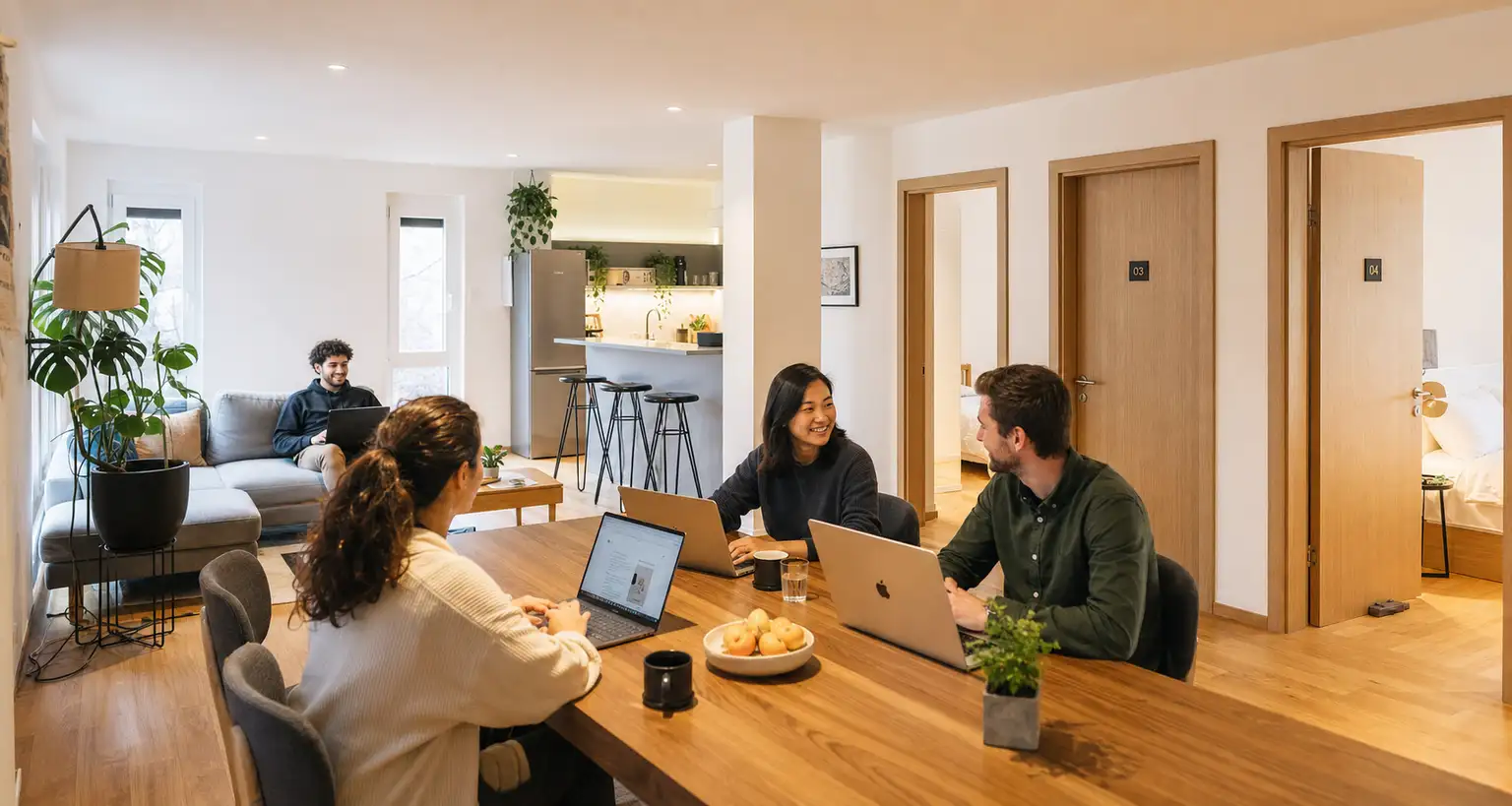
Co-living is a housing model where multiple people share a single property, with each tenant having their own private room (and in more advanced concepts, a private bathroom), while the kitchen, living room, and often a workspace or common area are shared with all tenants. Unlike classic shared flat living, co-living operators usually offer additional services – internet, regular cleaning of common areas, furnished spaces, and sometimes even organized community activities.
In practice, a typical co-living apartment or house has several separately lockable rooms, each equipped with a bed, desk, and wardrobe, while the kitchen and living room are fully equipped and accessible to all tenants. Some concepts go a step further and include a shared coworking space within the property itself, a small gym, or even organized social evenings for tenants – all with the aim of creating a sense of community, not just sharing rental costs.
It is worth distinguishing co-living from two related but different terms: co-housing is a model where tenants collectively decide on building management and are often co-owners of the space, while co-living is primarily a commercial rental managed by a single owner or operator. Also, co-living differs from a classic student dormitory in that it does not exclusively target students and usually offers a higher standard of privacy and amenities.
For investors, this niche is interesting because it allows for rental income per room, rather than per entire property, which generally results in higher overall income per square meter compared to renting an entire apartment to one household. At the same time, demand for flexible, shorter, and medium-term rental options is growing due to changes in working methods (remote work) and the mobility of the younger workforce.
Professional tip: Before investing in a co-living concept, calculate the expected income per room, not just per property as a whole – this is a key difference from the traditional model of rental profitability assessment.
Business models in co-living investments
Investors can approach co-living investments in several different ways, depending on the desired level of involvement and available time. In practice, three main models are most commonly encountered: self-management, engaging a property manager, and long-term lease to an operator (so-called master-lease).
Self-management means that the property owner independently finds tenants, enters into contracts, and maintains common areas. This model offers the greatest control and potentially the highest net income, but it requires the most time and operational engagement – from advertising and tenant selection, to managing handovers, to resolving everyday minor issues.
Engaging a property manager implies that the owner retains ownership but delegates daily management (advertising, communication with tenants, maintenance) to a specialized company for a fee, usually expressed as a percentage of the realized rental income. This model reduces the owner's operational burden, with a slightly lower net yield.
Lease to an operator (master-lease) means that the owner long-term leases the property to a specialized co-living operator who then manages the sub-leasing of individual rooms. This model provides stable, but generally lower, income for the owner, with almost complete absence of operational burden. Similar models already exist for apart-hotels and other hotel-condo combinations, and co-living adopts them in the urban apartment segment.
Professional tip: If you lack the time or experience for daily rental management, the model of leasing to an operator or engaging a professional manager can be a safer choice than self-management, despite a slightly lower net yield.
Target Group: Digital Nomads, Young Professionals and Students
Co-living spaces primarily attract three groups of tenants: digital nomads and foreign professionals who reside in Croatia for a medium term (several months to a year) and seek move-in ready, furnished accommodation without the obligation of a long-term contract; young professionals who move to larger cities for work and desire lower upfront housing costs with the opportunity to meet other people in a similar life stage; and students, especially those who do not find a place in student dormitories or are looking for a higher quality alternative to private accommodation.
These three segments partially overlap with the student accommodation market, but co-living offers a wider range to its target audience – including individuals who are no longer students but still seek a flexible, communal form of housing. Digital nomads and foreign professionals also appreciate the possibility of quick communication in English, transparent rental prices without hidden costs, and a furnished space adapted for remote work.
Common to all three groups is that they value contract flexibility, move-in readiness without additional furnishing costs (furniture, kitchen appliances, internet are already included), and proximity to amenities they use daily – be it a university, office, or coworking space. A co-living concept near a university will naturally attract a different tenant profile than one near a business zone or technology park, which investors must consider already in the location selection phase.
Professional tip: Analyze the profile of potential tenants in the chosen location before purchasing – co-living near a university will not have the same demand structure as co-living in a business zone or near a coworking space for digital nomads.

Advantages of the co-living model compared to classic rental
The main advantages that the co-living model offers to investors stem from the revenue structure and the way space is utilized. The ability to charge rent per room, instead of per entire property, generally results in higher total income per square meter compared to renting a whole apartment to a single household. Income is further diversified – if one tenant terminates the contract, income from other rooms continues to flow in, unlike a situation where an entire apartment remains without a tenant.
More flexible rental agreements (e.g., monthly or quarterly) allow for quicker adaptation to market rental prices, which can be an advantage in conditions of rising rents. At the same time, demand related to the trend of remote work and the mobility of the younger workforce is growing, especially in cities like Zagreb and Split, where digital nomads and young professionals seek furnished apartments adapted for a combination of work and living.
Professional tip: Although a larger number of tenants means income diversification, it also means a greater administrative burden – more contracts, more communication with tenants, and a greater need for regular space management. When calculating profitability, always compare gross and net yield.
Legal and regulatory aspects in Croatia
Co-living as a business model does not yet have a specific legal category in Croatian legislation, which means that existing regulations apply to it, depending on how the model is structured. If rooms are rented through standard long-term rental agreements and serve as housing, general regulations on residential rental apply. If the model is structured as short-term accommodation (e.g., stays shorter than one month, with services similar to tourist accommodation), the Hospitality Industry Act and regulations on hospitality services in households apply, with the obligation of registration.
The conversion of residential space into a space with multiple separately rentable rooms may require checking compliance with spatial planning documentation and, depending on the scope of work, a building permit, as well as the consent of co-owners and building manager. Minor interventions (such as non-load-bearing partition walls, adjustments to furniture and equipment) are often classified as simple interventions, but more serious changes to layout or installations should be planned in cooperation with a construction expert.
The tax treatment of co-living rental income depends on whether the investor operates as a natural person renting out property (apartment rental or hospitality services in a household), a sole proprietorship (craft), or a commercial company. Income from residential rental is taxed as income from property according to the rules of the Tax Administration, while income from tourist rental (hospitality services in a household) can be taxed on a lump-sum basis per bed, depending on the decision of the local self-government unit. Due to frequent changes in tax regulations, it is recommended to check the current rules on the Tax Administration portal or with a tax advisor.
Professional tip: Before purchasing a property intended for a co-living concept, check whether the spatial plan and the existing purpose of the space allow for division into multiple separately rentable units – subsequent conversion can be slower and more expensive than investors expect.
Risks and challenges of investing in co-living
Along with its advantages, co-living also carries specific risks that investors should consider. Regulatory uncertainty means that changes in the interpretation of existing regulations on apartment rentals or hospitality services can affect business operations. Greater operational complexity – managing multiple individual contracts, more frequent communication with tenants, and regular maintenance of common areas – requires more time or the engagement of a professional manager.
Shorter contracts mean more frequent tenant turnover, which increases the cost and time required to find new tenants and raises the risk of vacancy. Initial investment in common areas – equipping the kitchen, living room, and any potential workspace – represents an additional capital cost compared to standard rental of an unfurnished or minimally furnished apartment. The target group (digital nomads, young professionals) may be more sensitive to economic cycles and changes in remote work policies than traditional long-term tenants.
Professional tip: Before investing, create a realistic estimate of management costs and vacancy periods between tenants, not just gross rental income per room – the net profitability of the co-living model significantly depends on operational costs.
How to choose a location and property for co-living
The success of co-living investments largely depends on the location and physical characteristics of the property. Proximity to business zones and coworking spaces attracts young professionals and digital nomads who work remotely, while proximity to universities and student campuses increases appeal for the student population. Good transportation links – public transport and proximity to the city center – are important for tenants who often do not own a car.
Space layout is crucial: properties with multiple smaller rooms and spacious common areas naturally adapt better to the co-living concept than apartments with a small number of large rooms or heavily segmented space. The possibility of subsequent adaptation (e.g., creating an additional room from a large living room without interfering with load-bearing walls) can significantly reduce initial costs. When choosing a property, it is also important to check for any limitations from building regulations or specific decisions of co-owners related to more intensive use of the apartment.
Zagreb, as the largest labor market and with the highest number of higher education institutions in Croatia, is naturally the most developed market for the co-living concept – especially neighborhoods near business zones (e.g., around Radnička cesta and the wider center) and around university campuses. Split and Rijeka, with their growing business and academic communities and an increasing number of foreign professionals who come for remote work or seasonal jobs, represent secondary but growing locations for this type of investment. In coastal cities, it is additionally important to consider the seasonality of demand – co-living aimed at digital nomads can have more stable year-round occupancy than models that rely exclusively on the tourist season.
Professional tip: Before purchasing, investigate whether there is already an offer of co-living or similar communal living spaces in the vicinity – too high a concentration of similar concepts in a small area can make occupancy difficult and put downward pressure on rental prices per room.
Frequently Asked Questions (FAQ)
Is co-living the same as student accommodation?
No. Student accommodation targets exclusively the student population, while co-living encompasses a wider range of tenants – including young professionals and digital nomads – usually with a higher standard of furnishings and additional services.
Is a special permit required for co-living operations in Croatia?
Co-living currently does not have a specific legal category, so existing regulations apply depending on the business structure (long-term rental, short-term accommodation, or a combination). For models with short-term stays and accommodation services, it is necessary to obtain a decision from the competent authority for providing hospitality services in a household or an appropriate catering facility. We recommend legal consultation before starting operations.
Is co-living more profitable than classic long-term rental?
Potentially yes, as it allows for charging per room instead of per entire property, but profitability depends on operational costs, occupancy rate, and management costs. In practice, the net yield can be higher or lower than classic rental depending on how efficiently management is organized and what the average vacancy rate is.
What are the biggest obstacles when starting a co-living project?
The most common obstacles are regulatory uncertainty, the need for space conversion in accordance with spatial planning documentation, greater operational management requirements compared to traditional rental, and the need for additional investments in common areas and equipment.
What is the ideal property size for a co-living concept?
There is no universal size. The key is that the property allows for a sufficient number of separate private rooms along with functional common areas (kitchen, living room), which in practice usually means larger apartments or houses with the possibility of space redistribution without extensive construction work.
Do I have to manage the co-living property myself?
No. In addition to self-management, models are available for engaging a professional property manager or long-term leasing to a specialized co-living operator, who takes over daily management with a slightly lower net income for the owner.
Recommended
- How the real estate purchase and sale process in Croatia works step by step
- Real estate valuation: market, mortgage, tax
- Renting an apartment in Croatia: what you need to know before signing a contract
- How to properly draft an apartment rental agreement