Summary
Before buying real estate from a legal entity, make sure to check the seller's status in the court register via the sudreg.pravosudje.hr portal. Check if the company is active, who are the persons authorized to represent it, whether there is a liquidation, pre-insolvency, or insolvency procedure, and reconcile the data from the extract with the data in the land registries. This check takes a few minutes, is available online, and can protect you from signing a contract with a company that does not have the legal or financial capacity to complete the transaction.
Key facts
- The Court Register is publicly available via the sudreg.pravosudje.hr portal, and a basic seller check takes only a few minutes.
- Check the company's MBS and OIB, not just the name, as company names can change or be similar.
- The person signing the contract must be listed as authorized to represent or have a valid power of attorney for the specific legal transaction.
- The status "in the process of deletion," "in liquidation," "in pre-bankruptcy," or "in bankruptcy" requires additional legal verification.
- Data from the Court Register should be harmonized with data in land registers, especially the owner's OIB and name.
- Checking a company in the Court Register does not replace a property check, but complements it.
Purchasing real estate from a legal entity – be it an investor, a construction company, or a commercial company selling business or residential premises – carries risks that differ from purchasing from a natural person. The person signing the contract on behalf of the company must have valid authorization to represent it, the company must be registered and active, and its legal and financial status must not be questionable. The Court Register of the Republic of Croatia is a public record maintained by commercial courts, and online access is enabled via the unified portal of the Ministry of Justice and Public Administration at sudreg.pravosudje.hr.
This type of verification is particularly important when you are buying real estate from an investor or a company you do not know personally, when the transaction value is high, or when the seller is a foreign commercial company operating in Croatia through a branch. In practice, it is common for a company to have its headquarters in Zagreb but sell projects on the coast – for example, apartments in Split, Zadar, or Šibenik – so the buyer must pay special attention to ensure that the data about the company, its representatives, and the ownership of the property match. This guide builds upon a broader overview of documentation to check when buying real estate and focuses specifically on verifying the seller as a legal entity.
Contents
- What is the Court Register and why is it important
- Court Register or Crafts Register: What's the difference
- How to search the Court Register step by step
- What to pay attention to in the extract
- OIB and the tax status of the company
- Verification of liquidation, pre-bankruptcy, and bankruptcy
- Additional checks: land registers and lawsuits
- Risks of buying from a company and how to minimize them
- How Regent Real Estate Agency can help you
- Frequently Asked Questions (FAQ)
- Recommended
What is the Court Register and why is it important
The Court Register is a public record containing authentic and up-to-date data and documents on entities for which registration is prescribed by law. The register is maintained by commercial courts, and access is enabled via the unified portal of the Ministry of Justice and Public Administration. The Court Register is regulated by the Court Register Act, the Companies Act, and related subordinate legislation on registration procedures.
When purchasing real estate from a legal entity, the Court Register provides the first answers to several key questions: does the company exist, is it active, who is authorized to represent it, and are there any status changes that could affect the security of the transaction. An extract from the Court Register not only tells you "who the seller is" but also indicates whether the company operates regularly or if there are signs of increased risk.
Professional tip: Never rely solely on an oral statement that a certain person is the "director" of a company. Before signing a preliminary contract or agreement, always check the Court Register yourself or request an up-to-date extract.
How to search the Court Register step by step
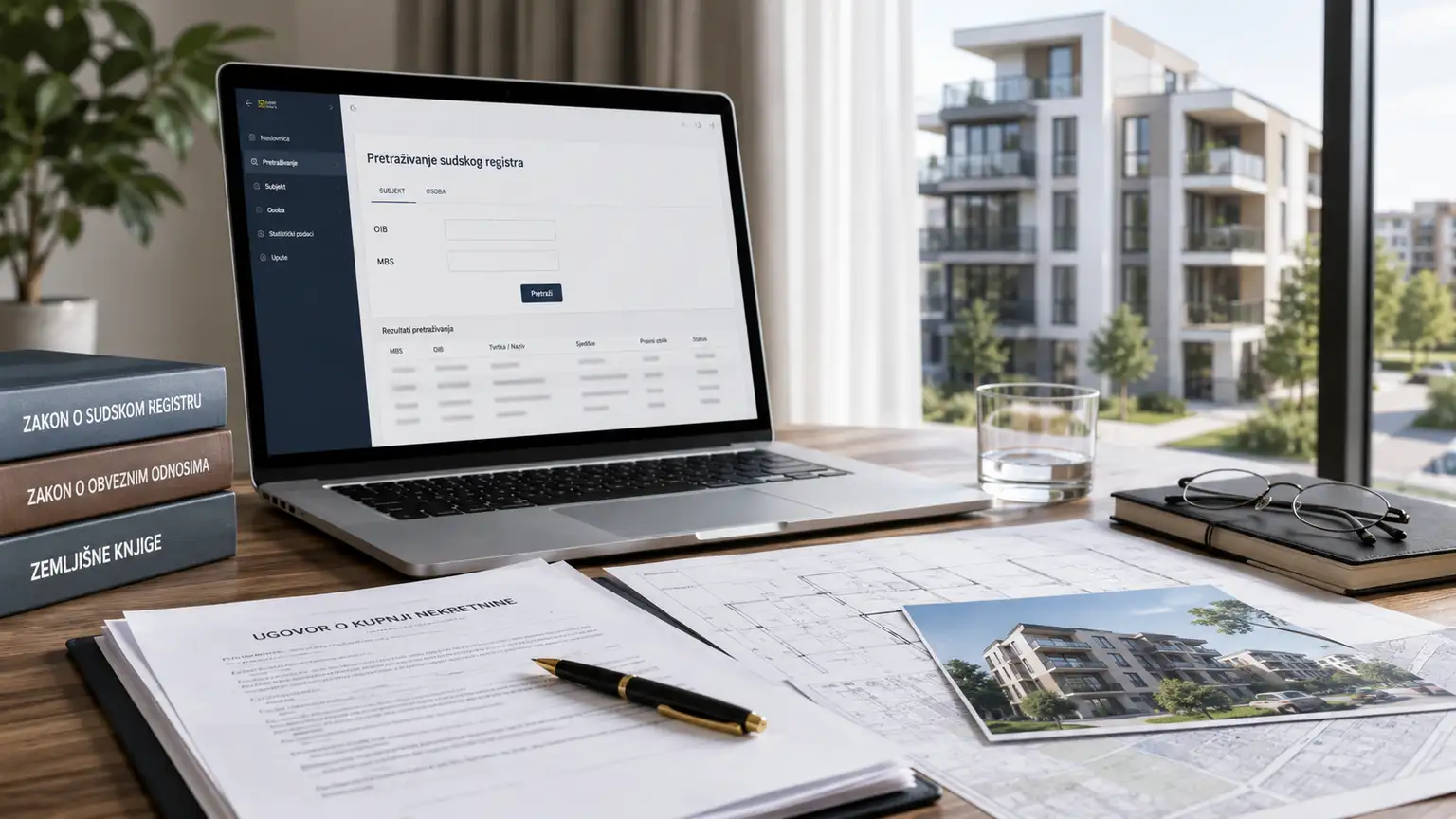
The Court Register search is available online and does not require registration for basic data. The process typically includes accessing the sudreg.pravosudje.hr portal, searching by company name, OIB, or MBS, opening the entity's card and reviewing basic data, and downloading a public extract. For a more detailed picture, it is useful to also check the date of the last change in the register, as recent changes to directors, headquarters, or ownership structure may require additional verification.
In addition to the public extract, when purchasing real estate from a legal entity, it is also useful to check the Register of Annual Financial Statements (RGFI) maintained by FINA. An insight into income, losses, and business continuity does not provide a complete legal picture but can help assess whether the seller operates stably or if it is a newly established or financially weakened company.
Professional tip: For larger transactions, save a PDF extract from the Court Register and, if possible, an extract from the RGFI in your case file. This provides a record of which data you verified before signing.
What to pay attention to in the extract
The extract itself contains several pieces of information that a real estate buyer needs to know how to read. These primarily include the entity's status, headquarters, OIB, MBS, persons authorized to represent, the method of representation, and data on share capital and fundamental company changes. If the person negotiating with you is not listed as a director, board member, or other person authorized to represent, request additional verification and a valid power of attorney.
Pay special attention to whether the person represents the company independently or jointly with another person. In cases of joint representation, a contract signed by only one representative can be legally problematic. It is also useful to check if the company has recently changed its headquarters, name, or management, especially if such changes occur immediately before the sale of the property.
Professional tip: If the indication is that the company is represented by two persons jointly, do not sign a preliminary contract or agreement until you have verified that all necessary representatives or a person with a valid special power of attorney will sign it.
OIB and the company's tax status
The company's OIB is a crucial piece of data that links the court register, tax records, annual financial statements, and land registers. When verifying the seller, it is recommended to compare the OIB from the court register with the OIB stated in the preliminary contract and the land registry extract. The company name can change, but the OIB remains the most reliable identifier for checking data consistency.
It is also useful to check if the company is in the VAT system, as this can affect the tax treatment of the specific real estate transaction. However, the issue of VAT and real estate transfer tax should be considered in the context of the specific transaction, type of property, and seller's status, so for more complex transactions, it is justified to request confirmation or an opinion from the Tax Administration or a tax advisor. If the seller requests payment to a third-party account that is not a contracting party, this is a serious signal for additional caution.
Professional tip: Always compare the OIB in all documents – court register, draft contract, invoice, land registry extract, and any power of attorney. An OIB discrepancy requires an explanation before any payment is made.

Verification of liquidation, pre-bankruptcy, and bankruptcy
The company's status directly affects the security of the transaction. If the company is in liquidation, it undergoes a special procedure for business cessation; if it is in pre-bankruptcy, this indicates financial difficulties and possible special conditions for disposing of assets; and if it is in bankruptcy, the bankruptcy administrator decides on the disposal of assets, not the company director as in regular operations. This is precisely why the purchase and sale of real estate from a company in one of these statuses must not be treated as a standard transaction.
The Court Register provides an important signal about the status, but it is not the only place for verification. In case of suspicion of liquidation, pre-bankruptcy, or bankruptcy, it is useful to additionally check the e-Notice Board of courts and other public announcements of the Ministry of Justice and Public Administration. Such verification is especially important when the property is sold at an unusually low price or under time pressure.
Professional tip: If the company is in liquidation, pre-bankruptcy, or bankruptcy, do not proceed with the transaction without prior legal verification. In such cases, a standard preliminary contract form is often not sufficient protection.
Additional checks: land registers and lawsuits
The Court Register confirms the legal status of the seller, but it does not confirm ownership of the specific property. This is verified in the land registers, where the name and OIB of the registered owner should be reconciled with the data from the Court Register. In addition to ownership, it is important to check for any encumbrances, mortgages, dispute annotations, or other restrictions that may affect the security of the purchase and future registration.
When purchasing real estate from a legal entity, it is especially important to request a current land registry extract, ideally not older than a few days. The status of the property can change quickly, so an older extract does not provide a reliable picture at the time of signing. If there is any suspicion of disputes or discrepancies, the purchase and sale process should be slowed down until the facts are clarified.
Professional tip: Company verification and property verification must go hand in hand. In practice, it is not enough for the company to be properly registered if the land register shows burdens, encumbrances, or other restrictions.
Risks of buying from a company and how to minimize them
The most common risks when purchasing real estate from a legal entity include signing a contract with a person without actual authorization to represent, buying from a company in financial difficulties, discrepancies between register data and land registers, and the possibility of contesting certain legal actions when the company enters insolvency. The mere fact that a company exists is not enough – it is also important what its status is, who represents it, and whether the specific property is indeed registered to that company.
The risk is reduced by combining several steps: checking the court register before the preliminary contract, checking the land register immediately before signing, comparing the OIB in all documents, checking the RGFI for financially unclear entities, and engaging a lawyer when the transaction value is high or the company's status is questionable. For more complex transactions, additional protection can be the use of a fiduciary or escrow account, so that payment is tied to the fulfillment of agreed conditions.
Professional tip: If the property price is significantly lower than comparable market prices, and the seller shows signs of financial difficulties, this is not automatically proof of a problem – but it is a clear reason for increased scrutiny.
How Regent Real Estate Agency can help you
Purchasing real estate from a legal entity requires an additional level of legal and administrative attention. At Regent, before every such transaction, we routinely check basic seller data, consistency of data from the court register and land registers, and warn about risks that may affect the security of the purchase and future registration. Depending on the complexity of the case, we also connect you with legal experts when additional verification is needed.
If you are buying real estate from an investor, a construction company, or another commercial company and wish to verify the legal status of the seller before signing, contact us via https://regent.hr/kontakt. You can also view more about our related services on the pages for legal services and administrative services.
Frequently Asked Questions (FAQ)
Is the Court Register search free?
Yes. Basic search and access to public data about a legal entity via the sudreg.pravosudje.hr portal are available online and without physically going to court.
What if the person selling the property is not listed as authorized to represent in the Court Register?
If the person is not registered as authorized to represent, it is necessary to check if there is a valid power of attorney for the specific legal transaction. In real estate transactions, a power of attorney is typically given in written form and certified by a public notary.
Can real estate be purchased from a company that is in liquidation?
Yes, but such a purchase requires additional caution and prior legal verification. Liquidation status means that the company is undergoing a special procedure for business cessation, so the purchase and sale must not be treated as a standard transaction.
How do I know that the company from the Court Register is the same company registered as the owner in the land register?
The safest way is to compare the company's OIB from the Court Register with the OIB stated in the land registry extract. The company name may change or be similar to another, but the OIB is a reliable identifier.
Do I need a lawyer to verify a company before buying real estate?
For a basic online check of the Court Register, a lawyer is not essential, but for high-value transactions, purchases from investors, or purchases from companies with financial difficulties, professional legal verification significantly reduces the risk.
Recommended
- Property inspection before purchase: legal verification, technical assessment, and handover
- How the real estate purchase and sale process works in Croatia step by step
- Property registration in Croatia: what it is, how it works, and what you need to know
- What are the title deed, land register, and cadastre, and how to read them