
TL;DR: Real estate due diligence before purchase includes two separate checks — a legal review of documentation and a technical assessment of the physical condition of the property. Without checking ownership, encumbrances, pending entries (plombe), foreclosures, and maintenance fund debts, the buyer assumes risks that cannot be corrected later without additional costs and court proceedings. A technical assessment protects against expensive surprises upon handover.
Buying real estate in Croatia — in Zagreb, Split, Rijeka, Zadar, or any other city — is one of the biggest financial steps in life. However, between finding a property and signing the purchase agreement, there is a step that is too often skipped or superficially handled: a thorough property inspection. This guide explains what this inspection entails, what are the most common buyer mistakes, and what specific risks you need to be aware of before making a down payment.
Key Information
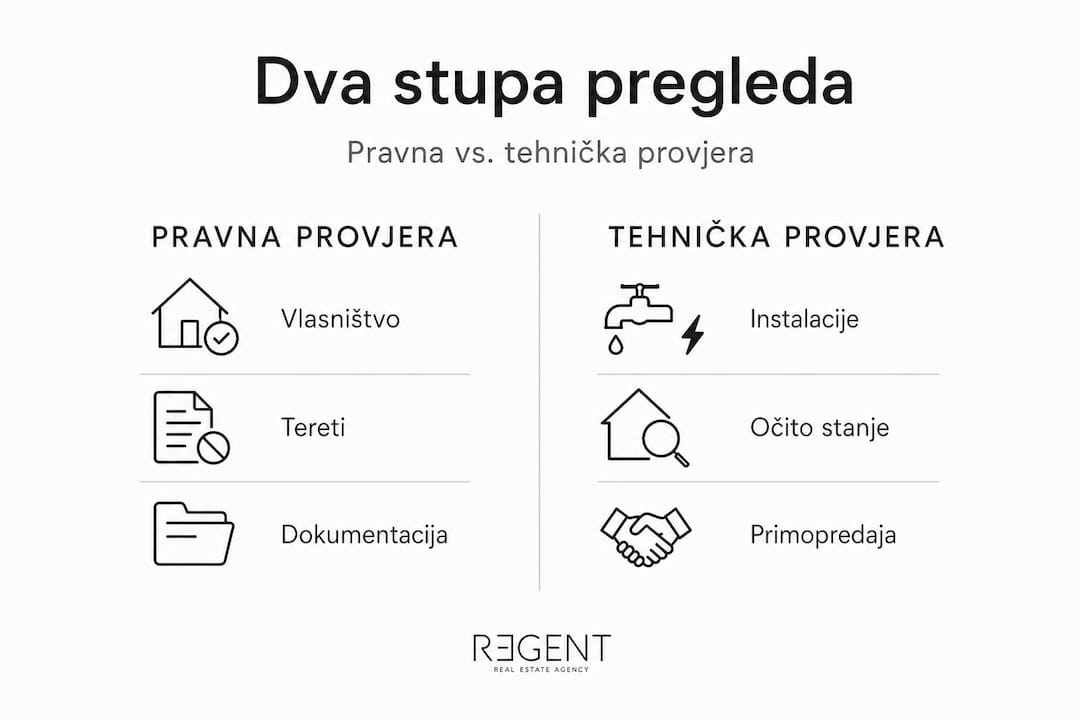
Property inspection is divided into two separate parts that cannot be interchanged:
Legal due diligence — includes ownership, encumbrances, pending entries (plombe), foreclosure notices, lawsuits, maintenance fund debts, pre-emptive rights, and documentation compliance. It is conducted by an attorney or an experienced agent.
Technical assessment — includes the physical condition of the property: construction, installations, moisture, roof, facade, and condition of common parts of the building. It is conducted by a licensed engineer or appraiser.
Both parts are equally important. Without legal due diligence, you might buy a property with encumbrances or an active foreclosure. Without a technical assessment, you might acquire a property with serious, expensive defects that become your problem from the moment the handover protocol is signed.
What does a property inspection before purchase include?
Many buyers equate the term "property inspection" with a physical tour of the premises. The actual inspection is considerably more complex. Due diligence — the professional term for a comprehensive property check before purchase — implies a systematic analysis of all legal, documentary, and physical aspects of the property being purchased.
Every thorough inspection must include:
- Land Registry extract — verification of ownership, encumbrances, and all entries in Part C
- Compliance of cadastral data with the Land Registry via the uređenazemlja.gov.hr portal
- Condominium elaboration — verification of legal division of condominium ownership
- Energy performance certificate — a legal obligation for every sale and rental, valid for 10 years
- Final occupancy permit — without it, the property is not formally fit for use
- Verification of notices: foreclosures, lawsuits, interim measures
- Certificate from the building manager on the state of the maintenance fund and any debts
- Written record of the technical condition with a list of observed defects
Legal and technical due diligence must be completed before signing the pre-agreement. The pre-agreement is a legally binding document — if you sign a pre-agreement with a down payment and only then discover a mortgage or an active foreclosure, you will find yourself in an unenviable position.
Read more about the step-by-step real estate purchase process on our blog.
Legal property inspection: why the first step is the most important
Legal property inspection is the foundation of every secure purchase as it reveals what is not visible to the naked eye. Checking ownership, encumbrances, and the alignment of cadastral and land registers is a fundamental step that precedes any further action.
Steps of legal due diligence
1. Checking the ownership certificate in the land registry
Access is free and available to everyone via the uređenazemlja.gov.hr portal. Always request an up-to-date extract, no older than 30 days.
2. Difference between ownership certificate and possession certificate
These two documents are often confused, but they are from different registers. The ownership certificate (Land Registry extract) from the land registry shows who is the owner and which encumbrances are registered. The possession certificate from the cadastre shows the physical description of the plot and the user. Both can now be obtained via the uređenazemlja.gov.hr portal.
3. Checking Part C — encumbrances and burdens
Mortgages, usufructs, rights of way, pre-emptive rights, lawsuits. Every entry in Part C must be analyzed.
4. Checking notices
Pay special attention to: foreclosure notices (meaning foreclosure has been initiated on the property, which affects all subsequent acquirers), lawsuit notices (active legal dispute), and interim measures prohibiting alienation.
5. Plombe (pending entry) on the ownership certificate
A temporary mark signaling a submitted proposal for registration that has not yet been processed. It is not always a problem, but it must be checked exactly what it signifies. Read more about plombe on our blog.
6. Verification of condominium division
Is the property legally divided into condominium ownership? Is there a valid condominium elaboration? Without condominium division, individual apartment registration is not possible.
7. Urban plan and spatial plan of the location
Verification via the ISPU portal (Spatial Planning Information System) — a publicly available and free tool. It reveals the purpose of the plot, the possibility of reconstruction, and any construction restrictions.
8. Final occupancy permit
Checked via the eDozvola system or by viewing the ISPU portal. Important note: for buildings constructed before 1968, an occupancy permit was not required by the law at that time — in these cases, a certificate of the age of the building serves as a substitute. This often applies to old apartments in the centers of Zagreb, Split, and Rijeka.
Spousal consent
For the sale of property that is marital property, written consent from the spouse, notarized, is required. Without it, registration may be blocked. This is a common problem discovered only at the registration stage — and one of the checks that must be part of the due diligence process.
Maintenance fund debts — transfer to the buyer
Unpaid maintenance fund contributions of the previous owner transfer to the new owner along with the property. Before purchasing, always request a written certificate from the building manager stating that there are no debts on the property to the common maintenance fund. This is one of the most common expensive surprises for apartment buyers in older buildings in all Croatian cities.
Mortgage on the property
A mortgage registered in Part C means that a bank or other creditor has the right to collect from the value of the property. A buyer who purchases a property with a mortgage inherits that encumbrance. An up-to-date extract should be obtained immediately before signing any contract. Read more about mortgages on property on our blog.
Technical assessment of condition: what needs to be inspected
A technical assessment is not just a visual tour. A handover inspection is an opportunity to discover defects before you become responsible for resolving them. When you sign the handover protocol, responsibility for the condition of the property transfers to you.
Elements to inspect in detail:
- Moisture and mold — check corners, behind furniture, and under floors. Moisture is expensive to remediate and can endanger health. Visible stains on the ceiling can be a sign of active moisture penetration.
- Electrical installations — check if the distribution box is modern, what the fuse capacity is, and if there are visible signs of overload.
- Plumbing installations — test water pressure and check for leaks under sinks and around sanitary fixtures.
- Facade and exterior walls — cracks in the facade may indicate foundation settlement, which is a serious structural problem.
- Floors and walls — check for flatness, creaking, and deformations.
- Heating and cooling system — test the operation of the boiler, radiators, or air conditioning unit.
- Elevator and common areas — assess their condition in the context of future common maintenance fund costs.
- Energy performance certificate — a legal obligation for sale, valid for 10 years. From 2026, all new construction must meet the nZEB standard (energy class A or A+).
Asbestos in old buildings
Buildings constructed approximately until 1980 may contain asbestos in roof panels, insulation, or floor coverings. Asbestos in good condition does not pose an immediate danger, but damaged material containing it is extremely dangerous to health. The City of Zagreb launched an asbestos register in November 2025. Buyers of older properties in Zagreb, as well as in Split, Rijeka, and other cities, should include this check in their technical assessment.
Responsibility for material defects
According to the Law on Obligatory Relations, the seller is responsible for material defects of the property. There are two different scenarios that buyers must be aware of:
Visible defects upon takeover — the buyer must report to the seller within 8 days of discovery. Defects that are visible upon takeover and not reported cannot be subsequently claimed by the buyer.
Hidden defects that appear after takeover — the buyer must notify the seller within 2 months of discovery. The seller is not responsible for defects that appear after 2 years from the handover of the property.
Important warning: the seller and buyer can exclude or limit liability for defects in the contract. Such a clause is null and void only if the seller knew about the defect and deliberately concealed it. Always read the contract carefully before signing and consult an attorney about any clause that limits liability.
Handover protocol: why it is crucial
The handover protocol is a written document by which the buyer confirms the condition of the property at the time of takeover and records all found defects. Without it, the buyer cannot subsequently prove what they found upon takeover.
The handover protocol must contain:
- Date and place of handover
- Exact description of each observed defect with its location in the space
- Condition of measuring devices (electricity, gas, water) with readings
- List of keys and access cards being handed over
- List of equipment and appliances remaining in the apartment (if agreed upon)
- Signatures of both parties
The protocol is drawn up in two copies — one for the buyer and one for the seller. If the seller refuses to sign a protocol with observed defects, it is a serious warning sign.
How Regent Real Estate Agency can help
Regent is a real estate agency with offices in Zagreb, Split, Rijeka, and Istria, operating throughout Croatia. We offer comprehensive support throughout the entire purchasing process — from the initial property inspection to final registration.
- Legal document verification and due diligence
- Administrative services — contract drafting, reporting to the Tax Administration, registration
- Services for foreign buyers with language support
- Contact
Frequently Asked Questions
What is most often discovered during a property inspection before purchase?
Most often, technical defects such as moisture, dilapidated installations, and cracks are discovered, as well as documentation inconsistencies — uncancelled mortgages, maintenance fund debts that transfer to the buyer, and foreclosure notices in Part C. The handover inspection is precisely an opportunity to identify these defects before the buyer becomes responsible for them.
Should I complete legal checks before or after the pre-agreement?
All legal checks must be completed before signing the pre-agreement. The pre-agreement is a legally binding document — by it, you commit to buying. If you postpone legal due diligence until after the pre-agreement, you lose the freedom to withdraw without financial losses.
What is a "plomba" (pending entry) on the ownership certificate and should I be concerned?
A "plomba" is a temporary mark in the Land Registry extract that signals a submitted proposal for registration that has not yet been processed. It is not always a problem, but it must be checked exactly what it signifies. Buying property with an active "plomba" carries risk because you do not know the subject of the entry.
Can I buy a property with a foreclosure notice?
Buying a property with a foreclosure notice in Part C is extremely risky because the foreclosure notice affects all subsequent acquirers — meaning the buyer can inherit the foreclosure. Such a purchase requires mandatory consultation with an attorney and settlement of the foreclosure before or at the time of purchase.
What is a handover protocol for an apartment and how do I draft it?
The handover protocol is a written document by which the buyer confirms the condition of the property at the time of takeover and records all found defects. It must contain the date, description of each defect, condition of measuring devices, list of keys, and signatures of both parties. Without it, subsequent proof of condition upon takeover is not possible.
Recommended
- What to pay attention to when viewing a property
- Documents you must check when buying property
- When to Buy Property: A Market Analysis Guide
- What to pay attention to when negotiating the price and terms of property purchase?