Summary
Prefabricated and wooden houses are not the same — there are different construction systems (panel, CLT, log cabin) with different characteristics. The price per m² ranges from approximately 700 to over 1,500 EUR, depending on the system and specification. With quality execution and regular maintenance, the lifespan is comparable to masonry construction. For prefabricated and wooden construction, the same rules apply for obtaining a building permit as for conventional construction. The misconception that they are "temporary" and quickly deteriorate largely does not correspond to reality with modern construction systems.
Key facts
- 4 types of construction: panel systems, CLT (cross-laminated timber), log cabins, classical masonry construction
- Price: 700–900 EUR/m² (basic systems), 900–1,200 EUR/m² (higher quality), 1,200–1,500+ EUR/m² (CLT/premium)
- Lifespan: 60–100+ years with quality execution and regular maintenance
- Durability depends on: quality of execution and maintenance, not on the material itself
- Energy efficiency: better with wooden systems with thinner walls
- Construction speed: prefabricated systems significantly faster than masonry construction (weeks to a few months)
- Resistance to moisture/fire/pests: same level of safety as masonry construction, with proper protection (vapor barrier, drainage, impregnation)
- Permits: identical procedure for obtaining a building permit as for masonry construction
- Prejudices debunked: are not "temporary", do not decay faster, are not automatically lower quality
- Legal status: equal market value and registration as a masonry property
Purchasing land and choosing the type of construction is one of the most important decisions for any investor or family planning to build a house in Croatia. In addition to classic masonry construction, more and more buyers are considering prefabricated and wooden houses — but numerous prejudices about their quality and durability still circulate. In this text, we provide an objective overview of prices, construction technologies, and the actual state of affairs, without favoring any type of construction.
Prefabricated, wooden, and masonry construction: what's the difference
- The term "prefabricated house" is often used as an umbrella term for anything that is not classic masonry construction, but in practice, there are several different systems:
- Panel systems (prefabricated construction in the narrower sense) — the house consists of prefabricated panels (wooden or with a wooden structure) that are produced in a factory and assembled on-site. This system allows for rapid construction, often within a few weeks to a couple of months.
- CLT construction (cross-laminated timber) — uses massive wooden panels with high load-bearing capacity, suitable for multi-story houses. It is considered one of the highest quality modern wooden construction systems.
- Log cabins — classic construction from solid wood (beams or logs), a traditional solution that today also comes in modern, energy-efficient designs.
- Masonry construction — a classic system of building with brick, block-brick, or concrete, which is still the most prevalent in the Croatian market.
- Each of these systems has its advantages in terms of construction speed, price, insulation properties, and aesthetics, so the choice depends on the specific needs and budget of the investor.
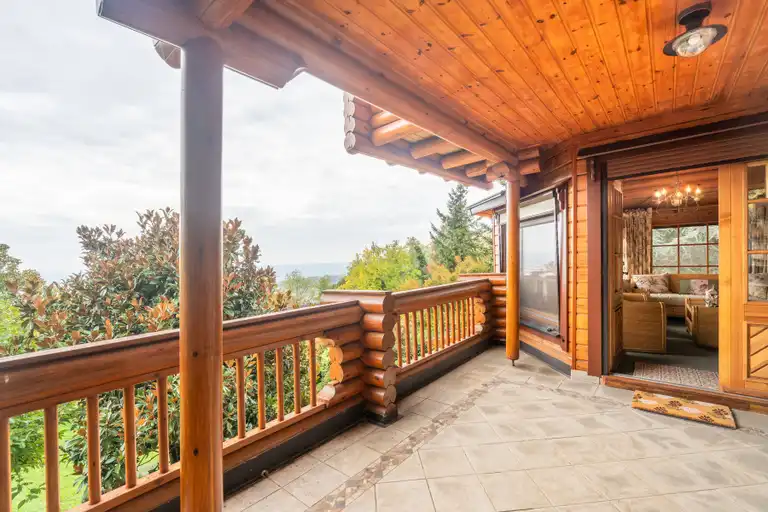
Featured from our Regent offer: Zagreb, Podsljeme - Charming wooden house with panoramic view
Prices per m²
The price of a prefabricated or wooden house in Croatia depends on several factors: the construction system, the level of equipment (shell construction, "turnkey" finish), material quality, and energy standards.
Approximate price range per m² for a finished house:
- Basic panel systems: from approximately 700–900 EUR/m²
- Higher quality panel and wooden systems with better insulation: 900–1,200 EUR/m²
- CLT construction and premium designs: 1,200–1,500+ EUR/m²
For comparison, classic "turnkey" masonry construction of average quality in Croatia falls within a similar range, with prefabricated and wooden systems often offering a lower initial price for simpler designs, while premium wooden systems can be more expensive than standard masonry construction.
It is important to note that a lower initial price for shell construction does not necessarily mean a lower overall price — foundations, installations, finishing works, and energy equipment must also be taken into account.
Durability: myth or reality
One of the most widespread prejudices is that prefabricated and wooden houses have a short lifespan compared to masonry construction. In practice, the key factor in durability is not the material itself, but the quality of execution and regular maintenance.
Modern wooden construction systems (CLT, high-quality panel systems) are designed for a lifespan of 60 to over 100 years, provided the wood is properly protected from moisture, pests, and UV radiation, and the facade treatment is regularly maintained. Log cabins, if properly impregnated and regularly maintained, can last for multiple generations — numerous examples of traditional wooden construction in Croatia and the region are over 100 years old.
On the other hand, a poorly executed prefabricated or wooden house — with inadequate waterproofing, a poor vapor barrier, or neglected maintenance — can indeed have problems with moisture and durability much earlier. The same applies to masonry construction: poor execution of waterproofing or the roof leads to problems regardless of the structural material.
The experts' conclusion is clear: the material itself is not the decisive factor — the quality of design, execution, and maintenance is crucial.
Energy efficiency, moisture, fire, and pests
- Energy efficiency — wooden and prefabricated construction systems often achieve better energy classes with thinner walls, thanks to the natural insulating properties of wood and the possibility of easier installation of thicker layers of thermal insulation within the panel structure.
- Moisture resistance — proper vapor-permeable yet waterproof protection (vapor barrier, windproof foil) and quality drainage around the foundation are crucial. With correct execution, wooden structures do not have an increased risk of moisture compared to masonry construction.
- Fire resistance — modern treated structural timber (especially CLT) has predictable and measurable behavior in a fire, as wood burns in a controlled manner, creating a protective layer of char that slows down further combustion. Accordingly, appropriate fire protection requirements are prescribed for this type of construction as well.
- Pest resistance — properly impregnated and treated wood is significantly more resistant to insects and fungi. Regular inspections and maintenance of protective coatings further reduce the risk.
Prejudices and reality
The most common prejudices about prefabricated and wooden houses include:
- "They are temporary and of lower value" — in practice, a well-built prefabricated or wooden house is as permanent a solution as masonry construction and is registered as real estate in the same way.
- "They quickly deteriorate" — as explained, deterioration is a consequence of poor execution or neglected maintenance, not the material itself.
- "They are of lower quality than masonry construction" — quality depends on the chosen system, materials, and contractor, not on the type of construction. Premium wooden systems often surpass standard masonry construction in energy and insulation properties.
These prejudices mainly stem from older, simpler prefabricated solutions from the past, while modern construction systems undergo strict certifications and testing that guarantee quality comparable to classic construction.
Obtaining permits
It is important to emphasize that the same rules for obtaining building permits apply to prefabricated and wooden construction as to classic masonry construction. Regardless of the chosen system, it is necessary to obtain the main project, a building permit (or follow the procedure according to valid regulations for simpler structures), and fulfill all conditions from the spatial plan for the respective location.
FAQ
Is a prefabricated house equally valuable real estate as a masonry house?
Yes, a well-built and legalized prefabricated or wooden house has the same legal status and market value as a masonry house, provided it is built according to regulations and registered in the land registry.
How long does it take to build a prefabricated house compared to a masonry one?
Prefabricated construction systems are usually significantly faster — shell construction can be completed in a few weeks to a couple of months, while masonry construction typically takes longer due to the time required for material drying.
Do I need a different permit for a prefabricated or wooden house?
No, the permit acquisition process is the same as for classic construction and depends on the size and purpose of the building, not on the construction material.
How often should a wooden facade or structure be maintained?
Depending on the type of protection and climatic conditions, periodic inspection and renewal of protective coatings are recommended every few years, which is crucial for long-term durability.
Is a prefabricated house more cost-effective than masonry construction?
For basic designs, the initial price per m² may be lower, but for premium construction systems, the price can be comparable to or even higher than masonry construction — cost-effectiveness depends on the specific project and chosen materials.
Recommended
Conceptual, main, and executive project: what's the difference
Land parcelization in Croatia: what it is, when it's needed, and how it's done?
Green building and nZEB standard: what are nearly zero-energy buildings and why is the EU requiring them by 2030?