Summary
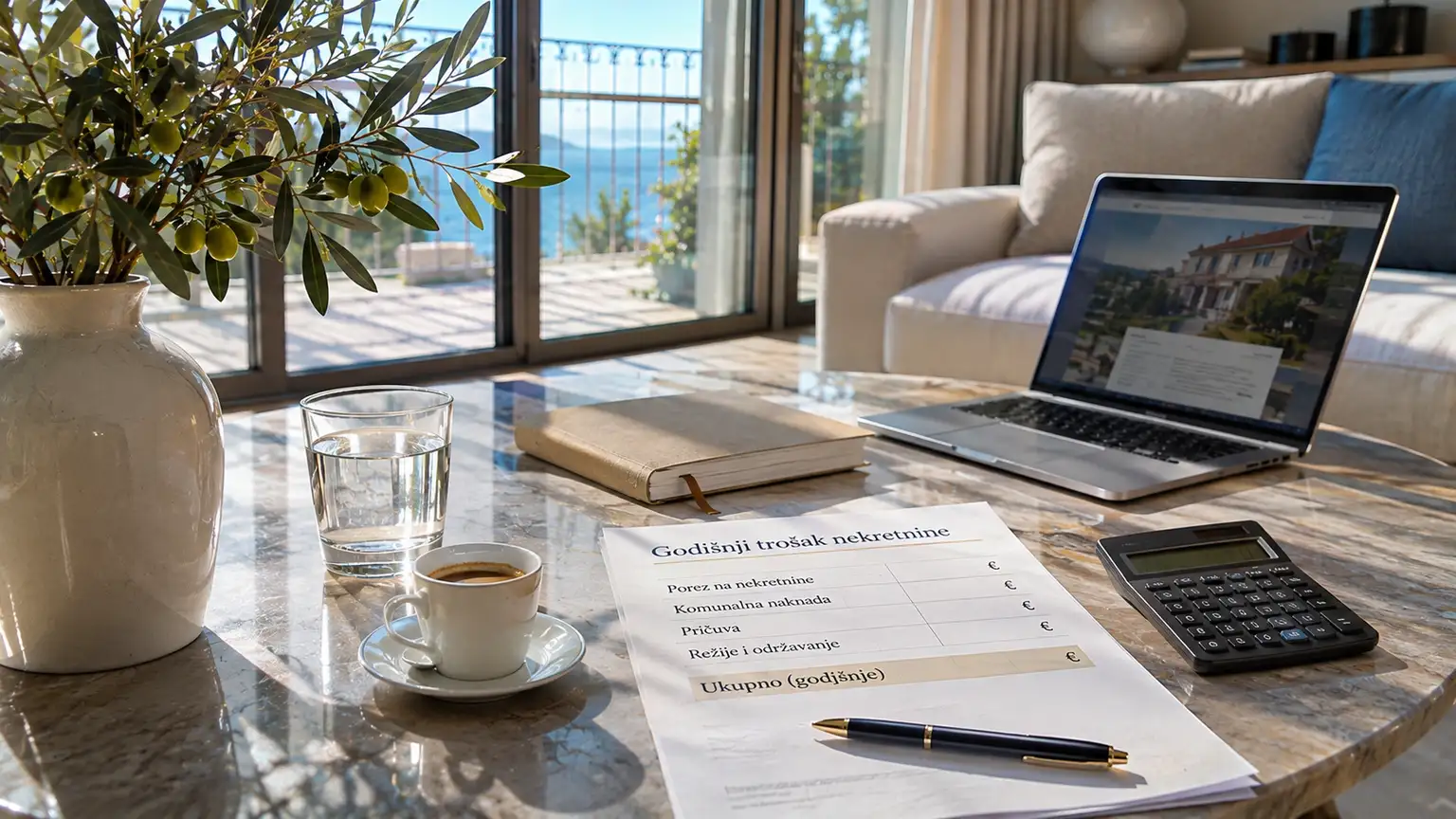
The annual cost of property ownership in Croatia includes real estate tax, municipal utility fee, joint building reserve fund, and utilities and maintenance. The first three items stem from laws and local government decisions, while the fourth depends on consumption and the condition of the property. You do not pay real estate tax for the home you permanently reside in, nor for a property you have rented out for permanent residence for at least 10 months. Verify the exact amount for a specific property in the decisions of the city or municipality and in the rulings of competent authorities, as of the purchase date.
Key facts
- The annual cost of ownership comprises property tax, communal charge, reserve fund, and utilities and maintenance.
- Property tax ranges from 0.60 to 8.00 euros per m² of usable area annually, with the exact rate determined by the city or municipality.
- Tax is not paid for properties used for permanent residence, nor for those rented for permanent residence for at least 10 months.
- The communal charge is paid by the owner or user, and any change in the obligated party must be reported within 15 days.
- The law prescribes the minimum amount for the common reserve fund, but the building can decide on a higher amount.
- Before purchasing, request the latest decisions and utility bills.
The price of a property is just the beginning of the bill. After purchase, recurring annual obligations arise, which must be factored in alongside loan repayments and one-time purchase costs. The annual cost of property ownership consists of four groups of expenses, each with a different legal basis and a different recipient of funds.
Below is an overview of what is determined by law and local decisions: property tax, utility fees, and common reserve fund. These are accompanied by utilities and maintenance, which are determined by the property itself and the market. There is no universal amount, as each location and each building has its own regulations. The goal is for you to know what to ask for and what to request for inspection before purchasing.
Annual Cost of Property Ownership: What Items are Included in the Calculation
The calculation begins with a list of items. Two are charged by local self-government: property tax and utility fees. The third, common reserve fund, is paid into the building's account and used for the maintenance of common parts. The fourth group, utilities and maintenance of the property itself, depends on consumption, building age, and construction quality.
Not all owners are equally burdened by all items. An apartment owner in a multi-owner building pays a reserve fund, while a detached house owner has no common parts with neighbors, so they must determine their own reserve for the roof, facade, and installations. Property tax is tied to the way the property is used, which is the topic of the next section. Utility fees depend on the zone and the local unit's decision, and utilities depend on how the property is heated and how well it is insulated.
Professional tip: Before signing the preliminary contract, create your own table with four groups of expenses and for each, write down the source of the amount: resolution, decision, or invoice.
Property Tax: Who Pays It and Who is Exempt
Property tax was introduced on January 1, 2025, as a replacement for the holiday home tax. It is regulated by the Local Taxes Act (Official Gazette 115/16, 101/17, 114/22, 114/23, 152/24). It is paid annually, from 0.60 to 8.00 euros per m² of usable area, and the amount is determined by the city or municipality where the property is located. According to the Tax Administration, in 2026, 125 cities and municipalities apply the lowest amount of 0.60 euros per m², while 84 of them apply an amount of 5.00 to 8.00 euros per m².
The obligor is the property owner, a domestic or foreign natural or legal person; if the owner cannot be determined, the tax is paid by the user. Tax is not paid for a property used for permanent residence, provided the obligor can prove this if requested by the tax authority. According to the Tax Administration, it is also not paid for property rented under a permanent residence lease agreement for at least 10 months.
The tax is determined by a decision based on the property's condition, purpose, and ownership as of March 31, and is payable within 15 days of the decision's delivery. Changes in data relevant for taxation, as well as evidence for exemption, must be reported by the owner by March 31 of the year for which the tax is determined. The Tax Administration states that owners who pay utility fees for that property or those whose long-term lease for permanent residence has been reported to the Tax Administration do not need to submit a declaration. How property tax fits into the broader European picture is described in the article on property taxes in Croatia and Europe.
Professional tip: If you are renting out an apartment long-term, the lease agreement should explicitly state that it is for permanent residence and should last for at least 10 months.
Utility Fees: A Permanent Obligation of the Owner or User
Utility fees are revenue for the city or municipality budget and are used for the maintenance of municipal infrastructure. It is regulated by the Communal Economy Act (Official Gazette 68/18, 110/18 (Constitutional Court Decision), 32/20, 145/24). It is paid by the owner or user of the property (Article 93). The user pays it when the obligation has been transferred to them by a written agreement, when they use the property without a legal basis, or when the owner cannot be determined.
The fee is calculated per square meter of usable area for residential, commercial, and garage spaces. The amount per m² is obtained by multiplying the zone coefficient, the purpose coefficient, and the point value determined by the city or municipality (Article 99). The first zone, best equipped with communal infrastructure, has the highest coefficient. Therefore, two apartments of the same size in different cities or zones have different fees.
The obligor is obliged to report the creation of the obligation to the administrative body of the city or municipality within 15 days, and the same applies to a change of obligor (Article 94). Anyone who fails to do so pays the fee from the date the obligation arose. When the obligation is transferred to the user by contract, the owner jointly guarantees its payment.
Professional tip: After purchase, within 15 days, report the change of utility fee obligor and check the area for which the decision was issued, and ask the previous owner for a copy of the last decision.
Common Reserve Fund: Minimum Amount Prescribed by Law
The reserve fund is money that owners of individual parts of the building pay into a common reserve account for the maintenance of the building's common parts. The rules are in the Building Management and Maintenance Act (Official Gazette 152/24, 47/26 correction), which applies from January 1, 2025.
The minimum amount of the common reserve fund per square meter of usable apartment area annually is 0.54% of the standard construction price published by the Ministry (Article 29). The reserve fund is paid monthly, and the monthly amount must not be less than one-twelfth of the annual minimum. The amount in euros is not fixed: it changes with the published standard price, so the amount the seller quotes you today is only a starting point.
A building may decide on a higher reserve fund than the legal minimum, for example, when a major renovation is planned. For special parts used for short-term rental or rental to multiple persons, the inter-owner agreement may specify a double amount for the reserve fund (Article 28). Therefore, distinguish between two pieces of information: the minimum amount required by law and the amount the building has actually decided to pay. The latter is relevant for your budget.
Professional tip: Before purchasing, ask the building manager for information about the current reserve fund amount, whether a double amount is specified for your apartment, and about planned major works.
Utilities and Maintenance: The Part of the Cost That Depends on the Property
Utilities depend on consumption and agreements with suppliers. Heating, electricity, water, and waste removal can vary significantly between two apartments of the same size. Crucial factors are the heating method, quality of joinery and insulation, and household habits.
The energy class holds a special place. A poorly insulated property generally consumes more energy, so the difference is visible in both bills and the need for renovation. Read more about this in the article on property energy classes. Maintenance of your own part, from painting to replacing installations, is included in the annual cost as a reserve you determine yourself. The transfer of contracts with suppliers after purchase is described in the article on utility transfer.
Professional tip: Ask the seller for utility bills for the last 12 months to see the actual annual consumption, including winter months.
How to Calculate the Annual Cost Before Purchase
The most reliable calculation follows the order of sources. First, the city or municipality decisions on property tax and utility fees, as they determine what you will pay at that location. Then, information on the reserve fund from the building manager. Finally, utility bills from the previous year.Once you have all three sets of data, sum them up on an annual basis and add a reserve for maintenance. This gives you a framework that you can compare with loan repayments or expected rental income. If you are buying for investment, each of these costs reduces the net rental income. For tax implications of renting, consult a tax advisor.
Professional tip: Perform the calculation for at least two properties in different locations, as differences in local decisions can change the ranking of your favorites.
How Regent Can Help You
Regent mediates in the purchase, sale, and rental of residential and commercial properties, as well as new builds, across Croatia and helps buyers find a property that suits their needs. Before any payment, it helps verify the legal status of the property, including its status in the land registry and any encumbrances. For parts that Regent does not handle, it refers you to the appropriate expert, such as a public notary, lawyer, authorized engineer or architect, or tax advisor. If you are planning a purchase, contact us or view properties for sale.
Frequently Asked Questions (FAQ)
How much is the annual cost of apartment ownership?
There is no single amount: the total depends on the city, building, and consumption. It consists of property tax from 0.60 to 8.00 euros per m² annually (if not exempt), utility fees, reserve fund, and utilities and maintenance. You will get the exact total from the decisions and invoices for the specific property.
Do I pay property tax if I live in the apartment permanently?
No, property tax is not paid for a property used for permanent residence. The obligor must prove this if requested by the tax authority. Utility fees and the reserve fund are separate obligations and are paid even when you live in the apartment.
Is property tax paid on a long-term rented apartment?
It is not paid if the property is rented under a permanent residence lease agreement for at least 10 months. Shorter or tourist rentals do not fall under this exemption. To check if a contract is covered, verify with the Tax Administration.
Who pays the utility fee, the owner or the tenant?
It is paid by the owner or user of the property. The user pays it when the obligation has been transferred to them by a written agreement, and the owner then jointly guarantees the payment. Therefore, the lease agreement should clearly state who bears this fee.
Can the reserve fund be lower than the legal amount?
No, the law prescribes the minimum amount of the common reserve fund: 0.54% of the standard construction price per square meter of usable apartment area annually. A building may decide on a higher amount. Request information on the current amount from the building manager.
Where can I find out the property tax rate for my municipality?
The rate is prescribed by a decision of the city or municipality where the property is located, and an overview of cities and municipalities is published by the Tax Administration on its website. Decisions are also published in the official gazette of the local unit. Always check the amount on the day of purchase.
Recommended
- Building Reserve Fund: What you pay and who decides
- Utility Contribution and Utility Fee
- Utility Transfer After Apartment Purchase: A Guide for New Owners
- Property Energy Class: What A-G labels mean