Summary
Opatija and Volosko are not just a summer postcard of Kvarner — with a mild Mediterranean climate, greenery, and a famous coastal promenade, these are places where life is pleasant all year round. Winter reveals their quieter, more authentic side, and a home that is warm, dry, and practical turns the Riviera into an everyday delight. It's also good news that the annual property tax is not paid on a home where you permanently reside. In this guide, we show why Opatija is good for year-round living and how to recognize an apartment that performs well even in winter.
Key facts
- Opatija and Volosko are pleasant for year-round living — mild climate, greenery, and the sea within reach.
- A home you permanently live in is exempt from annual property tax.
- Winter best shows how warm, dry, and practical an apartment is for everyday life.
- Energy class and a well-maintained building mean lower costs and greater comfort.
- Short-term rentals in the building are regulated, with the co-owners' consent — useful to know in advance.
- Checking the land registry before buying provides peace of mind and security.
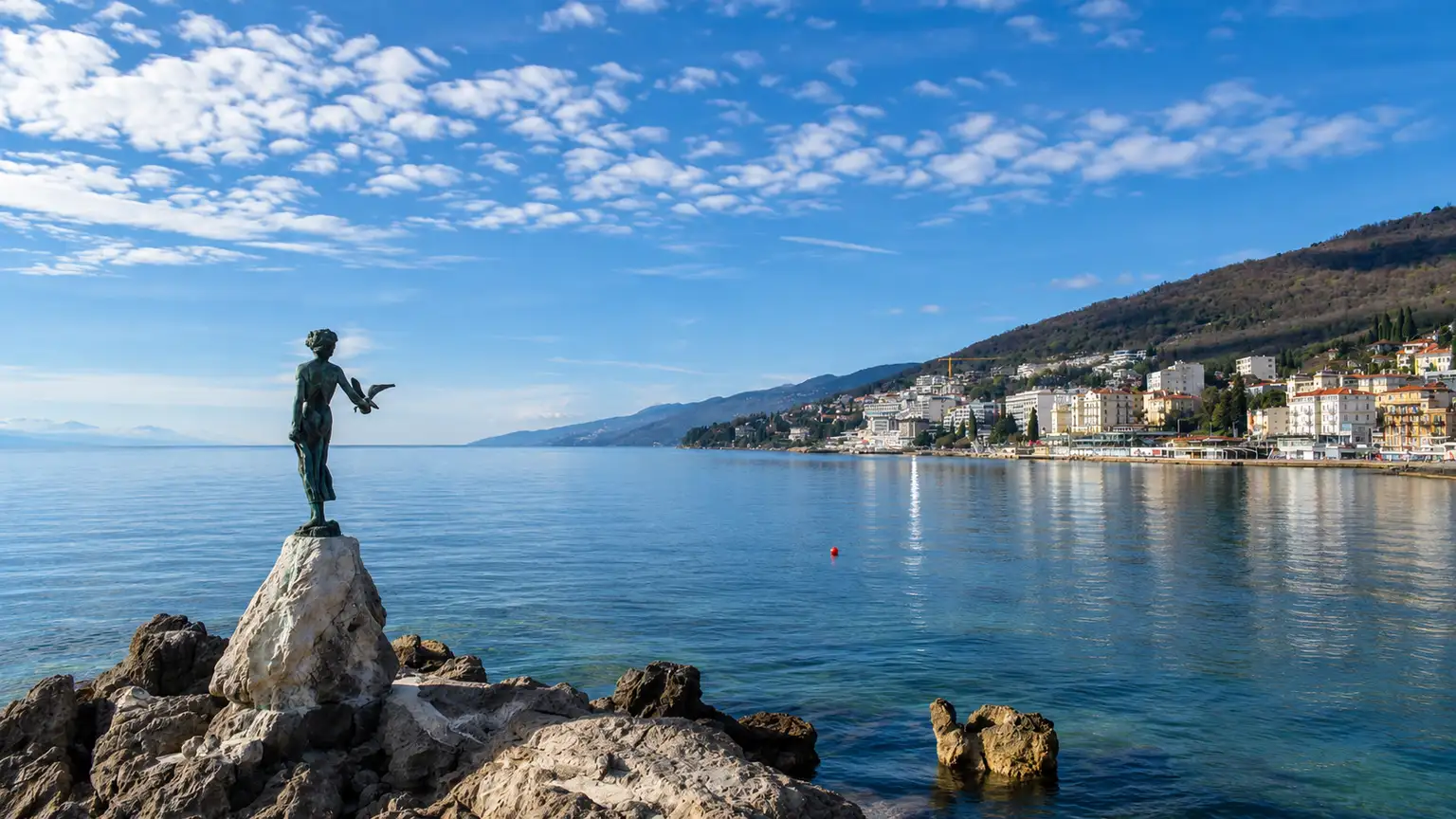
Life in Opatija in winter has a special charm: the Riviera calms down, Lungomare becomes a place for peaceful walks by the sea, and the town shows its true, year-round face. That's why more and more people are choosing Opatija and neighboring Volosko as a permanent home, not just for the summer — the climate is mild, nature is at your fingertips, and the city retains its vibrancy even outside the season.
To make that home comfortable for twelve months, it's worth choosing it with a little more care than a summer house — and that's good news, because it means you'll enjoy it without worries. Below, we cover what makes an apartment comfortable for year-round living in Opatija and Volosko: a warm and dry space, practical access, a well-maintained building, a favorable tax position for permanent residence, and a secure purchase. Where we rely on law or tax, we cite an official source, and anything dependent on your case can easily be checked with the competent authority.
Opatija in winter: why it's good for a year-round home
Opatija has a rare advantage: an elegant coastal atmosphere in summer and a peaceful, gentle rhythm in winter. The mild Mediterranean climate, lush greenery of the parks, and the coastal promenade connecting Volosko, Opatija, and Lovran make everyday life pleasant even outside the season. For many, this quieter side of the Riviera — without the summer crowds, but with the same sea and nature — is the reason they choose Opatija as a permanent home.
A buyer planning year-round living naturally looks a little further than the view: how the home is heated, how practical the access is, who maintains the building. These are not obstacles, but questions that lead to the right choice — a home that serves equally well in July and January. In Kvarner, you will find both charming older houses and comfortable new apartments, so the choice is wide; the key is to align the property with a year-round lifestyle.
Professional tip: If possible, view the property outside of the season or ask the seller for heating and utility bills for the entire year — this is the best way to feel how the home lives in winter and make a completely calm choice.
Favorable tax position for permanent residence
For those who choose Opatija as their permanent home, the tax position is favorable. Property tax is regulated by the Law on Local Taxes (NN 115/16, 101/17, 114/22, 114/23, 152/24), and the amount is determined by each city with its own decision. According to the instructions of the Tax Administration, the tax is paid annually in the range of 0.60 to 8.00 euros per m² of usable area, and for Opatija, the decision of the City of Opatija is relevant, so check the exact amount in its valid text.
The key, and pleasant, news is the exemption: tax is not paid on property used for permanent residence, nor on property leased under a permanent residence agreement for at least 10 months a year. In other words, a home where you actually live is generally not subject to annual tax — it applies to properties for vacation and occasional use. Taxpayers submit data on the property by March 31 of the year for which the tax is determined, and since mere registration of residence is not automatic proof of permanent residence, it is good to keep documentation on the actual use of the home.
Professional tip: If you plan Opatija as your home, arrange your residence registration in time and keep proof of actual residence (utilities, deliveries) — this way you easily confirm your right to exemption from annual tax.
Warm and dry home: heating, humidity, and energy class
A home that is comfortable in winter is, first and foremost, warm and dry, so it's worth paying attention to heating and energy properties — these directly mean both lower utility bills and greater comfort. The energy certificate provides a first orientation, and along with it, look at the heating source, the quality of the carpentry, and whether the facade and roof are well-maintained. A well-insulated apartment with quality carpentry is comfortable and economical all year round. In older buildings by the sea, humidity can be an issue, so if you notice signs like stains or peeling paint, it's worth asking for clarification and, if necessary, a professional inspection — an authorized engineer or architect can reliably assess the condition of the structure, insulation, and installations. If the building plans a renovation of the facade, roof, or installations, this is often a good sign of care for the property; inquire about your share in such investments with the manager. General information about energy labels can be found in our article on the energy class of real estate.
Professional tip: Request the energy certificate and heating bills — with them, you can immediately see how economical the home is, and quality carpentry and good insulation make a comfortable temperature affordable all year round.
Pleasant year-round access: parking and a house on a slope
The Opatija Riviera is picturesquely situated on a slope towards the sea, which offers beautiful views, and with a little attention, completely pleasant daily access. Since access varies from property to property, it's worth aligning it with your lifestyle: where to park, how far is the entrance, is there an elevator, and what is arrival like in the rain. For some, a few stairs by the sea are part of the charm; for others, proximity to parking is a priority — both are easy to check in advance.
If the apartment comes with a parking space or garage, check if it's part of the purchase and how it's registered, as its status can differ from the apartment itself. For a detached house, the garden, retaining walls, and stormwater drainage also enter the equation — items that, when known in advance, become part of pleasant planning, not a surprise.
Professional tip: Walk the path from the parking lot to the entrance, preferably in bad weather — this is the best way to feel the everyday access and choose a home that suits you for years to come.
Building community and rental possibility
By purchasing an apartment, you become part of the building's community, so comfort and costs partly depend on harmonious co-owners and proper maintenance — a well-managed building is a pleasant and secure choice in the long run. It's worth asking the manager about the condition of common parts and planned works; these are useful details not contained in the advertisement.
If you are also considering occasional renting, it is good to know in advance that short-term rental in multi-apartment buildings is regulated. The Law on Building Management and Maintenance (NN 152/24, correction NN 47/26) in Article 34 requires that for renting an apartment for less than 30 days, prior written consent of a two-thirds majority of co-owners must be obtained, along with the consent of all co-owners whose walls, floors, or ceilings border the apartment; consent is given for at least five years. Owners who have already rented have five years from the entry into force of the Law (January 1, 2025) to obtain it (Article 63), and the Constitutional Court, by decision U-I-411/2025 of March 31, 2026 (NN 41/2026), confirmed these rules. Clarify your case with a lawyer.
Professional tip: If you plan occasional rental, openly discuss it with neighbors from adjacent apartments even before making an offer — a good relationship in the building facilitates consent and makes cohabitation more pleasant.
Secure purchase: land registry and actual condition
Checking the legal status before purchasing is a simple step that brings peace of mind: it confirms who the owner is, whether there are any encumbrances, and if the actual condition matches what is registered. With this insight, you enter the purchase securely and without unknowns.
You can review the land registry status on the public part of the Uređena zemlja portal, using the cadastral parcel number or land registry entry number and the name of the cadastral municipality. The review is informative, and an extract with the status of a public document is issued through the e-Građani system, and can also be obtained by public notaries and lawyers. We assist you with this review, while the contract, tax implications, and construction matters are handled by appropriate experts — a lawyer or public notary, a tax advisor, and an authorized engineer or architect.
Professional tip: Request an up-to-date land registry extract before paying a deposit — when the status is clear and verified, the rest of the purchase proceeds smoothly and securely.
How Regent can help you
If you are considering a year-round home in Opatija or Volosko, we would be happy to help you find a property that suits year-round living — from heating and access to a well-maintained building — and verify its legal and land registry status before purchase. For legal, tax, and construction matters, we collaborate with appropriate experts, and we also work with foreign buyers. If you are considering buying in Kvarner, contact us or view our property listings for sale.
Frequently Asked Questions (FAQ)
Is property tax paid on an apartment where I permanently live?
No, property tax is not paid on property used for permanent residence. The exemption also applies to property leased under a permanent residence agreement for at least 10 months of the year for which the tax is determined. The competent authority may request proof of actual residence, so it is good to keep documentation.
How much is the property tax in Opatija?
The amount is determined by the City of Opatija through its tax decision, and the legal range is from 0.60 to 8.00 euros per m² of usable area annually. Check the exact amount for the current year in the valid decision of the City of Opatija or at the city tax department.
Am I allowed to rent out an apartment in a building to tourists?
For rentals shorter than 30 days in a multi-owner building, prior written consent of a two-thirds majority of co-owners is required, along with the consent of all co-owners whose walls, floors, or ceilings border the apartment. Consent is given for at least five years. Clarify your case with a lawyer.
Is the rule on co-owner consent for short-term rental in effect?
Yes, the rule is in effect. The Constitutional Court, in decision U-I-411/2025 of March 31, 2026 (NN 41/2026), rejected the challenge to Articles 33, 34, and 63 of the Law on Building Management and Maintenance. Owners who have already rented out an apartment have five years from the entry into force of the Law (January 1, 2025) to obtain consent.
What should I check first when buying an apartment for year-round living?
First, the land registry status and encumbrances, then the condition of the common parts of the building and the heating method. Only then does it make sense to compare appearance and view. Request heating and utility bills for the entire year from the seller, so you know how the home lives in winter.
Do I need another expert besides the agency?
For legal, tax, and construction matters, it is useful to involve appropriate experts — a lawyer or public notary, a tax advisor, and an authorized engineer or architect. The agency guides you through the process and refers you to them.
Recommended
- Umag year-round: daily life in an Istrian coastal town
- Energy class of real estate: what A-G labels mean and how they affect value and costs
- Short-term rental: a guide for investors and owners
- Property taxes in Croatia and Europe: where we are now and what awaits us