
TL;DR: A preliminary real estate purchase agreement in Croatia is a legally binding contract that protects both parties in the period between agreement and final sale. It must contain an accurate description of the property, the purchase price, deadlines, and deposit provisions. Thorough documentation review before signing is crucial for a safe and successful transaction.
Many real estate buyers and sellers view a preliminary agreement as a mere formality – a paper to be signed while waiting for a loan or sorting out documentation. This misconception can be costly. A properly drafted preliminary agreement is a legally binding document that protects both parties, defines the terms of the transaction, and specifies what happens if someone backs out. In this guide, you will learn what a preliminary agreement must contain, how a deposit (kapara) works, when notary verification is required, and what warning signs to look out for before signing.
Contents
- What is a Preliminary Real Estate Agreement and How Does It Work?
- Essential Elements of a Preliminary Agreement You Need to Know
- The Deposit (Kapara) in a Preliminary Agreement: What It Is and How It Protects Us?
- Preliminary Agreement vs. Main Purchase Agreement: Key Differences and Verification
- What Buyers Should Watch Out For Before Signing a Preliminary Agreement: Key Warning Signs
- Why a Preliminary Agreement is Not Just a Formality: Tips from Legal Practice
- How Regent Real Estate Agency Can Help with Concluding a Preliminary Agreement
- Frequently Asked Questions
Key Takeaways
Legal Significance of the Preliminary Agreement — The preliminary agreement obligates the parties to enter into the main contract and protects the interests of both parties in the real estate purchase process.
Essential Elements — The content of the preliminary agreement must include an accurate description of the property, the price, deadlines, and provisions regarding the deposit.
Role of the Deposit (Kapara) — The deposit serves as assurance of the seriousness of the offer and can be forfeited or returned with double the amount depending on who withdraws.
Difference from the Main Contract — The preliminary agreement does not transfer ownership; the main purchase agreement with notary verification is required for ownership transfer.
Preparation and Verification — Before signing, one must verify ownership, encumbrances, and clearly define the terms and deadlines in the preliminary agreement.
What is a Preliminary Real Estate Agreement and How Does It Work?
Many real estate buyers and sellers view a preliminary agreement as a mere formality – a paper to be signed while waiting for a mortgage loan or sorting out documentation. This misconception can have serious financial consequences. A properly drafted preliminary agreement is a legally binding document that protects both parties, defines the terms of the transaction, and specifies what happens if someone backs out. In this guide, you will learn what a preliminary agreement must contain, how a deposit (kapara) works, when notary verification is required, and what warning signs to look out for before signing.
A preliminary real estate purchase agreement in Croatia is a binding contract by which the parties undertake to conclude the main purchase agreement in the future under predetermined conditions, and it is regulated by the provisions of the Law on Obligations. It is not a document without legal weight but a contract that creates concrete obligations.
A preliminary agreement is most often used when there is a time gap between the agreement and the realization of the transaction. Typical examples include waiting for mortgage loan approval, arranging ownership documentation, resolving encumbrances on the property, or completing construction. Without a preliminary agreement, neither the buyer nor the seller has protection during this interim period.
It is crucial to understand what a preliminary agreement is and what it is not:
- A preliminary agreement is a legally binding contract that obligates both parties to enter into the main contract.
- A preliminary agreement is not a transfer of ownership; ownership is not transferred by signing a preliminary agreement.
- A preliminary agreement is protection for a buyer who wants to secure a property while waiting for a loan.
- A preliminary agreement is not a substitute for the main purchase agreement signed before a notary public.
- A preliminary agreement is the basis for paying a deposit (kapara) as confirmation of the seriousness of the intention.
A preliminary agreement is a bridge between an agreement and the final sale. Without it, the agreement remains just an oral understanding that is difficult to prove and even harder to legally protect.
Essential Elements of a Preliminary Agreement You Need to Know
The preliminary agreement should contain the essential components of the future purchase agreement, particularly: data about the parties, an accurate description of the property, the purchase price, the deadline for concluding the main agreement, and provisions regarding the deposit (kapara) or advance payment. Each of these elements has its function, and the omission of any can lead to disputes or the nullity of the contract.
Here’s what every preliminary agreement must contain:
1. Party Information — full name, OIB (Personal Identification Number), address, and contact details of both the buyer and the seller. If the seller is a legal entity, information about the company and the authorized representative is required.
2. Accurate Property Description — cadastral municipality, cadastral parcel number, area, floor, and apartment number if it's a condominium. The description must match the data in the land registry, not just the address.
3. Purchase Price and Currency — the price must be clearly stated, and if it's in Euros, this should be explicitly written. Ambiguities in the price are one of the most common causes of disputes.
4. Deadline for Concluding the Main Agreement — a specific date or condition that must be met. For example, "within 60 days of loan approval" or "no later than October 1, 2026."
5. Deposit (Kapara) Provisions — the amount of the deposit, the payment date, and clearly defined legal consequences in case one of the parties withdraws.
You should conduct a review of important documents for purchasing real estate before signing the preliminary agreement, not after. Any missing or incorrect document can become an obstacle to concluding the main agreement.
Professional Tip: Always insist that the property description in the preliminary agreement be identical to the description in the land registry. A difference of even one square meter or a wrong parcel number can create legal complications during ownership registration. 
The Deposit (Kapara) in a Preliminary Agreement: What It Is and How It Protects Us?
A deposit (kapara) is a sum of money that the buyer gives to the seller at the time of signing the preliminary agreement as confirmation of the seriousness of the purchase intention. It is not the same as an advance payment or pre-payment, although many confuse them. This difference has concrete consequences.
If the preliminary agreement is concluded with a deposit as a forfeiture clause, the typical rule is: if the buyer withdraws, they lose the deposit; if the seller withdraws, they must return double the deposit. This is a legal mechanism that encourages both parties to fulfill the contract. The specific consequences of withdrawal always depend on how the clauses are defined in the preliminary agreement itself – which is another reason for carefully drafting the document.
Differences between a deposit (kapara) and an advance payment (predujam):
- A deposit (kapara) has the function of a forfeiture clause – loss or return in double the amount is the legal consequence of withdrawal.
- An advance payment (predujam) is a down payment on the purchase price that is always returned or credited, without penalty effects.
- The deposit is credited towards the purchase price if the transaction proceeds smoothly.
- An advance payment does not have a protective function in case of withdrawal.
The deposit is not a penalty, but a balance. It protects the buyer from the seller selling the property to someone else, and the seller from the buyer simply backing out without any consequences.
Practical Example: A buyer signs a preliminary agreement and pays a deposit of 10,000 Euros. In the meantime, the seller receives a better offer and wants to cancel the agreement. The law obligates them to return 20,000 Euros to the buyer – double the deposit amount. This provision makes the seller's withdrawal expensive and thus protects the buyer who has already invested effort and money in the process.
Professional Tip: The deposit must be clearly agreed upon in writing. An oral agreement about the deposit is practically impossible to prove. Always ask for proof of payment and a written clause regarding the deposit in the preliminary agreement.
Preliminary Agreement vs. Main Purchase Agreement: Key Differences and Verification
The preliminary agreement and the main purchase agreement are two different legal documents with different effects. Understanding this difference is crucial for anyone buying or selling real estate in Croatia.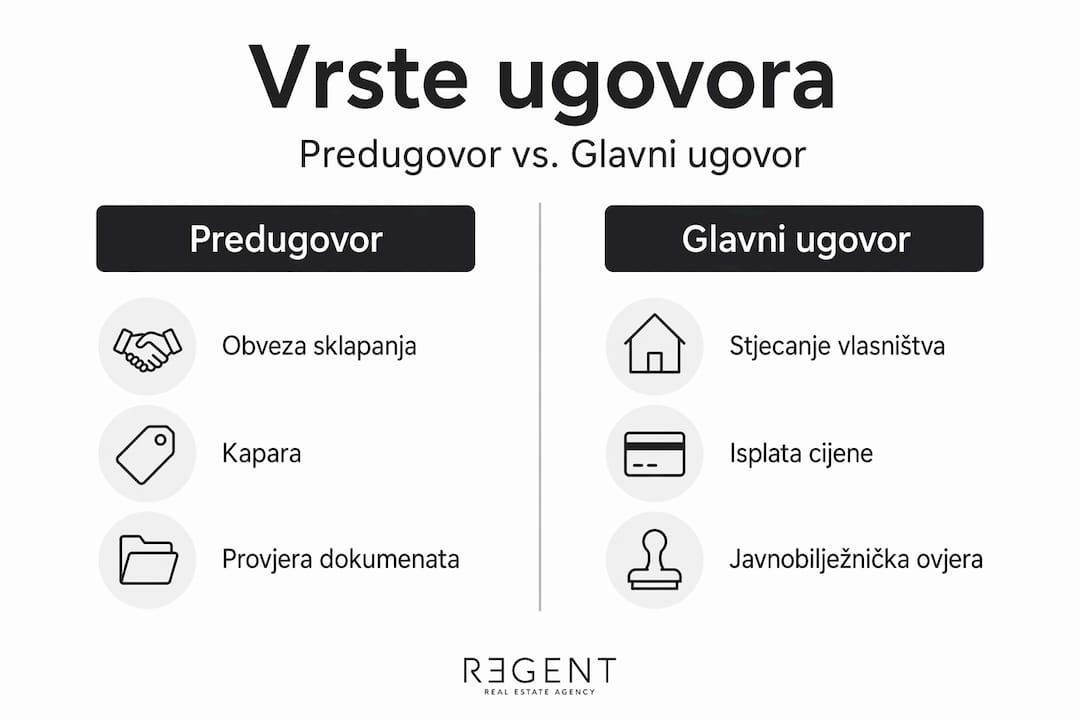
The verification of signatures on a preliminary agreement is not mandatory for it to be legally valid – verification is tied to the main purchase agreement, which serves for the transfer of ownership and registration in the land registry. However, notarization of the preliminary agreement is recommended for high-value transactions as it increases the document's evidentiary power.
Characteristic / Preliminary Agreement / Main Purchase Agreement
Legal Obligation / Obligation to conclude the main contract / Transfer of ownership
Transfer of Ownership / Does not transfer ownership / Basis for registration in the land registry
Verification / Not legally mandatory / Legal requirement for ownership registration
Deposit (Kapara) / Usually paid with the preliminary agreement / Remainder of the purchase price
Consequences of Withdrawal / Loss or return of double the deposit / Lawsuit for fulfillment or damages
Form / Written form is sufficient / Notarial deed or solemnization
The role of the notary public in the purchase process becomes crucial when signing the main agreement. Without notary verification or solemnization, it is not possible to register the change of ownership in the land registry. The entire real estate purchase process in Croatia goes through this step.
What Buyers Should Watch Out For Before Signing a Preliminary Agreement: Key Warning Signs
Signing a preliminary agreement without thorough verification is one of the most common causes of legal disputes in real estate transactions. Before signing a preliminary agreement, it is necessary to check the ownership and any encumbrances on the property, ensure that the property description matches the land registry data, and clearly define the deadlines and conditions for withdrawal.
Specific warning signs to pay attention to:
- Discrepancy in Ownership in the Land Registry — if the seller is not registered as the owner or there is co-ownership that is not stated, the transaction can be legally questionable.
- Encumbrances and Mortgages on the Property — mortgages in favor of a bank, seizures, or easements must be resolved or clearly agreed upon before signing.
- Unclear Deadlines for Concluding the Main Agreement — phrases like "within a reasonable time" are not precise and can lead to disputes about whether the deadline has expired.
- Absence of Building or Occupancy Permit — for properties built without a permit or with incomplete legalization, there is a risk that ownership cannot be properly registered.
- Unclear Deposit (Kapara) Clauses — if the preliminary agreement does not clearly define what constitutes withdrawal and what the consequences are, the deposit can become the subject of a lengthy legal dispute.
- Seller Rushing the Signing — pressure to sign quickly without time to review documents is always a reason for caution.
Professional Tip: Request an excerpt from the land registry and a land certificate immediately before signing the preliminary agreement, not weeks earlier. The situation in the land registry can change, and you need the most up-to-date information. Find advice for a complete document review before purchase and negotiation of price and terms in our guides.
Why a Preliminary Agreement is Not Just a Formality
There is one recurring mistake: parties sign a preliminary agreement quickly, without verification, because "we will sort everything out in the main contract anyway." This logic can have serious financial consequences.
Based on experience in real estate brokerage, a properly drafted preliminary agreement can critically protect the interests of both the buyer and the seller, precisely because it regulates the obligation to conclude the main contract and the consequences of withdrawal. Disputes almost always arise from the same reasons: unclear deposit clauses lead to questions of whether the deposit is forfeited or must be returned; undefined deadlines raise questions of whether the contract has expired or is still valid; imprecise property descriptions create problems with registration. Each of these issues can be prevented by carefully drafting the preliminary agreement.
Buyers who conclude a preliminary agreement without thorough verification often do not realize what they have signed until a problem arises. By then, it's too late for negotiation, and the only option is court.
Sellers, on the other hand, sometimes underestimate the obligation to return double the deposit. They think they can simply "change their mind" if they get a better offer. The law does not protect them in this regard, and court proceedings can last for years and cost more than the price difference itself.
Thorough document review and careful drafting of the preliminary agreement consistently pay off – any oversight in this step can be more expensive than the entire process.
How Regent Real Estate Agency Can Help with Concluding a Preliminary Agreement?
Real estate purchase is one of the biggest financial steps in life, and the preliminary agreement is the first binding step in that process. Whether you are buying an apartment in Zagreb, a house on the coast, or property in Istria, the preliminary agreement functions according to the same legal rules throughout Croatia – but local market and documentation knowledge can be crucial. With professional support, this step does not have to be a source of stress.
Regent Real Estate Agency provides legal services that include reviewing and advising on drafting preliminary agreements, checking land registry data, advising on deposits and deadlines, and providing support throughout the entire purchase process. Our team helps both the buyer and the seller understand what they are signing and what their obligations are.
If you are looking for a property to buy, browse our property listings and find a suitable option with expert support at every step of the transaction. For any questions, feel free to contact us.
Frequently Asked Questions (FAQ)
Is a preliminary real estate purchase agreement binding without notary verification?
Yes, a preliminary agreement is valid even without verification – written form is sufficient. Notarization of signatures is not a legal requirement for the validity of a preliminary agreement, but it is recommended for high-value transactions as it increases the document's evidentiary power.
What is the usual amount of the deposit (kapara) when buying real estate in Croatia?
The usual amount of the deposit ranges between 5% and 10% of the purchase price. For more expensive properties, a fixed amount can also be agreed upon – the specific amount is always freely negotiated between the buyer and the seller and must be clearly stated in the preliminary agreement.
What happens to the deposit if the buyer withdraws from the purchase?
If the buyer withdraws without a valid reason, they lose their right to the deposit, which remains with the seller as compensation for the missed transaction. The specific circumstances are always assessed according to what has been agreed upon in the preliminary agreement.
When is it necessary to conclude the main purchase agreement after the preliminary agreement?
The deadline for concluding the main agreement is freely negotiated in the preliminary agreement and is not legally prescribed. In practice, it usually ranges between 30 and 90 days, but it can be longer – especially when purchasing a new construction or waiting for mortgage loan approval.
What is the difference between a deposit (kapara) and an advance payment (predujam)?
A deposit (kapara) has specific consequences in case of withdrawal – loss or return in double the amount – while an advance payment (predujam) is a down payment that is always credited towards the price or returned, without penalty effects. The deposit is a stronger protective mechanism because it financially obligates both parties to fulfill the contract.
Recommended
- When to Buy Real Estate: A Market Analysis Guide
- Guide for Foreign Citizens Buying Property in Croatia
- Documents You Must Check When Buying Real Estate
- Buying a Home with a Loan: A Guide to Costs, Interest, and Taxes