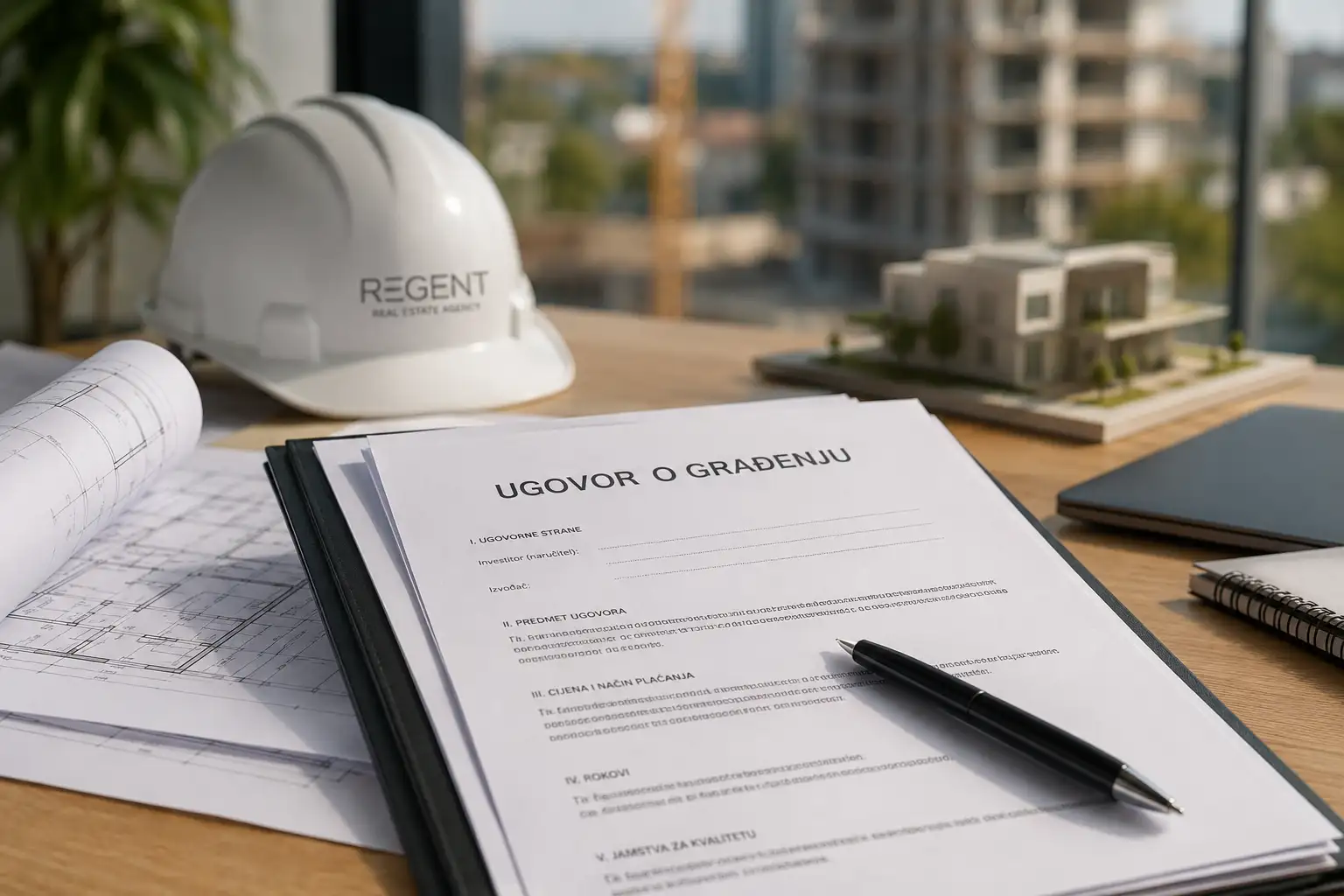
Summary
A construction contract is an agreement by which the contractor undertakes to build a structure or perform construction works according to a specific project and within the agreed deadline, and the client (investor) undertakes to pay the agreed price. According to the Law on Obligatory Relations (NN 35/05 – 69/26, Art. 620.), such a contract must be concluded in written form, with the project and bill of quantities as integral parts — an oral agreement is not legally valid. Essential elements are an exact description of the works, the price and its method of determination, deadlines with consequences for delays, supervision, and quality guarantees. For essential requirements for the structure, the contractor, and depending on the cause, also the designer and supervisory engineer, are liable for ten years from the handover of works, and this liability cannot be excluded by contract. A well-drafted contract regulates in advance the price, deadlines, supervision, and unforeseen works — precisely what causes the most disputes.
Key facts
- The construction contract is a special contract regulated by the Act on Obligations (Arts. 620–636); rules on contracts for services apply to it subsidiarily.
- It must be concluded in written form as a condition of validity, with the design and bill of quantities as integral parts.
- According to the law, the price is determined per unit of measure (unit price) or as a lump sum (fixed price); calculation based on actual costs plus profit is a contractual variant outside legal categories.
- The law also provides for price changes in case of significant changes in the prices of elements (Arts. 626–629), which is important during periods of significant market disruptions.
- Deadlines should be clear, with a contractual penalty for delay.
- Payment is safest tied to certified interim payment certificates and records in the construction logbook, rather than to a calendar.
- Professional supervision is generally a legal obligation according to the Construction Act, and not a choice.
- Additional and unforeseen works are carried out with the prior written consent of the client; an exception are urgent unforeseen works (Art. 624).
- For essential requirements of the building, liability lasts ten years from handover and cannot be excluded by contract (Art. 633).
Building a house, renovating an apartment, or performing major works on a property almost always implies a relationship between two parties: the one who orders and pays for the construction — the client, in practice the investor, and the one who performs the work — the contractor. This relationship is legally regulated by a construction contract. Unlike simple services, construction lasts a long time, involves large sums, and a series of participants, and the result is permanent and difficult to repair if something goes wrong. Therefore, a construction contract is one of the most important documents an investor ever signs regarding a property.
In practice, many disputes arise because the contract was not precise enough — the price was not clearly defined, deadlines were approximate, it was unclear who bears the cost of unforeseen works, or how subsequently noticed defects are resolved. In this guide, we explain what a construction contract is, what its essential elements are, how price and deadlines are regulated, what role supervision plays, and what guarantees you have for the quality of the performed works. The provisions we cite are found in the Act on Obligatory Relations (articles 620–636) and apply equally to construction in all places in Croatia.
What is a Construction Contract and Who are the Parties
By a construction contract, the contractor undertakes to construct a specific building on a specific plot of land according to a specific project and within the agreed period, or to perform other construction works on such land or on an existing building, while the client undertakes to pay him the agreed price (Article 620 of the Act on Obligatory Relations). The subject may be the construction of a new building, but also major interventions on an existing one — extension, reconstruction, or extensive renovation.
This is a special contract to which the rules on contracts for work apply subsidiarily. This means that the contractor owes a specific result, not just effort: you are entitled to a building that conforms to the project and professional standards, and if the result deviates, legal remedies for defects are available to you. The main parties are the client (investor) and the contractor, and the process regularly involves the designer and the supervisory engineer. The contractor often entrusts a part of the work to subcontractors, but for the entire job, the general contractor is usually responsible to the client, regardless of which part he entrusted to others.
Professional tip: Before signing, check if the contractor is registered and authorized for the works you are contracting, and regulate the issue of subcontractors in the contract. An unclear status of subcontractors later complicates liability for defects.
Written Form, Project, and Bill of Quantities
A construction contract must be concluded in writing (Article 620, paragraph 2). The written form here is not a matter of practicality but a condition of validity: an orally concluded construction contract is not legally considered concluded, which in a dispute may mean that the client cannot enforce the rights they would otherwise have. Along with the text of the contract itself, its integral part regularly includes attachments without which it would not be complete.
Key attachments are the project according to which the construction is carried out and the bill of quantities. The project defines what is built and how, and the bill of quantities details individual work items and their quantities, forming the basis for price calculation. When explicitly stated as an integral part of the contract and signed, they are as binding as the text itself. The more closely the description of works is tied to the project, the less room there is for later disagreements about whether something was included in the price or constitutes additional work.
Professional tip: Do not agree to construction "as agreed during the works." Insist on a project and bill of quantities before signing and that they are explicitly stated as integral parts of the contract, as the biggest cost overruns occur precisely with insufficiently defined jobs.
Price: Models and Price Changes
The Act on Obligatory Relations stipulates that the price of works can be determined per unit of measure of the contracted works (unit price) or as a total amount for the entire building (total agreed, i.e., lump sum price) — Article 625. With a unit price, the actually performed quantity of works multiplied by the price per unit is paid, so the final amount depends on the actual quantities. With a lump sum price, a predetermined price for the entire job is agreed upon, whereby the contractor assumes the risk of quantities. In practice, calculation based on actual costs increased by an agreed profit is also encountered, but this is not a legally prescribed model, but a contractual variant that needs to be clearly elaborated.
A special case is the "turnkey" clause, by which the contractor independently undertakes to perform all works necessary for the construction and use of the building, and the agreed price includes the value of all unforeseen works and excess works (Article 630). It is important to know that the basic "turnkey" clause does not automatically include design — it is included only if explicitly agreed upon. If several contractors participate in such a contract, their liability to the client is joint and several.
Furthermore, the price is not always unchangeable. If, in the period between the conclusion of the contract and its fulfillment, the prices of the elements on which the price of the works was determined significantly change, the law allows for a change under certain conditions: the contractor may request an increase when the increase exceeds the legal threshold, and the client a reduction when prices fall (Articles 626–629). In practice, price stability is additionally regulated by contractual clauses — an index clause or a sliding scale. In periods of sharp price increases for materials, this is one of the most sensitive issues, so it is worth regulating it in advance.
Professional tip: For a lump sum price ("turnkey"), pay special attention to what exactly is covered, as it is with this model that the biggest dispute arises over whether certain work falls within the agreed price. If you are building during a period of unstable prices, agree in advance on a price adjustment mechanism (e.g., a sliding scale) and its thresholds.
Deadlines and Consequences of Delays
The execution deadline is one of the essential elements and must be clearly defined — both the start and end dates, as well as any intermediate deadlines for individual phases. For long-term projects, a time schedule helps both parties track progress and timely identify delays.
For deadlines to have real weight, the contract should stipulate the consequences of delays. Most commonly, a contractual penalty (in practice: liquidated damages) is agreed for each day of delay, which financially motivates the contractor to adhere to deadlines, and provides you with predetermined compensation for damages due to delay. It is important to distinguish between delays for which the contractor is responsible and delays caused by external circumstances or the client themselves, as the consequences differ.
Professional tip: Agree on a contractual penalty for contractor delays and at the same time clearly define the circumstances that justify an extension of the deadline. This way, you avoid disputes about who is responsible for the delay.
Payment, Supervision, and Performance Security
For long-term construction, the price is rarely paid all at once. Payment in phases, tied to the actual progress of works, is customary: the contractor periodically submits a calculation of performed works (in the profession: interim payment certificate), the supervisory engineer certifies it, and the client pays the certified amount. Progress and commencement of work are recorded in the construction log, the official document of the construction site. This keeps payments in step with the actually completed work, instead of paying in advance for something that has not yet been performed.
During construction, you primarily protect your rights through professional supervision. For most buildings, supervision is not a matter of choice, but a legal obligation under the Construction Act: it is carried out by a supervisory engineer (authorized architect or authorized engineer) on behalf of the investor, monitors the conformity of construction with the project, professional standards, and regulations, controls quality and quantities, and certifies the performed works. Supervision is especially important for hidden works — those that are covered in later phases, such as installations or foundations — because they are difficult and expensive to check once covered.
In addition to a contractual penalty, the contract may also provide for security instruments that give you concrete coverage if the contractor fails to fulfill their obligations. The most common are a bank guarantee for proper performance of the work and a retained amount — a part of each installment that you temporarily withhold and pay only after the proper rectification of defects during the warranty period. These instruments are not prescribed by law but are agreed upon; their basis is also provided by the Special Usages of Construction (NN 137/21), which apply to contracts unless explicitly excluded by the parties.
Professional tip: Tie each installment to a certified interim payment certificate and an entry in the construction log, not to a calendar, and for more valuable constructions, agree on a retained amount that is paid only after the warranty period expires. Payment by date, regardless of actual progress, removes your main leverage if construction stalls.
Changes, Excesses, and Unforeseen WorksRarely does any construction proceed exactly as envisioned on paper. During execution, changes at the client's request, excesses or shortages of works compared to the bill of quantities, and unforeseen works almost regularly appear. The way the contract regulates these situations decisively influences the final price.
The basic rule is clear: for any deviation from the project or agreed works, the contractor must have the client's written consent, and cannot demand a price increase for works performed without such consent (Article 623). There is, however, an important exception for urgent unforeseen works — those that must be performed for the stability of the building or to prevent danger to human life and health, the environment, and property. The contractor may perform such works even without prior consent if, due to urgency, they could not obtain it, with the obligation to notify you immediately; for these, they are entitled to fair compensation, and if the price would significantly increase due to them, you may even terminate the contract (Article 624).
Professional tip: Agree that no additional or altered work shall be performed without prior written consent regarding scope and price, with a clearly defined procedure for urgent cases. Oral agreements on surcharges are an almost inevitable source of conflict.
Handover and Quality GuaranteesThe completion of works is formalized by a handover, which determines whether the works have been performed in accordance with the contract and the project. Noticed visible defects are recorded in a report, and the contractor is obliged to remedy them. For defects that could have been observed by a usual inspection, the contractor generally no longer bears responsibility after you have inspected and accepted the work, unless they were aware of them — therefore, a thorough and timely handover is in your interest.
Protection, however, does not end with the handover. For defects concerning the fulfillment of legally defined essential requirements for the building, the contractor is responsible for ten years from the delivery and acceptance of the works; under the same conditions, the designer (if the defect originates from the design) and the supervisory engineer (if it originates from supervision) are also responsible. This liability cannot be excluded or limited by contract (Article 633). You are obliged to notify the contractor of the defect within six months from the date you discovered it, otherwise, you lose the right to invoke it, and the right itself ceases one year from that notification (Article 634). Therefore, it is important that the contract clearly regulates warranty periods and the defect notification procedure.
Professional tip: Draw up a detailed handover protocol with a list of observed defects and deadlines for their rectification, and for subsequently observed defects, react immediately and in writing — notification deadlines are short, and their omission can cost you your rights.
Most Common Mistakes When Concluding ContractsMost disputes between clients and contractors boil down to a few recurring omissions. The first is an insufficiently defined subject and price — construction is contracted "by agreement," without a detailed bill of quantities, so every unforeseen item becomes a negotiation. The second is the absence of clear deadlines and a contractual penalty, which means that delays have no consequences. The third is payment that is not tied to actually performed and certified works, whereby you lose leverage if the contractor stalls.
A fourth common mistake is relying solely on the contractor, without independent supervision, even though supervision is a legal obligation for most buildings. The fifth is the unregulated issue of additional and unforeseen works. The common thread of all these mistakes is relying on oral agreements and trust instead of a precise written contract. The time invested in a good contract before the start of works almost always pays off many times over.
Professional tip: Before signing, have a draft contract reviewed by a legal expert and a construction professional. The cost of this review is negligible compared to the value of the job and potential damages.
Frequently Asked Questions (FAQ)What is a construction contract?
A construction contract is an agreement by which the contractor undertakes, according to a specific project and within the agreed deadline, to construct a specific building or to perform other construction works on an existing building, and the client (investor) undertakes to pay the agreed price. It is regulated by the Act on Obligatory Relations (articles 620–636) and applies to new constructions, as well as major interventions such as extensions or reconstructions.
Must a construction contract be in writing?
Yes. The Act on Obligatory Relations stipulates that a construction contract must be concluded in writing (Article 620, paragraph 2). The written form is a condition of validity, not just a means of proof, so an orally concluded construction contract does not legally produce effects. The project and the bill of quantities regularly form an integral part of the contract and are as binding as the text itself.
How is the price determined in a construction contract?
According to the Act on Obligatory Relations, the price of works can be determined per unit of measure of the contracted works (unit price) or as a total amount for the entire building (total agreed, or lump sum price). In practice, calculation based on actual costs increased by the contractor's profit is also agreed upon, but this is not a legally prescribed model. The law also provides for the possibility of price changes when the prices of the elements on which the price was determined significantly change (articles 626–629).
Must the client's consent be sought for additional works?
Yes. For any deviation from the project or agreed works, the contractor must have the client's written consent and cannot demand a price increase for those works without it (Article 623). An exception is urgent unforeseen works that must be performed for the stability of the building or to prevent danger to people and property: the contractor may perform these even without prior consent if, due to urgency, they could not obtain it, with the obligation to notify the client without delay (Article 624).
Is professional supervision mandatory?
For most buildings, professional construction supervision is a legal obligation under the Construction Act, and it is carried out by a supervisory engineer (authorized architect or authorized engineer) on behalf of the investor. The supervisory engineer monitors the conformity of construction with the project, professional standards, and regulations, certifies performed works, and keeps records in the construction log. Independent supervision is particularly important for hidden works, so it is recommended to tie payment dynamics to its certifications.
RecommendedProperty Inspection Before Purchase: Legal Due Diligence, Technical Assessment, and HandoverProperty Registration in Croatia: What it is, How it Works, and What You Need to KnowWhat are a Title Deed, Land Register, and Cadastre, and How to Read ThemHow the Property Purchase and Sale Process Works in Croatia, Step by Step