Summary
A smart home doesn't have to mean a collection of impressive-looking but rarely used devices — the most worthwhile are those that solve a real problem and, over time, recoup the investment through savings or security. The benefits are most tangible in three areas: smart lighting (lower consumption and comfort), smart heating (the greatest potential for reducing utility bills), and smart security (protection and peace of mind). It's crucial to choose based on actual benefit, not technological appeal, and to distinguish between devices that pay off from those that are merely trendy. In this guide, we break down what truly pays off in a smart home and why.
Key facts
- Smart devices that solve a real problem and return the investment pay off the most.
- Smart heating has the greatest potential for reducing utility bills, but the effect depends on the type of heating.
- Smart lighting brings lower consumption and comfort with a relatively low investment.
- Smart security returns value through protection and peace of mind, harder to measure but real.
- It is chosen based on actual benefit and use, not technological appeal.
The smart home has ceased to be a futuristic idea and has become an accessible reality — devices that connect, are controlled from a phone, and make the home more comfortable, safer, and more efficient are now within reach and within the budget of many owners. But with this accessibility comes a trap: it's easy to spend money on gadgets that impress in the store but are barely used or bring no real benefit in everyday life.
Therefore, the real question is not "how smart can I make my home", but "what truly pays off in a smart home". Some devices return the investment through lower energy consumption, others through security and peace of mind, and still others through daily comfort that justifies the cost. In this guide, we focus on three areas where the benefit is most tangible — lighting, heating, and security — and explain what truly brings value in each, how to distinguish useful from trendy, and how to connect a smart home with reduced utility bills, instead of it becoming a collection of purposeless devices.
What makes a home "smart" and what pays off
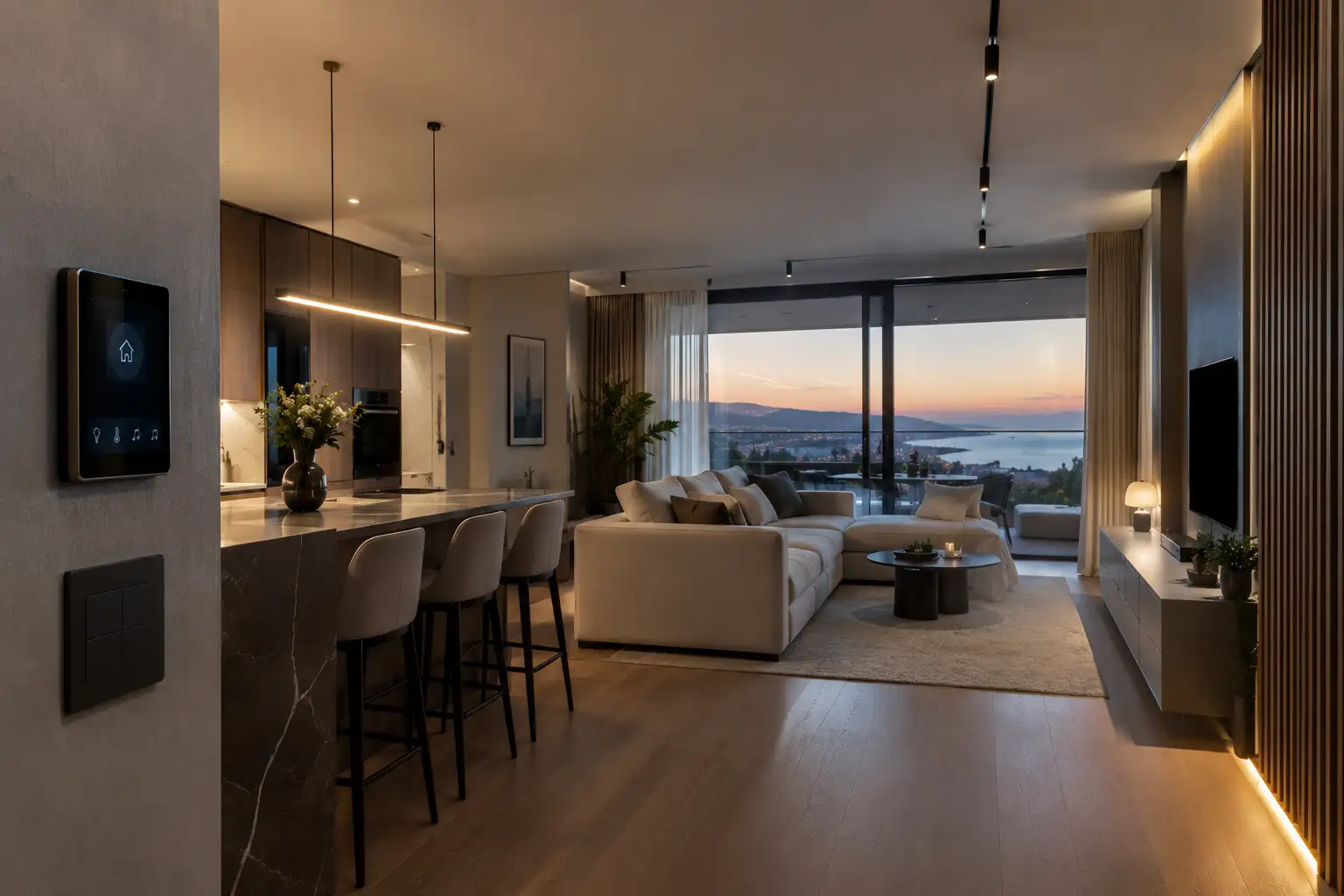
A smart home is a home where devices and systems are connected and can be managed, monitored, or automated — most commonly via a phone, voice assistants, or predefined rules. Instead of each device being used manually and separately, a smart home enables remote control, automation, and the connection of multiple devices into a whole, from individual smart bulbs and thermostats to fully integrated systems. It's important to understand that "smart" doesn't automatically mean "better" or "more cost-effective": a device is smart because it's connected and controllable, but its true value depends on whether it solves a real problem or need. We also write about how living is changing towards a connected and efficient home in our guide on the home of the future.
To distinguish the useful from the trendy, it's worth evaluating each device with three simple questions. First: does it solve a real problem or meet a real need? Second: does it return the investment — through energy savings, security, or significant comfort?
Third: will I actually use it, or is it a novelty that will fall into disuse after a few weeks? The benefit typically comes in three forms: financial savings (most direct for heating and lighting), security and peace of mind (for home protection), and comfort and time savings (for automation). Devices that offer one or more of these benefits in a tangible way are worthwhile investments, while those that offer merely an "effect" are not — and this framework guides everything that follows.
Professional advice: Don't measure a smart home by the number of connected devices, but by the benefits they actually bring — before every purchase, ask yourself if the device solves a real problem, returns the investment, and if you will truly use it. These three questions reliably separate what's worthwhile from an expensive novelty.
Smart Lighting
Smart lighting is one of the most accessible and cost-effective areas of a smart home because it combines lower consumption, comfort, and low investment. Smart bulbs and lighting systems enable remote and automatic light control — switching on and off by schedule or presence, dimming, and adjusting color and scenes. The benefit is twofold: lower consumption, because light is not wasted unnecessarily and efficient LED bulbs are used, and comfort and ambiance, because lighting adapts to needs and time of day.
Savings in lighting come from several sources: automatic shutdown when no one is present, dimming instead of full brightness, the use of energy-efficient sources, and scheduling that avoids unnecessary consumption. Although savings per bulb are modest, they add up to a tangible amount across the entire home and over time, and the investment is relatively low and easily introduced gradually. Additionally, smart lighting also brings a security benefit — simulating presence while you are away — and the convenience of controlling lights without getting up, making it often a good first investment in a smart home.
Professional advice: Introduce smart lighting gradually, starting with the rooms you use most or where lights are often left on — that's where the impact is greatest, the investment low, and the benefit immediately visible, making it a good first step into a smart home.
Smart Heating: The Greatest Potential for Savings
If a smart home has one area with the greatest potential for reducing utility bills, it is heating. Since heating (and cooling) accounts for a large portion of a home's energy costs, even relatively small improvements in management yield significant savings. Smart thermostats and heating systems enable precise temperature control — by schedule, by room, according to presence and habits — instead of heating uniformly and constantly, regardless of whether anyone is home. Savings come from avoiding unnecessary heating: the home is not heated to full temperature when no one is present, it is heated according to the actual schedule, and individual rooms according to actual use.
It is worth noting, however, that the effect crucially depends on the type of heating. A smart thermostat brings the most benefit where heating is easily regulated — gas, heat pump, electric heating — whereas with systems that the user does not control, such as district heating with per-square-meter billing in some buildings, the benefits may be minimal or non-existent. Where regulation makes sense, a thermostat that learns habits or lowers the temperature while you are away and heats the home before your return can significantly reduce consumption without sacrificing comfort. For a broader picture of reducing housing costs, our guide on utility bills and on the energy class of a property is also useful.
Professional advice: If you're choosing where to start for lower utility bills, begin with heating — but first, check if you can even regulate it. Where heating is controllable, even a basic smart thermostat with scheduling and temperature reduction during absence brings savings that pay off faster than almost any other smart device.
Smart Security
Smart security brings a different kind of value — not through direct financial savings, but through protection and peace of mind, which are equally valuable to many owners. Smart security devices include cameras, motion and opening sensors, smart locks, alarms, and smoke, gas, or water leak detectors, and they are connected by the ability to remotely monitor and notify — the home "informs" the owner what is happening, regardless of their location.
The benefit is tangible, although harder to measure in money. The ability to remotely check your home, receive notifications of unusual events, or warnings for smoke, gas, or water leaks can prevent damage and provides peace of mind, especially during absences, travels, or for a vacation home that is empty for part of the year. Some of these devices, such as leak or smoke detectors, can prevent major damage with little investment, making them worthwhile in a practical sense too. Smart security is thus not just a matter of protection against burglary, but also early warning of household risks, and its value is greatest where the risk or absence is highest.
Professional advice: For smart security, first address risks that carry the greatest potential damage with little investment — smoke, gas, and water leak detectors can prevent costly havoc, especially in a home that is vacant part of the time, making them often more cost-effective than more expensive cameras and systems.
What Doesn't Pay Off and How a Smart Home Reduces Utility Bills
It's fair to state the other side: not every smart device is worth the investment. Part of the offering is attractive and technologically appealing, but in everyday life, it brings little real benefit or quickly ceases to be used — devices that solve a problem that isn't really a problem, duplicate something a simple device already does cheaper, or offer an "effect" without real convenience. Without delving into specific products, the principle is clear: a device that fails the test of real utility, return on investment, and actual use is likely trendy, not cost-effective. This doesn't mean that comfort and pleasure have no value — they do — but that they should be consciously weighed against the cost, instead of buying for the sake of impression.
Since reducing utility bills is a primary motivation for many, it's worth highlighting it as a goal around which a smart home can be thoughtfully built. The greatest contribution comes from devices that manage energy consumption — primarily smart heating and cooling, then lighting. For an owner for whom savings are a priority, the approach is clear: invest first in devices with the highest and quickest return (heating, then lighting), and only then consider comfort. It's worth keeping in mind that smart devices reduce consumption but don't eliminate it — they help consume smarter, and they yield the greatest effect in combination with an energy-efficient home (good insulation, efficient energy sources), which we write about in our guide on green building and the nZEB standard.
Professional advice: Resist the temptation to "smart-ify" every corner of your home — the most satisfied owners are not those with the most devices, but those who invested in a few right ones. If your goal is lower utility bills, invest in order of return and combine that with the energy efficiency of the home.
What to Look for When Equipping
When equipping a smart home, it's worth keeping in mind a few practical things that guard against wrong investments. First, compatibility and connectivity: devices from different manufacturers don't necessarily work together, so it's worth choosing within compatible systems. Second, ease of use: a device that is complicated for everyday use quickly falls out of use, no matter how powerful it is. Third, gradual implementation: a smart home doesn't have to be equipped all at once, but is built starting with what is most beneficial. It's also worth considering the type of housing — in a rented apartment or with shared building systems, some devices (thermostats, locks, cameras) are harder to install or not worth it, so the choice also depends on whether the home is owned.
Additionally, with connected devices, security and privacy must be considered — because they are connected to the network, it's important that they are protected, especially cameras and systems that collect data about the home. One must also account for reliance on the internet and applications: a connection interruption, the discontinuation of a manufacturer's service, or monthly subscriptions (especially for cloud storage of camera footage) change usability and the overall cost. Finally, the cost should be weighed holistically — in addition to the purchase price, consider maintenance, subscriptions, and eventual replacement. A thoughtful, gradual approach almost always yields better results than suddenly equipping a home with a multitude of devices.
Professional advice: Build your smart home gradually and within a compatible system — start with a few devices that offer the greatest benefit, check if they work together, if they are simple, and what costs (subscriptions, internet) they entail, then expand further. Suddenly equipping everything at once often results in unused devices.
How Regent Can Help You
A smart home is increasingly becoming part of what makes a property more comfortable, efficient, and sought after, and energy efficiency and lower utility bills can increase its perceived value and market desirability. At Regent, we help you assess the energy efficiency and potential of a property during purchase or sale, including what contributes to lower housing costs; in doing so, the fundamental characteristics of the home (insulation, energy class) have a more reliable impact on value than individual devices themselves.
Whether you are looking for a home ready for a modern lifestyle or selling and want to present it in the best light, see what selling with Regent looks like or contact us.
Frequently Asked Questions (FAQ)
Is it worth investing in a smart home?
It is worth investing in the right devices — those that solve a real problem and return the investment through savings, security, or significant comfort. It is not worth accumulating devices for impression or trend. The most tangible benefits come from smart heating (lower consumption), smart lighting (savings and comfort), and smart security (protection and peace of mind).
Which smart devices reduce utility bills the most?
Smart heating and cooling have the greatest potential, as heating accounts for a large part of energy costs, so even small improvements in management yield significant savings. Smart lighting follows. The effect, however, depends on the type of heating and habits, and is greatest in combination with an energy-efficient home, as smart devices help consume less but do not eliminate consumption.
Is smart lighting really useful or just trendy?
It is useful and among the most accessible areas of a smart home. It brings lower consumption (automatic shutdown, dimming, efficient sources), the convenience of light control, and a security benefit through presence simulation. Moreover, the investment is relatively low and easily introduced gradually, making it often a good first investment in a smart home.
Is smart security worth it if it doesn't bring direct savings?
Yes, because it brings value through protection and peace of mind, and some devices also through damage prevention. Smoke, gas, or water leak detectors can prevent costly havoc with little investment, especially in a home that is vacant part of the time. The ability to remotely monitor and notify provides security that is as valuable to many owners as financial savings.
How to avoid buying smart devices that aren't worth it?
Evaluate each device with three questions: does it solve a real problem, does it return the investment, and will I actually use it? A device that doesn't pass these questions is likely trendy, not cost-effective. The best approach is selective — invest in a few right devices with tangible benefits instead of accumulating devices for the sake of impression.
Should I equip my smart home all at once?
No. A smart home is best built gradually, starting with devices that offer the greatest benefit (typically heating and lighting), checking that the devices are compatible and easy to use. Suddenly equipping everything at once often results in unused devices, while a gradual, thoughtful approach yields better results with less risk of wrong investment.
Recommended
- Transfer of Utility Bills After Buying an Apartment: A Guide for New Owners
- Energy Class of a Property
- Green Building and nZEB Standard
- What the Luxury Home of the Future Will Look Like