
LTV, DSTI, EKS and other credit terms: what they mean and how to read them
TL;DR:LTV shows the ratio of the loan to the estimated value of the property, and the regulatory maximum is 90%. DSTI measures the share of total credit obligations in monthly income, with a maximum limit of 45%. EKS shows the actual costs of the loan including interest and fees, which is more important than the nominal interest rate when comparing offers.
LTV, DSTI, and EKS are three key ratios that Croatian banks measure before approving a housing loan, and understanding each of them directly determines how much you can borrow and at what price. Most real estate buyers in Croatia become familiar with these terms only at the negotiating table in the bank, which puts them in a poor negotiating position. This guide defines each term, illustrates it with a concrete example of a property worth 200,000 EUR, and explains how the regulatory framework of the Croatian National Bank (HNB) affects your application for a housing loan. In addition to LTV and DSTI, we will also cover EKS, NRS, the amortization schedule, and the difference between fixed and variable interest rates.
What are LTV, DSTI, and EKS in a housing loan?
TL;DR: LTV measures the ratio of the loan to the property value, DSTI measures the share of your total debts in your income, and EKS shows the actual total cost of the loan. HNB prescribes a maximum LTV of 90% and a maximum DSTI of 45%, with a repayment period of up to 30 years for housing loans.
These three indicators together determine whether your loan will be approved and under what conditions.
What is the LTV ratio and how to calculate it?
LTV (loan-to-value) is the ratio between the loan amount and the estimated value of the property, expressed as a percentage. The bank uses it as a primary risk indicator: the higher the LTV, the riskier the loan for the lender because there is a smaller cushion of equity between the debt and the asset.
How LTV is calculated using an example of 200,000 EUR
The formula is simple: LTV = (loan amount / property value) × 100.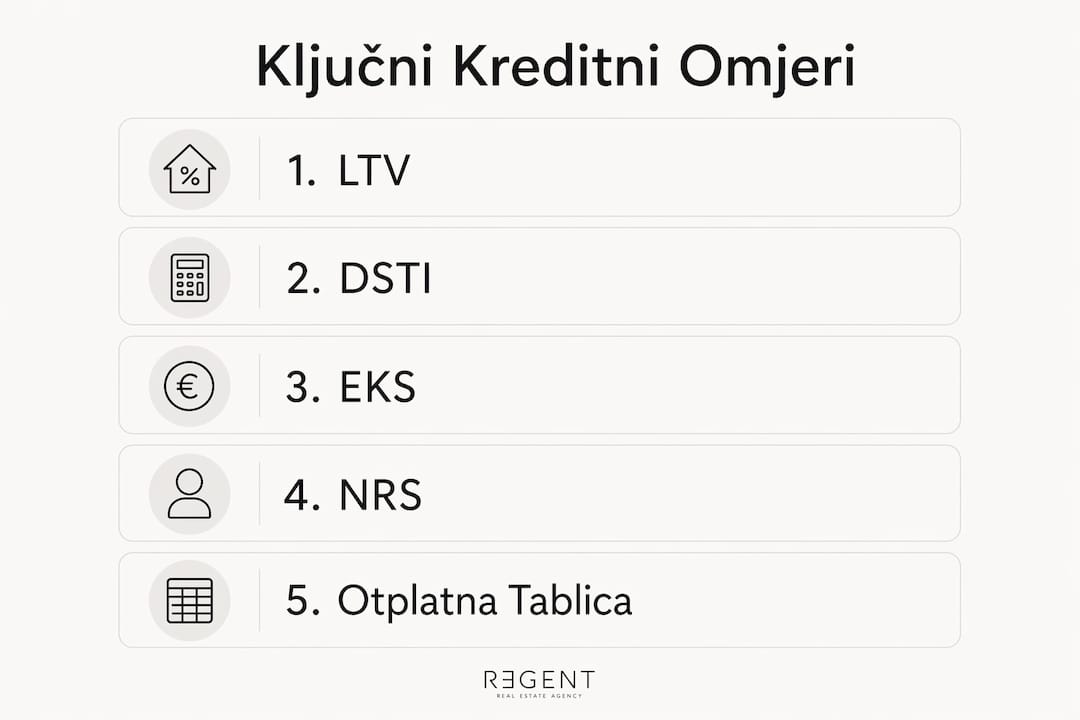
Suppose you are buying an apartment worth 200,000 EUR. If you contribute your own down payment of 20,000 EUR (10%), you are requesting a loan of 180,000 EUR.
In this case, the LTV is 90%, which is the regulatory maximum that HNB allows for housing loans in Croatia. If you contribute 40,000 EUR as a down payment, the LTV drops to 80%, which opens up the possibility of more favorable interest conditions as the bank takes on less risk.
There is one trap that buyers often overlook. Property appraisal by the bank does not necessarily match the purchase price. If the bank appraises the same apartment at 185,000 EUR instead of 200,000 EUR, the maximum loan at an LTV of 90% is 166,500 EUR, not 180,000 EUR. You must cover the difference of 13,500 EUR from your own funds. This situation, where the appraised value of the property falls below the purchase price, is one of the most common reasons why buyers suddenly need additional capital at the last minute.
Key points to remember about LTV:
- The minimum self-participation is 10% of the property value according to HNB regulations
- LTV is calculated based on the lower of two values: the purchase price or the bank's appraisal
- A lower LTV (e.g., 70% or 80%) regularly results in a more favorable interest rate
- Property appraisal is not a formality, but a bank protection instrument that directly affects the loan amount
Professional advice: Before applying for a loan, request an independent property appraisal from a certified appraiser. If the market price is significantly higher than typical bank appraisals in that neighborhood, plan for a larger down payment to avoid unpleasant surprises.
What is DSTI and how is creditworthiness calculated?
DSTI (debt-service-to-income) is a ratio that shows what share of your total monthly income goes towards servicing all credit obligations. The bank looks not only at the new housing loan installment but at the sum of all your existing obligations: cash loans, credit cards, and overdrafts on your checking account are included in the calculation.
Step-by-step: DSTI calculation
Imagine the following scenario. Your net monthly income is 2,000 EUR. You currently pay a cash loan installment of 200 EUR and have a credit card with a minimum repayment of 50 EUR. Your total existing obligations amount to 250 EUR.The calculation of the maximum allowed installment goes like this:
- Calculate 45% of your net income: 2,000 × 0.45 = 900 EUR (maximum allowed DSTI amount)
- Subtract existing obligations: 900 EUR minus 250 EUR = 650 EUR
- The maximum installment for a new housing loan is 650 EUR
If you request a loan whose installment would be 750 EUR, the application will not be approved because the total DSTI would exceed the prescribed 45% threshold.
This limit is not a discretionary decision by the bank, but a regulatory requirement of the HNB that applies to all credit institutions in Croatia. The practical implication is clear: any debt you carry at the time of application reduces the amount of housing loan you can get. Closing overdrafts and credit cards before applying for a loan significantly improves the DSTI indicator and creates room for a larger installment, and thus a larger loan amount.
Professional advice: Use the DSTI calculator offered by banks such as Erste Bank, Zagrebačka Banka, or Privredna Banka Zagreb on their websites. Enter all existing obligations, including those you consider "small," because every euro of obligation reduces your creditworthiness.
What is EKS and how does it differ from NRS?
EKS (effective interest rate) is a standardized indicator that shows the actual total cost of a loan, including interest, fees, appraisal costs, and insurance. NRS (nominal interest rate) shows only the interest portion of the cost, without accompanying fees. The difference between these two numbers can be small or significant, depending on the cost structure of a particular credit product.
Comparison of NRS and EKS using a housing loan example
NRS (nominal interest rate) — 3.50%
- Includes only interest cost
- Does not include processing fee
- Does not include property appraisal cost
- Does not include insurance cost
EKS (effective interest rate) — 4.10%
- Includes interest cost
- Includes processing fee
- Includes property appraisal cost
- Includes insurance cost
This difference of 0.60 percentage points on a loan of 180,000 EUR with a repayment period of 25 years can represent several thousand euros in total cost over the entire life of the loan. That is precisely why comparing offers by EKS is the only reliable way to assess the true price of a loan.
Costs included in EKS but not appearing in NRS include:
- A one-time loan processing fee (usually 0.5% to 1% of the loan amount, i.e., the amount varies depending on the bank and product)
- Cost of property appraisal by a bank appraiser
- Life insurance premium or property insurance if it is a loan condition
- Administrative fees for maintaining the credit account
When comparing offers from two banks, always ask for the EKS for the same loan amount, the same term, and the same type of interest rate. A bank with a lower NRS is not necessarily a cheaper option if it has higher accompanying fees.
What is an amortization schedule and how to choose the type of interest?
An amortization schedule is a document that shows the structure of each installment throughout the entire repayment period: how much of each installment goes towards principal repayment and how much to interest. At the beginning of repayment, a larger portion of the installment consists of interest, and a smaller portion is principal. As the loan progresses, the ratio changes in favor of the principal.For example, on a loan of 180,000 EUR with a term of 25 years and an interest rate of 3.5%, the first few installments might look like this: out of a total installment of about 900 EUR, the first 525 EUR goes to interest, and only 375 EUR to principal repayment. After 10 years, the ratio changes: the interest component decreases, and the principal component increases. This dynamic explains why early repayment of a loan in the first years results in greater interest savings than the same payment in later years.
Fixed interest rate: security and predictability
A fixed interest rate remains unchanged throughout the agreed period, regardless of market index movements such as EURIBOR. This type of rate provides payment stability and predictability, which is particularly valuable during periods of market uncertainty. If you agree on a fixed rate of 3.5% for 10 years, the installment remains the same regardless of whether EURIBOR rises to 4% or falls to 1%.The disadvantage of a fixed rate is that banks charge a security premium for it. The initial fixed rate is usually 0.3 to 0.8 percentage points higher than the initial variable rate. If market interest rates fall, the user of a fixed-rate loan does not profit from that drop.
Variable interest rate: risk and adaptability
A variable interest rate changes according to an agreed index, most often 6-month or 12-month EURIBOR, increased by a fixed bank margin. If EURIBOR is 2.5% and the bank margin is 1.2%, your rate is 3.7%. If EURIBOR rises to 3.5%, the rate rises to 4.7%, and the installment increases.
A variable rate favors users who:
- Plan early repayment of the loan within 5 to 7 years
- Have a financial cushion that can absorb an increase in installments of 100 to 200 EUR
- Apply during a period of high interest rates when their decline is expected
A fixed rate favors users who:
- Plan to keep the loan long-term (15 to 30 years)
- Have limited financial space and cannot bear an increase in installments
- Prefer the security of planning a household budget
Professional advice: Consider a hybrid model that some banks offer: a fixed rate for the first 5 or 10 years, then switching to a variable rate. This model combines short-term security with long-term flexibility and often comes with more favorable terms than purely fixed loans.
Key Insights
Understanding the LTV, DSTI, and EKS ratios is the foundation of every financially responsible decision regarding a housing loan in Croatia, as these indicators together determine the amount, cost, and sustainability of your borrowing.
LTV ratio — The maximum is 90%; calculated based on the lower of the appraisal or purchase price.
DSTI limit — All credit obligations together must not exceed 45% of net income.
EKS vs. NRS — EKS includes all loan costs and is the only reliable basis for comparing offers.
Amortization schedule — Shows the ratio of interest and principal per installment; early repayment is more profitable at the beginning.
Type of interest rate — A fixed rate offers security, a variable rate offers flexibility; the choice depends on the financial profile.
Regent: what we've learned from hundreds of credit processes
Through working with real estate buyers in Croatia, Regent has noticed a recurring pattern: buyers come with a pre-approved loan amount and consider the job done. The reality is different. Pre-approval is an estimate based on declared income and rough parameters, and the final loan amount depends on the bank's appraisal of the specific property.The most common situation that surprises buyers is precisely the difference between the purchase price and the bank's appraisal. The bank appraises the property conservatively, according to comparable transactions in the same neighborhood, and not according to the seller's asking price. In a market like Split or Dubrovnik, where prices have risen faster than bank appraisals, this difference can amount to 10 to 15% of the property's value. A buyer who has not planned for this scenario suddenly needs 20,000 to 30,000 EUR more of their own capital.Another pattern we see is the neglect of DSTI. Buyers who have active credit cards with high limits, even if they don't use them regularly, can have a problem because some banks include potential card obligations in the DSTI calculation, not just actual ones. Closing unused cards and overdrafts before applying for a loan is not just financial discipline; it is a concrete tactic that can increase the approved loan amount.Regent's recommendation is to start preparing for a loan at least 6 to 12 months before the planned application. During this period, it is worth closing all non-essential credit lines, reducing the balance of cash loans, and collecting income documentation. Banks supervised by the HNB have some discretion in assessing a client's profile within regulatory limits, so a neat financial profile can lead to a better interest rate.
— Regent
Find a property with Regent's expert support
Regent offers complete support to real estate buyers in Croatia, from the first search to signing the contract. Our team knows the credit conditions of leading Croatian banks and can help you assess which property fits your LTV and DSTI profile before you invest time in negotiations. Browse current properties for sale in our offer, which includes apartments, houses, and new constructions in all major Croatian cities. With Regent, you don't just buy a property; you gain an expert partner who understands the financial side of the transaction.
FAQ
What is LTV and what is the maximum in Croatia?
LTV (loan-to-value) is the ratio of the loan amount to the property value. According to HNB regulations, the maximum allowed LTV for housing loans in Croatia is 90%, which means a minimum of 10% own participation.
How is DSTI calculated and what is included in the calculation?
DSTI is calculated as the share of total monthly credit obligations in net income. All obligations are included in the calculation: housing loan, cash loans, credit cards, and overdrafts on the account, and the regulatory maximum is 45%.
Why is EKS more important than the nominal interest rate when comparing loans?
EKS includes all loan costs (interest, fees, appraisal, insurance), while NRS shows only the interest cost. Comparing offers exclusively by NRS can lead to choosing a more expensive loan with a lower nominal rate but higher accompanying fees.
What is an amortization schedule and what is it for?
An amortization schedule shows the structure of each installment throughout the entire repayment period, separating it into interest and principal components. It is useful for planning early repayment because it shows when the interest component in the installment is highest.
What is the difference between a fixed and a variable interest rate?
A fixed interest rate remains unchanged throughout the agreed period and provides planning security, while a variable rate changes according to a market index (most often EURIBOR) and can be lower or higher than the fixed rate depending on market conditions.
Recommended
- New lending measures in Croatia: How will they affect the realization of housing loans?
- Housing loan for foreigners in Croatia: Conditions, process, documentation, and tips 2026.
- Buying a home with a loan: a guide to costs, interest, and taxes
- Etažiranje (Subdivision into parts): What it is, why it's important, and how it's done?