
TL;DR: Co-ownership of real estate in Croatia involves shares expressed as ideal parts, which do not define physical space but rather shares in the right of ownership. Rules of management, decision-making, and exiting co-ownership require knowledge of laws and written agreements to protect the interests of co-owners. In case of disagreements or conflicts, there are several legal options including physical division, buyout of shares, establishment of condominium ownership, or a court procedure for dissolution.
Co-ownership of real estate in Croatia is far more complex than most buyers assume. Many enter into joint ownership thinking it's simply a matter of sharing costs, but reality brings specific legal rules, obligations, and potential conflicts. In Zagreb, Split, and Dubrovnik, co-ownership is particularly common in old apartments acquired through inheritance, where multiple heirs automatically become co-owners of the same property. Understanding the rights of co-owners, decision-making methods, and procedures for exiting co-ownership is not just useful — it's essential for protecting your investment. This guide takes you through all key aspects, from the definition of an ideal part to court division, with concrete examples from practice.
Contents
- What is co-ownership of real estate and how does it differ from exclusive ownership
- Rights and obligations of real estate co-owners in practice
- How decisions are made in co-ownership: from everyday to major interventions
- Procedure for exiting co-ownership: voluntary and judicial division
- What happens when co-owners cannot reach an agreement
- Why legal understanding and a written agreement are key to successful co-ownership
- How Regent real estate agency can help
- Frequently Asked Questions (FAQ)
Key Insights
Co-ownership means a share in the property — Co-owners possess ideal parts that represent shares in the right of ownership, not precise physical parts of the property.
Rights and obligations are proportional to the share — Each co-owner has the right to use the entire property but must participate in maintenance costs and taxes proportionally to their ideal part.
Major decisions require the consent of all or a qualified majority — The sale of the entire property or the establishment of a mortgage requires the consent of all co-owners; for reconstruction and major interventions, a qualified majority is sufficient.
Dissolution can be amicable or judicial — If co-owners do not agree, they can initiate a dissolution procedure which may include physical division, buyout of shares, establishment of condominium ownership, or sale of the property.
Legal protection of co-owners' rights is complex — There are various legal measures and procedures to protect the rights of co-owners in case of conflicts or rule violations.
What is co-ownership of real estate and how does it differ from exclusive ownership
To properly understand co-ownership, we must first clarify what an ideal part means and how it differs from single-person ownership.
When one person owns a property, they have full and exclusive ownership rights over every square meter. Co-ownership functions differently. According to the Property and Other Real Rights Act (Official Gazette 91/96 and amendments), when multiple persons have ownership rights over the same thing so that a part of that right belongs to each, these parts are called ideal parts. These are mathematical shares, expressed as fractions or percentages, and not as physically delimited spaces.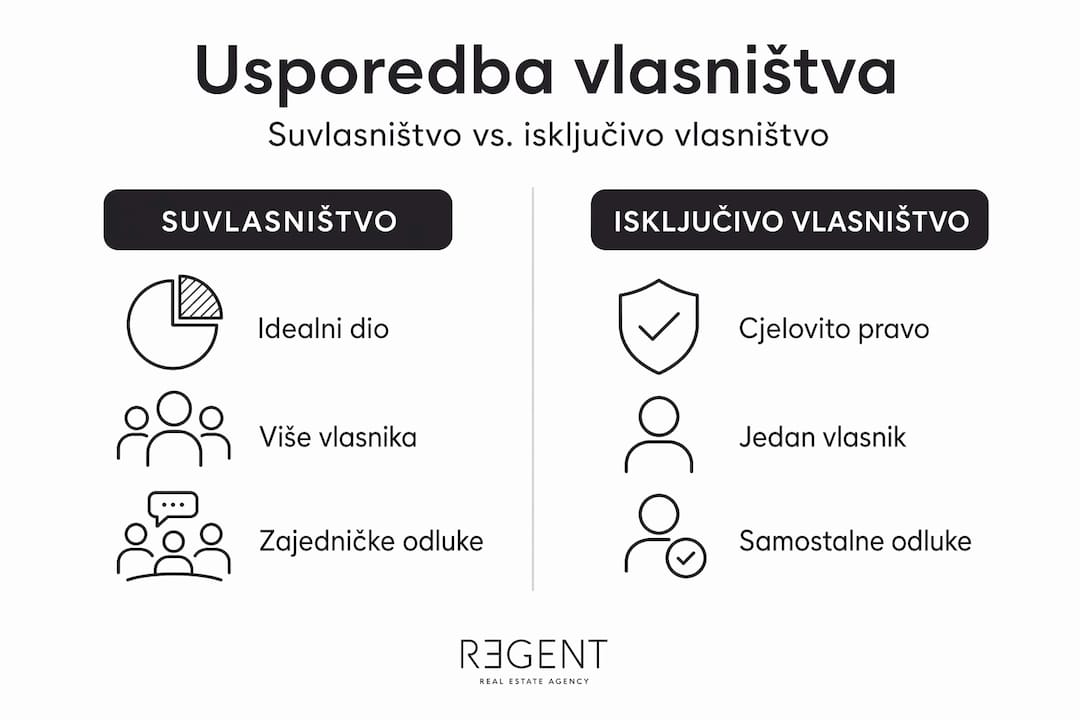 Key difference between physical and ideal parts:
- A physical part implies that the property is actually divided and that each person uses a precisely defined space
- An ideal part means that each co-owner has a share in the entire property, without precisely defined boundaries in space
- An ideal part of 1/2 does not mean you own the "left half of the house," but rather that you have 50% ownership rights over the entire property.
It is also important to understand the difference compared to condominium ownership. Condominium ownership arises from co-ownership — the condominium owner has exclusive rights to their apartment, but at the same time remains a co-owner of the common parts of the building (corridors, elevator, roof) proportional to their ideal part. Co-ownership without condominium registration means that none of the co-owners has exclusive rights to any part of the property.
Understanding the concept of an ideal part is particularly important when buying, as it affects all future decisions about the property. A co-owner can freely dispose of their ideal part — sell it or encumber it with a mortgage — but must know that a mortgage on an ideal part can create complications in the eventual sale of the entire property. Other co-owners do not have an automatic legal right of first refusal — it only exists if specifically agreed upon or if a special law prescribes it.
Read more about this in the guide on title deeds and land registers and on the seal on the title deed — because entries and encumbrances on the property are visible from the land registers and are crucial for a safe purchase.
Rights and obligations of real estate co-owners in practice
Now that we have explained what co-ownership and an ideal part are, let's look at what rights and obligations arise from this relationship.
Each co-owner may exercise the powers they have as the holder of an ideal part concerning the entire property without the consent of other co-owners, but must not violate the rights of other co-owners in doing so. In practice, this means you have the right to use the entire property, but not in a way that excludes or interferes with others.
Co-owners' rights include:
- The right to use the entire property proportional to their share
- The right to dispose of their own ideal part (sale, donation, mortgage)
- The right to a share in the income from the property (e.g., rent)
- The right to request the dissolution of co-ownership — with the note that this right can be contractually limited to a period of up to 5 years, and exceptionally longer with a valid reason
Co-owners' obligations include:
- Payment of maintenance costs proportional to the ideal part
- Participation in paying property taxes and other public levies
- Respecting the rights of other co-owners when using the property
- Obtaining consent for major interventions or changes to the property
Maintenance costs and tax burdens are divided proportionally to the co-owners' ideal parts. If you own 1/3 of the property, you bear 1/3 of the costs, regardless of how much physical space you actually use.
Note: Before entering into co-ownership, always conclude a written co-ownership agreement that clearly defines who uses which part of the property, how costs are divided, and what happens if one co-owner wishes to exit. Without such an agreement, relationships between co-owners can quickly become a source of prolonged disputes.
How decisions are made in co-ownership: from everyday to major interventions
Understanding rights and obligations provides us with a basis for insight into management and decision-making within co-ownership.
Managing shared properties requires agreement, but the level of agreement needed depends on the type of decision. The law makes a clear distinction between regular management and tasks that exceed that scope. For residential buildings, the new Law on Building Management and Maintenance (Official Gazette 152/2024), effective from January 1, 2025, is particularly important, as it introduces the obligation to conclude an inter-owner agreement. Read more about this in the guide on what an inter-owner agreement must contain.
Decisions made by the majority of co-owners (by share size):
- Regular maintenance (painting, minor repairs)
- Renting out the property for a period of up to one year
- Establishing house rules
- Hiring a manager for the shared property
Decisions requiring the consent of all co-owners:
- Sale of the entire property
- Renting out the property for a period longer than one year
- Establishing a mortgage on the entire property
- Change of property use
Decisions for which a qualified majority is sufficient:
- Reconstruction or upgrade
- Major interventions exceeding regular maintenance
This means that a single co-owner with a share of just 1% can block the sale of the entire property. This provision often surprises people who enter into co-ownership with the assumption that "the majority always decides."
Decision-making process in practice:
- The co-owner initiating a decision is recommended to notify others in writing
- Other co-owners should respond within a reasonable timeframe — the law does not prescribe a fixed period, and practice suggests 15 to 30 days depending on urgency
- If there is no consent, the initiator can seek court intervention
- In certain cases, the court may decide on behalf of the co-owners when the required consent is unjustifiably withheld — but not for the alienation of the entire property
- For more terms and definitions related to real estate management, it is useful to review the guide to real estate terms.
Procedure for exiting co-ownership: voluntary and judicial division
Sometimes conflicts in co-ownership cannot be resolved by agreement, so it is important to understand the legal mechanisms for exiting co-ownership.
Co-ownership can be dissolved amicably or judicially. If an agreement is not possible, each co-owner has the right to initiate a court procedure for dissolution — no one can be permanently forced to remain in co-ownership. We note that the right to dissolution can be contractually limited for a certain period, but not permanently.
Ways to terminate co-ownership:
- Amicable division — co-owners agree on physical division or payment; with proper documentation, it can be resolved in a few weeks to 3 months
- Buyout of shares — one co-owner buys out the share of another at an agreed price
- Sale and division of proceeds — the property is sold, and the proceeds are divided proportionally to the shares
- Establishment of condominium ownership — a common and practical exit for co-owners of residential buildings; each co-owner obtains exclusive rights to their part of the property
- Judicial division — the court decides on the method of dissolution when an agreement is not possible
When division is sought judicially, the procedure and outcome depend on the possibility of physical division. If physical division is possible (e.g., a house with separate entrances), the court will order it. If it is not (e.g., an apartment that cannot be physically divided), the court may order a sale and division of proceeds — a so-called civil division — but only if it is proven that physical division is not possible or practical. The parties must prove this; the court does not automatically order it.
Phases of the judicial dissolution procedure:
- Filing a lawsuit for the dissolution of co-ownership
- Valuation of the property (court expert)
- Determining the possibility of physical division
- Issuance of a judgment on the method of dissolution
- Enforcement of the judgment — registration in land registers or public auction
Illustrative example: Imagine a property worth 300,000 euros in which you have an ideal part of 1/3. Another co-owner with a 2/3 share wishes to retain the property. In the case of an amicable buyout, they pay you 100,000 euros (1/3 of 300,000). In the case of a judicial sale, the property is sold at a public auction, and you receive 1/3 of the realized price, reduced by the costs of the procedure.
Comparison of dissolution methods:
Amicable division — Duration: several weeks to 3 months / Costs: low (notary) / Advantage: fast, without court
Buyout of shares — Duration: 1 to 2 months / Costs: low / Advantage: simple, flexible
Establishment of condominium ownership — Duration: 2 to 6 months / Costs: medium (condominium registration, entry) / Advantage: each receives exclusive rights to their part
Judicial physical division — Duration: 12 to 24 months (complex cases and longer) / Costs: medium (expert appraisal) / Advantage: each co-owner receives a physical part
Civil division (sale) — Duration: 12 to 24 months (complex cases and longer) / Costs: high (lawyer, court, auction) / Advantage: the only option when physical division is neither possible nor practical
Judicial procedures related to probate and inheritance often result in co-ownership by multiple heirs, which is one of the most common sources of subsequent disputes. Read more about property transfer in the guide on how to transfer property ownership.
Note: If possible, try to resolve the dissolution amicably. Judicial division not only takes a long time but also reduces the final value that all co-owners receive — due to procedural costs, expert appraisals, and potential sales discounts at a public auction.
What happens when co-owners cannot reach an agreement
When agreement is not possible and conflict escalates, it is necessary to know the legal options and procedures for protecting co-owners' rights. The right of co-ownership is protected through several types of lawsuits, depending on the nature of the infringement.
Types of lawsuits for the protection of co-owners' rights:
- Reivindicatory lawsuit (action for recovery of property) — used when a third party unlawfully possesses the property; it applies limitedly between co-owners, as a co-owner using the entire property does not possess it unlawfully in the classic sense — a negatory lawsuit is more appropriate
- Publician lawsuit — similar to reivindicatory, but for cases where the plaintiff cannot prove full ownership, but rather a legal title and prolonged conscientious possession; it differs from possession protection precisely by the requirement for *iusta causa* (just cause)
- Negatory lawsuit (action for disturbance) — when someone obstructs your right to use the property without physically taking it; most appropriate between co-owners when one excludes others or changes locks without consent
- Deletion lawsuit — when a right that is not legally valid has been registered in the land registers; the plaintiff must prove that they were registered in the land registry, that the registration in favor of the defendant is invalid, and that the defendant was not in good faith; the deadline for filing is 3 years from the disputed entry, with exceptions
A typical example of conflict arises when one co-owner starts using the entire property and excludes others, changes locks, or rents out the space without consent. In such cases, other co-owners can initiate a negatory lawsuit.
Preparation for judicial proceedings includes:
- Obtaining an excerpt from the land registers as proof of ownership
- Documenting the infringement of rights (photos, witnesses, written correspondence)
- Hiring a lawyer specialized in real rights — Regent provides legal services related to real estate
- Attempting an amicable settlement before filing a lawsuit (mediation)
Knowledge of the right of first refusal is also useful, as infringements of this right are resolved by similar judicial mechanisms.
Why legal understanding and a written agreement are key to successful co-ownership
In practice, the biggest source of problems in co-ownership is not the law, but assumptions. Co-owners enter into a joint relationship with the belief that "we'll agree when it comes to it," and then face a blockage in selling, disagreement over costs, or a dispute over who has the right to use which space.
The legal logic of dissolution clearly shows that retaining someone in co-ownership without consent is not permanently sustainable. Every co-owner can seek to exit at any time — unless they have contractually limited this right temporarily. This means that a co-ownership relationship, without written regulation, always carries the risk of a sudden request for dissolution at the most inconvenient moment.
A written co-ownership agreement is not a luxury, but fundamental protection. It is important to note that notary certification of a co-ownership agreement is not legally mandatory — a written form is sufficient — but notarized documentation has greater legal force in potential disputes. Such an agreement should contain provisions on the use of individual parts of the property, allocation of costs, decision-making methods, and the procedure if one co-owner wishes to sell. For residential buildings, in addition to the co-ownership agreement, there is also the mandatory inter-owner agreement according to the Law on Building Management and Maintenance (Official Gazette 152/2024) — more in the guide on what an inter-owner agreement must contain.
Practice shows that the most difficult cases are those where co-owners function for years without a written agreement, and then circumstances change — divorce, death, financial difficulties. Then, relationships that seemed stable disintegrate quickly and expensively. Investing in the legal regulation of co-ownership at the beginning is many times cheaper than resolving a dispute at the end.
We recommend familiarizing yourself with legal terms in co-ownership and the real estate purchase process before signing any agreement — a detailed overview can be found in the guide to real estate terms and in the guide on how the real estate purchase process in Croatia works. For an insight into the current legislative framework, also check the overview of the new legal framework for real estate in Croatia.
Frequently Asked Questions (FAQ)
What does it mean to have an ideal part of a property?
Having an ideal part means you are a co-owner of the property with a certain mathematical share, expressed as a fraction or percentage, but without a precisely defined physical space. Your right of ownership refers to a share in the entire property, not to a specific part of the building or plot. Read more about this term in the guide on what an ideal part of a property is.
Can I sell my co-ownership share without the consent of other co-owners?
Yes, you can sell your ideal part independently without the consent of other co-owners. Other co-owners do not have an automatic legal right of first refusal — according to Article 37 of the Property and Other Real Rights Act, the right of first refusal exists only if specifically agreed upon between co-owners or if it arises from a special law. Read more about this in the guide on the right of first refusal for real estate.
What if co-owners cannot agree on property management?
In case of disagreement, a judicial procedure for the dissolution of co-ownership can be initiated, which may include physical division, buyout of shares, establishment of condominium ownership, or sale of the property with division of proceeds. Each co-owner has the right to initiate such a procedure regardless of the will of other co-owners.
How long does judicial division of co-ownership take?
Judicial division takes on average between 12 and 24 months, depending on the complexity of the case, the number of co-owners, and the need for property valuation. In more complex cases with multiple co-owners or property disputes, the procedure can take longer than two years.
Is an inter-owner agreement mandatory?
Yes — from January 1, 2025, the Law on Building Management and Maintenance (Official Gazette 152/2024) introduced the obligation to conclude an inter-owner agreement for all residential buildings. Co-owners who have not concluded an inter-owner agreement should do so. Read more about the content and obligations in the guide on what an inter-owner agreement must contain.
Recommended
- Guide to Real Estate Terms: everything you need to know
- Probate and Property Inheritance: steps, costs, and deadlines
- Property Registration in Croatia: what it is, how it works, and what you need to know?
- Right of First Refusal for Real Estate: who has it, when it arises, and how it affects buying and selling?