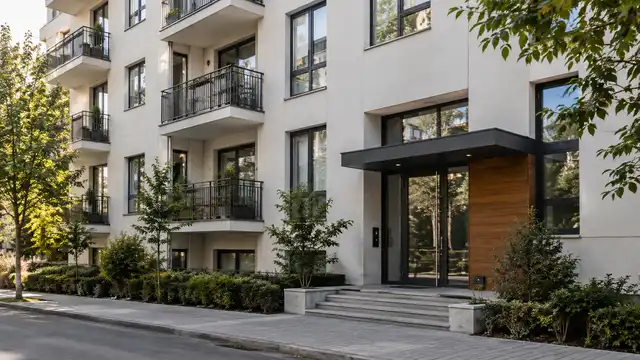
Apartment renovation is one of the most common real estate interventions — whether you want to modernize the space, increase functionality, or raise market value.
However, before you start working, it is crucial to understand what you can do without a permit, when you need a project, and in which cases you enter a more serious administrative procedure.
To make it easier for you to navigate, we bring you a practical guide through three levels of interventions: work without a permit, work that requires a project, and interventions for which a building permit is necessary.
No Permit Zone: What You Can Do Immediately
The good news is that a large part of renovations does not require a building permit. According to current regulations, certain works are classified as simple interventions.
However, it is important to emphasize — the fact that a permit is not required does not mean that there are no obligations.
In some cases, owner or building manager consent may be required, especially when it comes to common parts.
This category most often includes:
- painting walls and ceilings and decorative work
- replacement of floor coverings (parquet, laminate, tiles) without structural intervention
- replacement of interior doors
- replacement of sanitary ware (toilet, sink, shower, bathtub) without changing the installation system
- minor repairs of electrical and plumbing installations
- replacement of radiators of the same type and power
Special attention should be paid to:
Replacement of windows and exterior carpentry — although it is allowed if the dimensions of the openings are not changed, in multi-apartment buildings, the appearance of the facade must be respected, and consent from the manager or co-owners is often required.
Key Rule: You can change elements, but you must not interfere with the structure or change the system.
Work Without a Permit, But With a Mandatory Project
There is a common misconception that work that does not require a building permit does not require any expert documentation. In practice, this is not true.
Certain interventions require the creation of a main project prepared by an authorized architect or engineer.
This category includes:
- Demolition of non-load-bearing walls
- Removal of partition walls to create an open-space area generally does not require a building permit.
- However, it is very important to determine beforehand whether it is indeed a non-load-bearing wall — which often requires expert assessment or a project.
- Complete replacement of installations
If:
- you are changing the layout of electrical installations
- you are moving water or sewage connections
- you are creating a new kitchen or bathroom in a different location
— then we are no longer talking about "minor repairs," but about an intervention that requires project documentation.
Structural Interventions (With Project)
Creating openings in load-bearing walls or any intervention that could affect the building's static integrity requires the engagement of an authorized expert.
In practice:
- a main project is required
- co-owner consent is often required
- in certain cases, a building permit may also be required
This is an area where mistakes are most often made — and where the consequences are most expensive.
Work Requiring a Building Permit
For certain interventions, there is no room for interpretation — a building permit is mandatory.
This includes:
Interventions on the load-bearing structure (demolition of load-bearing walls)
- interventions on columns, beams, or floor structures
- Change of space use (conversion of commercial space into an apartment or conversion of an apartment into commercial space) ; Such changes require compliance with the spatial plan and new documentation.
- Subdivision and division of an apartment
The division of one property into several separate units includes:
- project
- co-owner consent
- registration in the land registry
Increasing the surface area
- enclosing a loggia
- adding a balcony
- expanding living space
Any increase in gross area requires a building permit.
What If Work Has Already Been Done Without a Permit?
This is a common situation — especially with older renovations
It is important to know that classic legalization as it once existed in Croatia is no longer open to new applications.
Today, irregularities are resolved through:
- creating a survey of the existing condition
- preparing project documentation
- attempting to comply with current regulations
In some cases:
- it is possible to obtain the necessary permits retrospectively
- in others — the intervention cannot be legalized
This directly affects:
- real estate sales
- valuation
- possibility of obtaining a loan
How to Avoid Problems: Practical Advice
To ensure the renovation goes smoothly, it is important to think ahead:
- Consult an expert before starting work — even when you think it's not necessary
- Inform the manager and neighbors — especially in apartment buildings
- Check if co-owner consent is needed
- Choose contractors who understand the legal framework
- Document installations before closing walls
The biggest mistake owners make is not the renovation itself — but the assumption that everything is allowed as long as it is done "inside the apartment."
A good renovation starts with good information
Apartment renovation can significantly increase the quality of life and property value — but only if it is carried out in accordance with the law.
The line between what is permitted and what is problematic is often thin, and wrong decisions can result in additional costs, legal problems, or difficulties in selling.
If you are planning a renovation or are unsure about the condition of your property, a timely expert assessment can save you time, money, and stress.