TL;DR: Buying real estate or land in Croatia requires understanding basic terms from spatial plans. GUP determines what and where can be built, coefficients limit the size of a building, GBP is a measure of area important for certain administrative calculations, construction planning and individual fees related to real estate, and the right to build means you are buying a building — but not necessarily the land beneath it.
All this information is checked through the ISPU portal (ispu.mgipu.hr) and the location information issued by the city or municipality. From January 1, 2026, the new Spatial Planning Act (NN 155/25) will be in force, introducing the ePlanovi digital system and stricter restrictions on the expansion of construction areas under certain circumstances, which may affect the development potential and market perception of individual undeveloped plots.
Introduction
Buying real estate in Croatia means encountering a series of professional terms from spatial plans and urbanism. Terms like GUP, building coefficient, GBP, or right to build do not only appear in technical documentation — they directly determine what can be built on the plot you are considering, what the actual value of the property is, and what your rights as a buyer are. This glossary explains each of the key terms clearly and concisely, exactly as needed before signing a contract.
Note: From January 1, 2025, amendments to the Building Act (NN 145/24) are in force, and from January 1, 2026, the new Building Act (NN 155/25) and the new Spatial Planning Act (NN 155/25) will also be in force. Permit issuance procedures are increasingly digitalized, and new regulations foresee shorter decision-making deadlines for orderly cases. The actual duration of the procedure still depends on the completeness of the documentation, the complexity of the intervention, and the involvement of competent authorities.
Contents
- GUP (General Urban Plan)
- UPU and DPU: planning levels below GUP
- Building coefficient (kig) and utilization coefficient (kis)
- GBP (Gross Building Area)
- Right to build
- Superficial property
- How to check the spatial plan
- Frequently Asked Questions (FAQ)
GUP (General Urban Plan): the fundamental document for every purchase
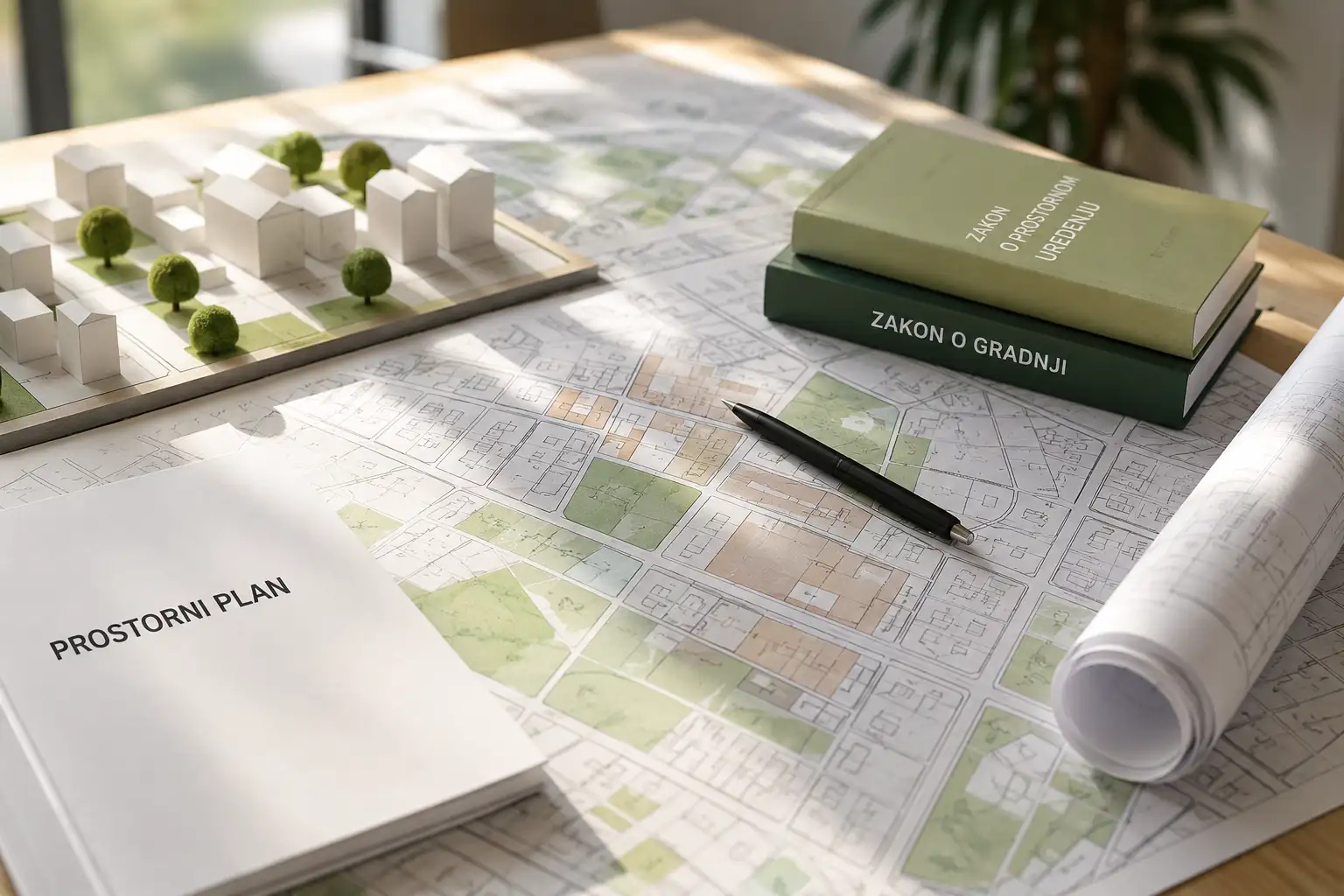
The General Urban Plan (GUP) — a document that defines the "rules of the game" for construction throughout the city — is the most important spatial document for urban areas. It determines the basic land use (residential, commercial, mixed, park, etc.), construction conditions, traffic and utility infrastructure, and protection zones.
The GUP is adopted by the city council, and for municipalities, an analogous document (municipal spatial development plan) is adopted by the municipal council. Every amendment goes through a legally prescribed procedure that includes public inspection and public debate — a legal right of every citizen to submit written objections.
How to use GUP when buying:
- On the ISPU portal (ispu.mgipu.hr), find the cadastral parcel (unique identifier of each plot, like an OIB for real estate) and check the zone's purpose.
- Read the implementation provisions for that zone — they specifically prescribe what can be built, and the map itself is not sufficient.
- Request location information — an official document issued by the LGU (city or municipality) that confirms the construction conditions for a specific plot; a crucial step when buying land.
- Always use the consolidated text and the latest decision on GUP amendments, as older versions may be outdated.
Important for 2026: The new Spatial Planning Act (NN 155/25) introduces stricter conditions for the expansion of construction areas, especially when there are unused or infrastructurally undeveloped areas within existing areas. This may affect the future development potential of certain peripheral and undeveloped plots.
For a broader overview of the spatial plan's impact on the real estate market, see Regent's blog on the new Zagreb GUP.
UPU and DPU: planning levels below GUP
Below the GUP level, there are more detailed documents that elaborate on conditions for smaller spatial units.
UPU (Urban Development Plan) elaborates on the GUP for a specific city district or functional area. It determines road routes, locations of public facilities, and conditions for the development of individual zones — a medium level of planning.
DPU (Detailed Development Plan), if it exists for a specific location, further elaborates on construction conditions down to the level of an individual plot — including building placement, design, and connections. In practice, they are not present for all areas, but existing DPUs may still be valid and play an important role in determining construction conditions.
Both plans are adopted with a mandatory public discussion. From January 1, 2026, all new spatial plans are exclusively created through the ePlanovi digital system (new ZPU, NN 155/25) — older plans remain in force, but are no longer created according to the old procedure.
Practical advice: always check if there is a valid DPU for your location through the ISPU portal — because if there is, it is precisely that which determines the precise construction conditions.
Building coefficient (kig) and utilization coefficient (kis): what they mean for your plot
These two technical terms determine how much can be built on a plot — and are crucial for assessing the value and potential of the land.
Building coefficient (kig) — a number that shows what percentage of the building's footprint can occupy the plot. If kig is 0.30, on a 1,000 m² plot, the building's footprint can be a maximum of 300 m².
Utilization coefficient (kis) — a number that shows what the total gross area of all floors allowed on the plot is in relation to its area. If kis is 1.20, on a 1,000 m² plot, a total of 1,200 m² of gross area can be built.
It is important to note that the utilization coefficient is sometimes not prescribed — in which case construction is determined by the building coefficient and maximum height.
According to the Spatial Plans Ordinance (NN 152/2023), the official designations are kig and kis — the older designation "ki" is no longer in official use but still appears in older spatial plans.
Why these coefficients are important:
- A higher coefficient means more space for construction — which directly affects the value of the plot.
- Remaining construction capacity means potential for extension or addition.
When comparing two plots of similar price, always calculate the total permitted construction capacity.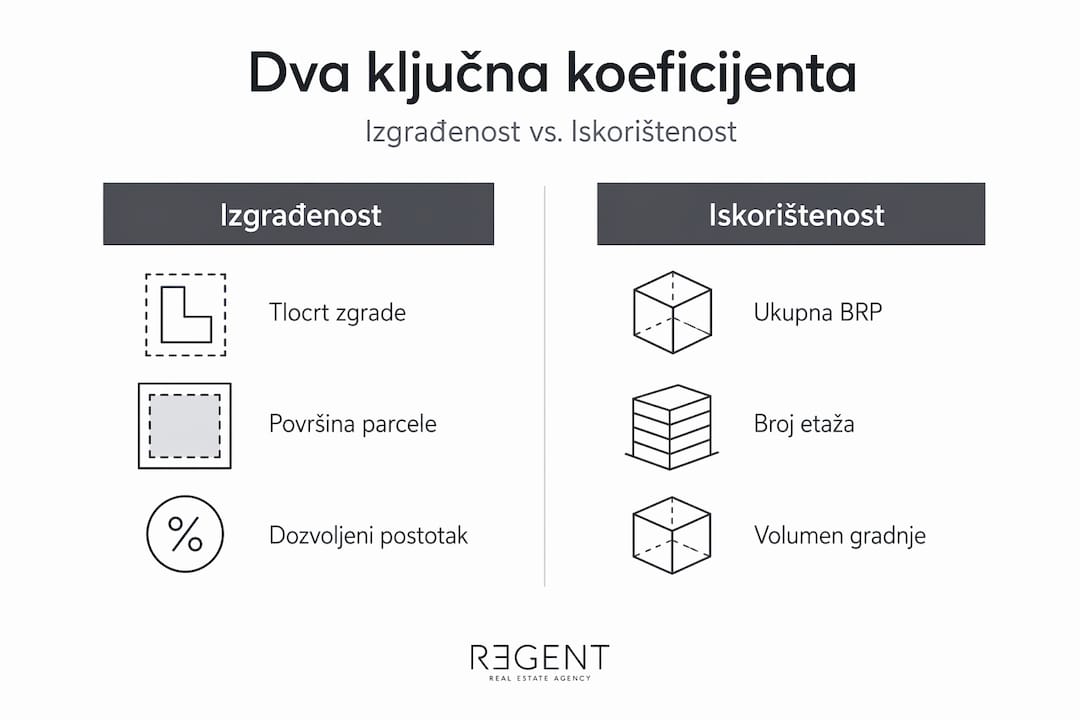
GBP (Gross Building Area): why it's important for buyers
Gross Building Area (GBP) — in older practice known as BRP (gross developed area) — is the sum of the areas of all floors (basement, ground floor, upper floor, attic) of a building, measured along the outer edges of the construction. It is defined by the Ordinance on the method of calculating the gross (building) area of a building (NN 93/17).
GBP is the basis for:
- Utility contribution — a one-time fee during construction calculated according to the volume of the building (m³), with GBP serving as one of the bases for assessment.
- Estimating the market value of real estate.
- Determining the permitted construction capacity according to kis.
- Administrative calculations related to the property.
GBP vs. net living area: GBP includes wall thickness, hallways, staircases, and common areas — net living area is only the space you use daily within the apartment. The difference can be significant, depending on the type of building and the thickness of the structure. When a seller states the area of an apartment, always check if they mean GBP or net living area.
Right to build: you buy the building, but not the land
The right to build is a real right that gives the holder the authority to construct and use a building on someone else's land. This is not the same as land ownership. The holder of the right to build is the owner of the building, but not of the plot on which it stands. The right to build is regulated by articles 280–294 of the Law on Ownership and Other Real Rights.
Key characteristics of the right to build:
- Can be transferred to another person by contract.
- Can be inherited.
- Can be encumbered with a mortgage — a bank can accept the right to build as collateral for a loan, but always check the terms with the bank.
- It is usually established for a specific period, often long-term (e.g., several decades), which is why it is important to check the duration of the right in the land registry.
By purchasing an apartment or business premises located on a plot with a right to build, you do not become a co-owner of the land. Always check the land registry to see if there is a right to build on the plot you are interested in, and when it expires.
Superficial property: when the building is separate from the land
"Superficial property" is an informal term for a building whose ownership is legally separated from the land. In Croatian law, the general principle superficies solo cedit applies — everything on the surface belongs to the land. However, the Property Law (Art. 9, para. 4) provides for exceptions: a building can be legally separated from the land based on a right to build or a concession.
A classic example is a building constructed on city or state land, where a private owner owns the building, but not the land beneath it.
By purchasing such a property, you inherit all obligations and restrictions that come with this separate ownership — including the time limit of the right to build. The legal status should always be thoroughly checked before purchase, as it can affect the possibility of sale, refinancing, or construction. The guide explains how to check the status of ownership and encumbrances on a property: What are a title deed, land registry, and cadastre - and how to read them.
How to check the spatial plan
Spatial plans are not static documents — they change, and every change can affect the value of your property.
Here's how to actively monitor and check plans:
- ISPU portal (ispu.mgipu.hr) — the main publicly available centralized tool for checking spatial plans in Croatia; through a cadastral parcel or address, you get insight into the zone's purpose and valid plans.
- Location information — request it from the LGU (city or municipality) before every purchase of land or undeveloped plot; it is an official confirmation of construction conditions.
- City and municipal websites — announcements about public discussions and plan amendments.
- Spatial planning institutes by county — for more detailed registers of plans at the local level.
Professional advice: Do not only look at the current state of the spatial plan. The investment value of a property often depends on plans that are only in the proposal phase. To check the status of a property in the land registry, see the guide: Real estate registration in Croatia.
Regent Real Estate Agency: expert support for real estate purchases
Understanding terms such as GUP, building coefficients, or the right to build is an essential prerequisite for a safe purchase — but checking documentation in practice requires expert experience. Regent offers comprehensive support to real estate buyers in Croatia, from checking spatial plans and the legal status of properties to advising on negotiations and contract signing.
Regent real estate agency experts monitor current changes in spatial plans, including the new ZPU (NN 155/25) in force from 2026, and timely inform clients about everything that may affect the value or construction conditions.
Also read the guide: Building and occupancy permits: differences and why they are important when buying real estate and Guide to tourist zones in Croatia if you are considering an investment property.
Frequently Asked Questions (FAQ)
What is GUP and why is it important when buying real estate?
GUP (General Urban Plan) is the fundamental spatial document that determines land use and construction conditions for the entire urban area. Without insight into the GUP, you cannot know if the property is in a residential, commercial, mixed, or protected zone — nor what can be built on it.
What is the difference between kig and kis?
The building coefficient (kig) limits the building's footprint in relation to the plot area, while the utilization coefficient (kis) limits the total gross area of all floors. Together they determine the maximum construction capacity on the plot. Note: kis is sometimes not prescribed — in which case construction is determined by kig and maximum height.
What is the difference between GBP and net living area?
GBP (gross building area) includes all floors measured along the outer edges of the walls — hallways, staircases, walls, and common areas. Net living area is only the space you use inside the apartment. The difference can be significant depending on the type of building — always check what the seller states as the area.
What does the right to build mean and can it be sold?
The right to build is a real right that allows the holder to construct and use a building on someone else's land (Art. 280–294 of the Property Law). It can be transferred, inherited, and encumbered with a mortgage, but it does not grant ownership of the land itself. It is established for a specific period — it cannot be permanent.
Can I get a housing loan for a property with a right to build?
Yes — the right to build can be encumbered with a mortgage according to Art. 280–294 of the Law on Ownership and Other Real Rights. However, each bank has its own conditions for accepting the right to build as collateral — always check with the bank before purchasing.
How can I check the spatial plan for a specific plot?
Use the ISPU portal (ispu.mgipu.hr) — the only central tool for checking spatial plans in Croatia. Enter the address or cadastral parcel number and you will get insight into the zone's purpose and valid plans. For complete legal certainty, also request location information from the LGU (city or municipality).
What is location information and why is it important?
Location information is an official document issued by the LGU (city or municipality) that confirms the construction conditions for a specific plot according to the valid spatial plan. It is a crucial step when buying land or an undeveloped plot — without it, checking the plans is not complete.
Recommended
- Services for buyers | Regent real estate
- When to Buy Real Estate: A Guide to Market Analysis
- Real estate valuation: what market, mortgage, and tax value mean for buyers and sellers?
- Capital gains tax on real estate in Croatia: what you need to know