Summary
Managing property remotely when living abroad is feasible, but it requires two things: a reliable person on the ground and properly settled tax and legal obligations. For representation before institutions and signing on your behalf, you generally need a power of attorney, while for daily operations — keys, repairs, guests — you need a trusted person or professional management. As a foreign owner, you need an OIB, and if you rent out, as a non-resident, you pay income tax in Croatia; property that is not a primary residence is generally also subject to annual property tax. In this guide, we explain how to arrange all of this from abroad.
Key facts
- Remote management almost always requires a reliable person or agency on site.
- For representation and signing on your behalf, a power of attorney is generally required, along with notarization and a possible apostille.
- A non-resident who rents out property pays income tax on property in Croatia (12% rate).
- Property that is neither a primary residence nor a long-term rental is subject to annual property tax.
- For foreign owners who are rarely in Croatia, professional management is most often more cost-effective.
Managing property remotely when living abroad is feasible, but it requires two things: a reliable person on the ground and properly settled tax and legal obligations. For representation before institutions and signing on your behalf, you typically need a power of attorney, and for daily operations—keys, repairs, guests—a trusted person or professional management. As a foreign owner, you need an OIB (Personal Identification Number), and if you rent out, as a non-resident, you pay income tax in Croatia; property that is not a primary residence is generally subject to an annual property tax. In this guide, we go through how to arrange all this from abroad.
Owning property in Croatia and living in another country are perfectly compatible, but daily remote property management raises questions that local owners rarely encounter. Who will open the door for a handyman, welcome guests, or pick up mail from the court? How to pay utilities and taxes without going to Croatia? And what is required of you as a non-resident to do everything in accordance with regulations? From working with foreign clients, we see that the problem is almost never the property itself, but the organization around it. With a clear division of responsibilities, the right power of attorney, and properly arranged tax obligations, property can be managed peacefully from abroad. Below, we explain the steps—from representation on the ground to choosing between independent and professional management.
Contents
- What it means to manage property remotely
- Representation on the ground: power of attorney and a reliable person
- Taxes and obligations of a foreign owner
- Practical operations: bills, bank, maintenance, guests
- Independent management or professional agency
- Frequently asked questions
Key Insights
- Remote management almost always requires a reliable person or agency on the ground.
- For representation and signing on your behalf, a power of attorney is generally required, with authentication and a possible apostille.
- A non-resident who rents out property pays income tax on property in Croatia (rate 12%).
- Property that is not a primary residence or long-term rental is subject to annual property tax.
- For foreign owners who are rarely in Croatia, professional management is most often more cost-effective.
What it means to manage property remotely
Remote property management encompasses everything an owner would typically do in person, but now from another country: maintenance and repairs, paying utilities and taxes, communicating with the building manager and neighbors, and for rentals, the entire relationship with tenants or guests. The key difference compared to a domestic owner is not in the type of tasks, but in the fact that you cannot perform them spontaneously—each requires a pre-arranged method of execution. In practice, owners from abroad choose between three models. The first is independent management with a reliable person on the ground (relatives, friend, local collaborator). The second is professional management, where an agency or manager takes over operations for a fee. The third is a combination—you make decisions and handle finances, while entrusting some tasks (e.g., cleaning and guest handover) to specialized services. The choice of model depends on distance, the type of property use, and how much time you can realistically invest.
Professional advice: Before you even choose a model, list all the tasks that might arise around your property during the year and next to each, write down who would perform it if it happened tomorrow. The empty fields in that list are exactly what you need to resolve before leaving Croatia.
Representation on the ground: power of attorney and a reliable person
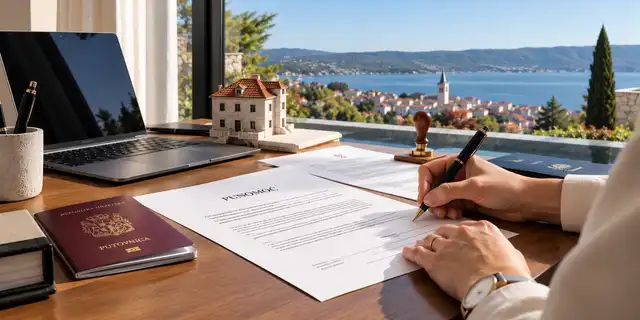
A power of attorney is the foundation of remote management because it authorizes a trusted person to represent you to a precisely defined extent. Without it, many actions—from communicating with institutions to signing certain documents—cannot be validly performed by someone else on your behalf. Define the scope of the power of attorney carefully: it can be narrow (only for transferring utilities or representation before a single institution) or broader, depending on how much trust and control you wish to delegate. A power of attorney issued abroad generally requires authentication, and depending on the country of issue, also legalization for international use (apostille) and a translation by a certified court interpreter into Croatian. Formal requirements vary from country to country, so check them before issuing to ensure the document is not rejected when you need it most. In addition to a proxy, for daily minor issues, it is useful to have a person who can physically access the property quickly—this is not necessarily the same person who legally represents you.