Summary
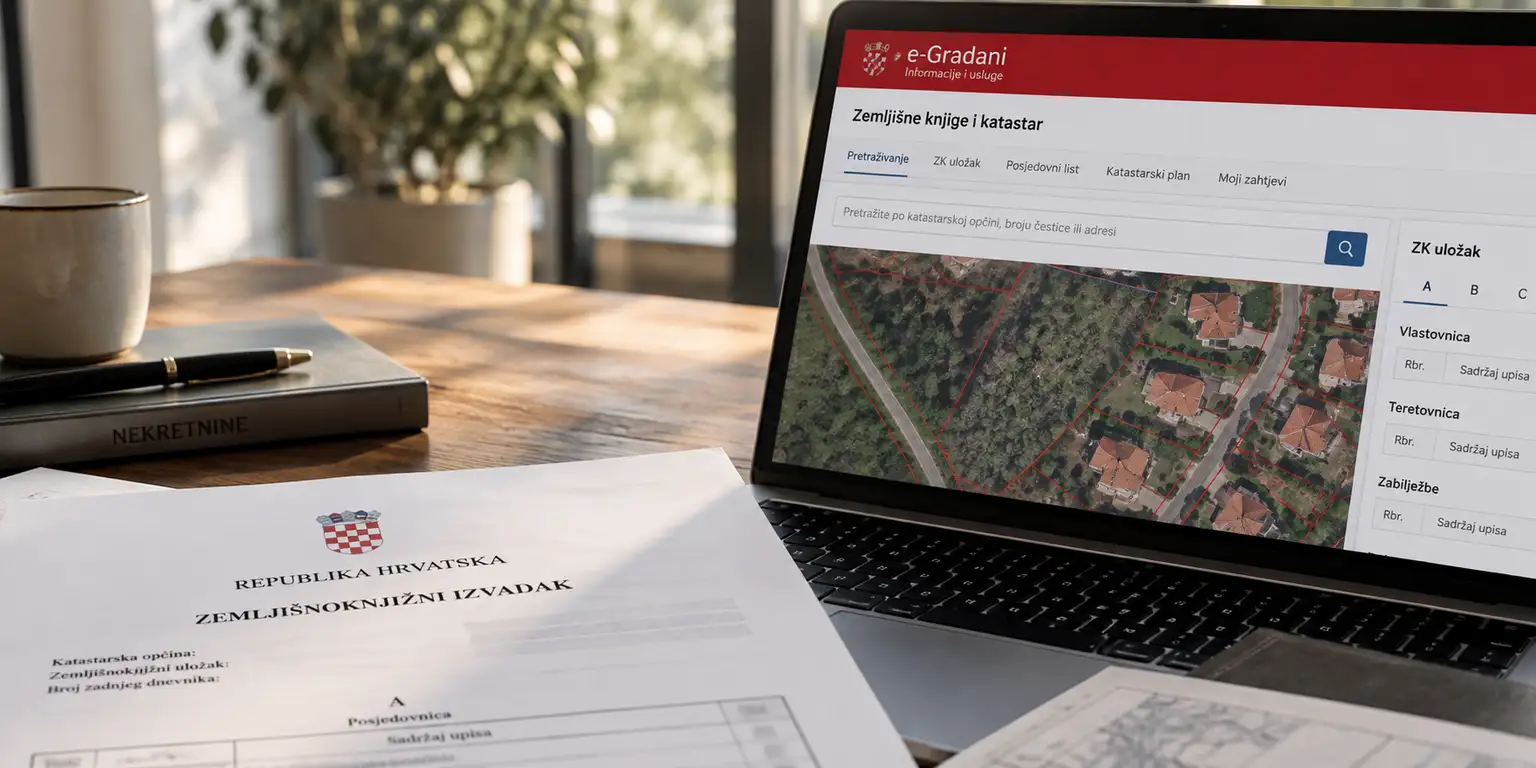
An e-excerpt from the land registry can be requested without going to court: log in to the e-Citizens system, open the land registry and cadastre service (ZIS-OSS), find the property by cadastral municipality and plot number or land registry entry, choose the type of excerpt, and download the digitally signed PDF. The official e-excerpt has the same legal force as an excerpt obtained at a court counter, and the procedure takes only a few minutes. In this guide, we explain what an e-excerpt is, how to request it, and when it is needed.
Key facts
- The e-excerpt is an electronic, digitally signed version of the land registry excerpt. The official e-excerpt has the same legal force as an excerpt obtained at a court counter. It is requested online via e-Citizens (ZIS-OSS "Uređena zemlja"), with a NIAS login. An informative overview is publicly and freely available, but has no evidentiary value. The procedure takes a few minutes when the land register for that plot has been digitized and updated. Foreign buyers without Croatian credentials generally obtain the excerpt through a proxy.
The land registry extract is an official document showing the legal status of a property — who is the owner, whether there are mortgages, easements, annotations of disputes or other encumbrances, and to which cadastral parcel it corresponds. Until recently, one had to go to the land registry department of the court to get it, where waiting was common; today, the same document is usually obtained online, in a few minutes.
Below, we explain how an e-extract differs from a regular informational overview, how to request it step-by-step, when you need it, and how foreign buyers without Croatian credentials obtain it — so you know exactly what you are looking for and get a document that the institution will accept.
What is an e-land registry extract
An e-extract is an electronic version of the land registry extract, issued directly from the land registry and cadastre information system, digitally signed and with legal validity identical to an extract from a court counter. It is issued through the Joint Information System of Land Registers and Cadastre, better known as ZIS-OSS or "Uređena zemlja" (oss.uredjenazemlja.hr), which is accessed via e-Građani. It carries an electronic signature and a time stamp, so banks, public notaries, and other institutions accept it equally with a paper extract, and the system generates it immediately, provided that the register for that parcel is updated and digitized. We write about how to read a title deed and land register in a separate guide.
Professional tip: When someone asks you for an "extract with a stamp," know that a digitally signed e-extract has the same validity — an institution that rejects it because it's not on paper is acting incorrectly.
Informational overview or official e-extract
The system offers two levels of access. The informational overview is publicly available, without registration, and free of charge — it shows who is registered as the owner and if there are any registered encumbrances, but it has no evidentiary power as it is not digitally signed or issued on behalf of the court. The official e-extract carries an electronic signature and a time stamp, so institutions accept it equally with a counter-issued extract; for sales, mortgages, or inheritance, an official, not informational, extract is always required.
For an official extract, registration via e-Građani is required — a Croatian electronic ID card, mToken, or internet banking credentials linked to NIAS. Croatian citizens and companies with an OIB usually submit the request themselves, while for foreign citizens without a Croatian eID or a domestic bank account, NIAS registration is typically not available.
Professional tip: A free public overview will serve for quick orientation, but for a preliminary contract, loan, or inheritance, immediately request an official, digitally signed extract — institutions will not accept an informational overview as proof.
How to request an e-extract online, step by step
The procedure is simple and, with updated data, takes a few minutes:
- System login. Log in to e-Građani and open the ZIS-OSS service (land registers and cadastre).
- Property search. Find it by cadastral municipality and parcel number, or directly by the land registry entry number from a contract, appraisal, or previous extract.
- Selection of extract type. Options include the title deed, possession list, full extract with encumbrance sheet, or historical extract. For purchase or loan, a complete, valid extract with an encumbrance sheet is most often required.
- Fee, if applicable. Downloading an official e-extract via e-Građani is generally free; if a court fee is stipulated, the system displays it before confirmation and charges it online. Check the current amount within the system itself.
- Document download. You download the extract as a PDF with an electronic signature and time stamp, ready to be submitted to a bank, notary, or other institution.
Professional tip: Before the crucial steps of purchase, request a fresh extract — the situation can change (a new seal, encumbrance), so the date of the extract is as important as its content.
When is an e-extract needed
The e-extract is a fundamental document in a series of real estate transactions. It is most often requested:
- Before purchase and sale — verification of ownership, encumbrances, and annotations before signing a preliminary or final contract.
- For financing — banks regularly request an up-to-date extract when approving a mortgage loan.
- For inheritance — for probate proceedings and subsequent registration of heirs.
- For due diligence — a standard step before any significant transaction, including checks performed by an agency.
In all these cases, an official, not informational, extract is required. The verification is part of a broader legal and technical property inspection before purchase, especially when it comes to encumbrances like mortgages.
Professional tip: Pay special attention to the encumbrance sheet — it shows mortgages, easements, and annotations; if you notice an encumbrance, clarify it before proceeding with the transaction.
For foreign buyers and diaspora
Foreign citizens without a Croatian eID or a domestic bank account generally cannot independently access NIAS registration, so the e-extract for them is most often obtained by a lawyer or public notary in Croatia, based on a power of attorney. This is a common and anticipated route, not a workaround: notaries and lawyers are authorized users of the system who issue verified extracts, and this step fits into the broader property verification before purchase. We offer more about the specifics of buying from abroad through support for foreign buyers.
Professional tip: If you are buying from abroad, arrange the power of attorney for obtaining the extract and legal verification at the beginning — this way, documents are obtained without your need to come to Croatia and without delays at crucial moments of the transaction.
What if the land registry is not updated
The system provides an extract immediately only when the land register for the requested parcel is digitized and updated. If the parcel is not digitized or there is an inconsistency with the cadastre — for example, a building that is not registered or data that does not correspond to the actual state — the system usually signals this, and the extract is then requested directly from the competent land registry department of the court, along with a possible request for reconciliation. For a buyer, such an inconsistency is a warning sign, as it may indicate an unresolved property status that needs to be clarified before purchase.
Professional tip: If the system cannot issue an e-extract for a property you are interested in, do not treat it as a technical minor detail — clarify the cause before purchasing, as an unresolved legal status sometimes lies behind it.
How Regent can help you
Checking the land registry status is the foundation of a secure purchase, and we guide you through this step. As a real estate intermediary, we verify ownership, encumbrances, and annotations on the property you are interested in and alert you to everything that needs to be clarified before purchase. For issuing verified extracts and legal implementation, we collaborate with lawyers and public notaries, which is especially useful for foreign buyers who cannot access the system themselves. For verification and advice, see what buying with Regent looks like or contact us.
Frequently Asked Questions (FAQ)
Is an e-extract legally equivalent to an extract obtained at court?
Yes. An official e-extract with an electronic signature has the same evidentiary power as an extract obtained at court, in accordance with the European eIDAS regulation. This applies to the official, digitally signed extract — not to the informational overview, which has no evidentiary power.
How long does it take to issue an e-extract?
When the land register for the requested parcel is updated and digitized, the document is generated immediately. Delays occur only when the data is incomplete or inconsistent with the cadastre, in which case the extract must be requested directly from the competent land registry department of the court.
Can I request an e-extract for a property that is not mine?
Yes. The land register is public, so anyone can request an extract, not just the owner — which is useful when checking a property before purchase. For an official, digitally signed extract, registration via e-Građani is required.
What if the property is not registered or the land register is not updated?
If the parcel is not digitized or there is an inconsistency with the cadastre, the system usually signals this, and the extract should then be requested directly from the competent land registry department of the court, along with a possible request for reconciliation of the status.
How does a foreigner without Croatian credentials obtain an extract?
Through a representative in Croatia — most often a lawyer or public notary, who are authorized users of the system and submit the request and retrieve the document on behalf of the client. This is a common and anticipated route.
What is the difference between a land registry extract and a cadastral map?
A land registry extract shows the legal status — ownership and encumbrances. A cadastral map and possession list show the physical status — shape, area, and purpose of the parcel. For a complete picture, both documents are often needed.
Recommended
- What are a title deed, land register, and cadastre, and how to read them
- Property registration in Croatia: what it is, how it works, and what you need to know
- Pledge right and mortgage: what they mean for a property buyer
- Property inspection before purchase: legal verification, technical appraisal, and handover