Summary
The home office is increasingly affecting the demand for apartments, as buyers and renters are looking for spaces that can serve both for living and working. An additional room, a functional workspace, a quiet location, good natural light, quality acoustics, and stable internet are becoming important criteria when choosing a property. Apartments with flexible layouts, separate zones, and the possibility of setting up a workspace have greater market appeal, especially in larger cities and among renters who work hybrid or remotely. Sellers should therefore clearly highlight all elements that make the apartment suitable for working from home.
Key facts
- Home office changes the demand for apartments as buyers increasingly seek space that can serve both living and working needs.
- An additional room becomes an important advantage as it can be used as a study, guest room, children's room, or a flexible space.
- In smaller apartments, a well-designed workspace is particularly important, preferably with natural light and away from main thoroughfares.
- A quiet location, good sound insulation, and privacy are becoming increasingly important criteria, especially for buyers who work from home several days a week.
- Natural light, good lighting, apartment orientation, and the possibility of shading directly influence the comfort of working from home.
- Apartments with flexible layouts have greater market appeal as they can be more easily adapted to lifestyle changes.
- Sellers should specifically highlight an extra room, workspace, quiet orientation, good internet, loggia, terrace, or quality joinery in their advertisements.
- In new constructions, buyers are increasingly looking at layout functionality, the number of electrical outlets, joinery quality, acoustics, and the possibility of setting up a workspace.
Home office is changing the real estate market because buyers and tenants are increasingly looking for an apartment that is not just a living space, but also a functional place to work.
Working from home and hybrid work models have changed the way people evaluate apartments. An extra room, a workspace, a quiet location, good lighting, and quality acoustics have become important criteria, especially for buyers who spend part of their work week at home.
In this guide, we explain how the home office impacts apartment demand in Croatia, why buyers are paying more attention to flexible floor plans, and how sellers can better present a property adapted to a modern lifestyle.
Contents
- What a home office means for the apartment market
- Why an extra room is becoming an important advantage
- Workspace as a solution for smaller apartments
- Quiet location and quality of daily work
- Natural light, lighting, and apartment orientation
- Acoustics and privacy as new buyer criteria
- How home office affects new construction
- What sellers can highlight in an ad
- How Regent can help you
- Frequently Asked Questions
- Recommended
What a home office means for the apartment market
A home office doesn't mean all buyers are looking for larger apartments, but it does mean that more and more of them are thinking about the functionality of the space. An apartment is no longer viewed only through the number of rooms, square footage, and location, but also through whether it can be used for quality work for several hours a day or several days a week.
This is especially important for buyers working in digital, creative, administrative, financial, or consulting professions. For them, the apartment must support both their private and business rhythm. The workspace doesn't have to be large, but it must be quiet enough, well-lit, and practically organized.
In the Croatian market, this is most evident in larger cities like Zagreb, Split, Rijeka, and Osijek, but also among buyers looking for a second home on the coast. An apartment or house that allows for quality remote work can be more attractive to buyers who want to combine living, vacation, and work.
Professional advice:
When evaluating an apartment, don't just look at how many rooms it has, but how the space can actually be used. A larger living room isn't always more functional than an apartment with a smaller living area and an additional separate room.
Why an extra room is becoming an important advantage
An extra room is one of the most sought-after characteristics for buyers who work from home. It doesn't have to be large, but it must allow for concentration, separation from the rest of the apartment, and basic equipment: a desk, chair, shelves, lighting, and enough power outlets.
In two-bedroom and three-bedroom apartments, an extra room can significantly change the impression of the property. An apartment previously perceived as a space for a couple can now be interesting to a buyer who wants to combine a bedroom, living space, and an office.
For families, the situation is even more pronounced, as working from home often needs to be reconciled with children, school, and different daily rhythms.
An extra room increases the flexibility of the apartment. Today it can serve as an office, tomorrow as a child's room, a guest room, a wardrobe, or a hobby space. This adaptability is becoming increasingly important because buyers do not want an apartment that only suits their current stage of life, but also possible future changes.
Professional advice:
If you are selling an apartment with a smaller extra room, don't just present it as a “room”. Show it as a study, guest room, or flexible space — the buyer will immediately understand its value.
Workspace as a solution for smaller apartments
Not all apartments can have a separate study. In smaller apartments, a workspace can be a very good solution if cleverly positioned. It works best when it's not in the middle of a main thoroughfare, has enough natural light, and can be at least visually separated from the living area.
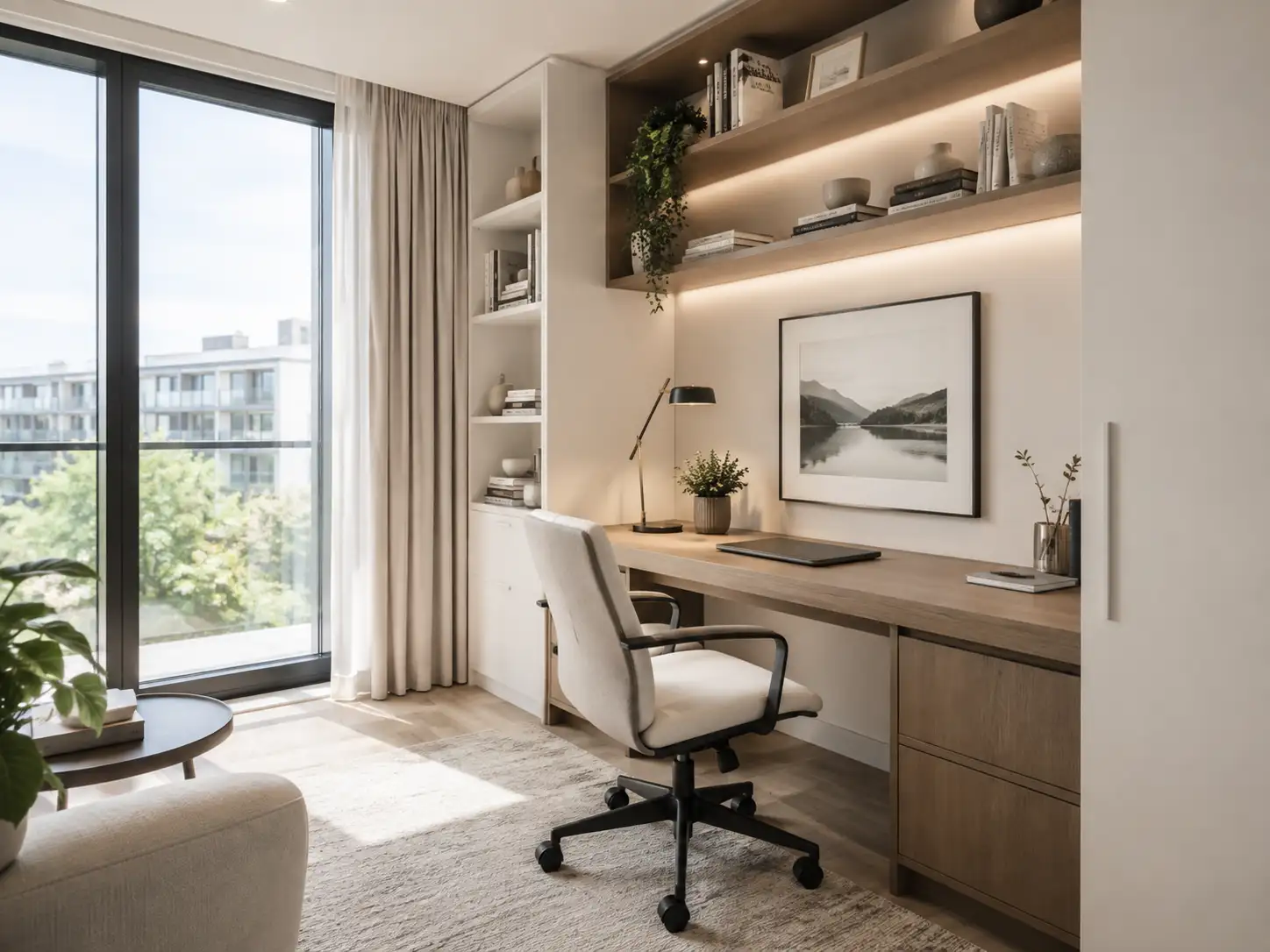
A workspace can be placed in a wider hallway, a living room alcove, part of a bedroom, a gallery, an enclosed loggia, or a space by the window. It's important that it doesn't look like an improvisation. Buyers often respond well to small but functionally arranged work zones because they help them imagine daily life in the apartment.
When renting, a workspace is especially important for digital nomads, foreign professionals, students, and young employed individuals. A furnished apartment with good internet, a desk, and a comfortable spot for video calls can stand out better compared to an apartment furnished only for traditional living.
Professional advice:
When photographing an apartment for sale or rent, arrange the workspace simply and cleanly: a desk, ergonomic chair, lamp, plant, and a neutral background are often enough for a very good impression.
Quiet location and quality of daily work
Location is always one of the key factors when buying a property, but a home office changes how location is evaluated. Proximity to work is no longer the only important factor for buyers if they don't have to commute to the office every day.
Peace, building quality, availability of neighborhood amenities, and the comfort of daily living are becoming increasingly important.
An apartment on a quieter street, near a park, shops, cafes, public transport, and essential amenities can be very attractive to buyers who spend part of the week at home. If they work from home, they use the neighborhood they live in more. This means that noise, traffic, greenery, walking opportunities, and proximity to services become important to them.
In larger cities, this can increase interest in neighborhoods that offer a good balance between connectivity and quieter living. In coastal and tourist locations, a home office further raises the question of the possibility of longer stays outside the main season, which is important for buyers who want a second home or an apartment for occasional work from another city.
Natural light, lighting, and apartment orientation
Natural light has become even more important because buyers who work from home spend more time in their apartments.
An apartment with good orientation, ample daylight, and a pleasant atmosphere throughout the day is more easily perceived as a space where one can live and work comfortably.
For working from home, it is especially important to avoid a space that is constantly dark, poorly ventilated, or too exposed to direct sun without the possibility of shading. An ideal work zone has natural light, but not uncomfortable glare on the screen. Therefore, blinds, curtains, shades, and good artificial lighting are just as important as the position of the desk.
In new construction, buyers are increasingly asking about apartment orientation, opening sizes, carpentry quality, and the possibility of light regulation. For older apartments, it is important to check if the workspace can be adequately lit without significant investment.
Professional advice:
When furnishing a home office zone, the desk doesn't always have to face the window directly. It is often better to position it sideways to the light source to reduce screen glare and improve working comfort.
Acoustics and privacy as new buyer criteria
Acoustics is one of the criteria often overlooked, yet it can strongly impact the quality of life. Working from home means more video calls, phone conversations, and the need for concentration. Because of this, buyers are increasingly noticing noise from neighboring apartments, hallways, elevators, traffic, or nearby catering establishments.
In quality new construction, sound insulation between apartments, good carpentry, and a well-thought-out room layout are important. A study that shares a wall with a neighboring apartment's living room or faces a busy street will not have the same utility value as a quieter room facing the courtyard.
Privacy is also important within the apartment itself. If two people work from home, an open living space is not always sufficient. Buyers therefore increasingly value apartments with separate zones, a hallway separating the living and sleeping areas, an additional toilet, or a room that can be closed off.
How home office affects new construction
New construction is gradually adapting to lifestyle changes. Buyers are increasingly looking for functional floor plans, not just attractive visuals. A 70 m² apartment can be excellent for a home office if it has two well-arranged rooms and a living room, whereas a larger apartment might be less practical if it has a lot of unused hallway space or an open plan without the possibility of separation.
In new projects, details that were not previously in the foreground are becoming increasingly important: a sufficient number of outlets, good internet infrastructure, quality carpentry, acoustic insulation, the possibility of installing a workspace, air conditioning, light regulation, and a terrace as a break area during the workday.
Buyers also look for buildings that offer better daily functionality: a garage, storage, elevator, bicycle storage, proximity to public transport, and neighborhood amenities. A home office is not just about a desk, but about the overall quality of living.
Professional advice:
When buying new construction, ask for a floor plan with measurements and consider where a desk could actually fit. Renders often look spacious, but the actual dimensions of walls, doors, and windows determine if a workspace is feasible.
What sellers can highlight in an ad
Sellers who have an apartment suitable for working from home should clearly highlight this. An extra room, quiet orientation, fast internet, good lighting, an enclosed loggia, quality carpentry, or a separate work zone can be very relevant advantages.
In the ad, it is useful to specify: whether there is space for a home office, if the room has natural light, if it faces the quiet side of the building, if it can be closed off, if there is good internet infrastructure, or multiple positions for a desk. Such information helps buyers quickly recognize the apartment's potential.
When taking photos, it is important to present the workspace as a real functional zone, not just a randomly placed desk. A well-arranged home office zone can change the perception of an apartment, especially in smaller square footage where every meter is important.
How Regent can help you
Regent Real Estate can help buyers and tenants find an apartment that suits a modern lifestyle, including working from home, hybrid work, and the need for flexible space. When choosing a property, we look not only at the square footage but also at the layout, orientation, quietness of the location, the possibility of arranging a workspace, and long-term functionality.
We can help sellers identify and properly highlight the advantages of an apartment that are important to today's buyers: an extra room, quality lighting, a quiet micro-location, good connectivity, a terrace, a loggia, or a flexible floor plan. For new constructions and investment projects, we can help position apartments according to the target group of buyers and tenants.
The goal is not just to sell or buy a property, but to find a space that truly fits the user's lifestyle — and for an increasing number of people, this includes a quality workspace.
Frequently Asked Questions
How important is an extra room when buying an apartment?
An extra room is becoming increasingly important because it offers flexibility to the buyer. It can serve as a study, child's room, guest room, wardrobe, or hobby space. For buyers who work from home, it can be one of the key reasons for choosing an apartment.
Can a smaller apartment be good for a home office?
Yes, if it has a well-designed workspace, enough light, a quiet position, and a functional layout. For smaller apartments, clever space organization is more important than the square footage itself.
What is most important for a workspace in an apartment?
The most important aspects are peace, sufficient light, a good desk position, power outlets, stable internet, and the possibility of visual or physical separation from the living area.
Does a home office affect the price of an apartment?
A home office in itself does not determine the price, but it can increase the market appeal of an apartment. An apartment with an extra room, a good floor plan, a quiet orientation, and quality lighting can be more attractive to buyers and tenants.
Is an apartment with an open plan or separate rooms better?
It depends on the buyer's needs. Open space can be great for daily living, but for working from home, it is often useful to have at least one zone that can be closed off or separated.
What to look for when buying an apartment for working from home?
You should check for noise, orientation, natural light, layout, carpentry quality, internet, number of outlets, possibility of placing a desk, and privacy in relation to other rooms.
Is a home office also important for rentals?
Yes. For long-term, medium-term, and business rentals, an apartment with a workspace, good internet, and a quiet location can be more attractive to tenants who work hybrid or remotely.
Recommended
Apartment orientation, floor, and floor plan: what affects the quality of living and property price
Boutique new constructions: why buyers increasingly choose smaller projects
Budget-friendly tips for refreshing an apartment before selling
The future of housing: 5 key trends in new construction in Croatia for 2026
New Law on Real Estate Brokerage (2026): what is changing, which myths need to be debunked, and what you gain with an agency