
Communal Contribution and Communal Fee: What They Are, Who Pays Them, and How Much They Amount To
TL;DR:Communal contribution is a one-time payment made by a landowner or investor during construction, while communal fee is a regular obligation for the use and maintenance of services. The amount of both obligations depends on local decisions and zones, and the legal framework defines their basis and payment deadlines. Precisely defining and verifying these costs are crucial for proper financial planning of real estate in Croatia.
Communal contribution is a one-time monetary public levy that a landowner or investor pays when building or reconstructing real estate, while communal fee is a regular, periodic obligation for using communal services. Both levies are regulated by the Act on Communal Services, and their amount depends on the decisions of local self-government units. For anyone buying new construction, building a house, or investing in commercial space in Croatia, understanding these two obligations is not just useful, but a prerequisite for accurate planning of total real estate costs.
What is Communal Contribution: Definition, Legal Framework, and Calculation
Communal contribution is a one-time payment made by a landowner or investor during construction, while communal fee is a regular obligation for the use and maintenance of communal services.
The amount of both obligations depends on local decisions and zones, and the legal framework defines their basis and payment deadlines. Precisely determining and verifying these costs are crucial for proper financial planning when buying or building real estate in Croatia.
Legal Basis and Who Enacts It
Communal contribution is a monetary public levy for the use of communal infrastructure and the locational advantages of building land. The obligation arises from a decision by the competent local self-government body in accordance with the Act on Communal Services. It is not a tax in the classical sense, but a fee for the right to connect to an already built network of roads, water supply, sewage, and public lighting. It is paid either once or in installments, depending on the decision of the local self-government, and the obligation arises when construction begins or when the object is legalized.
The Act on Communal Services sets the framework, but the specific amount of the communal contribution is determined by each local self-government unit through its own decision. This means that the City of Zagreb, the City of Split, and the City of Bjelovar can have completely different amounts for the same type of building. The spatial plan and the local decision on communal contribution together define the zones and values applied during calculation. Every investor must check the current decision of the competent city or municipality before even starting to plan construction costs.
How Communal Contribution is Calculated
The calculation is performed by zones, whereby the value of the first zone may not exceed 10% of the average construction costs per cubic meter in the Republic of Croatia.
Each zone has its unit value, and the final amount is obtained by multiplying that value by the volume of the building expressed in cubic meters. The closer the property is to the center or a more attractive location, the higher the zone and the greater the amount.
The specific formula looks like this:
- Building volume (m³) is multiplied by the unit value of the zone (€/m³)
- The result is the amount of communal contribution that the investor must pay
For a residential building of 500 m³ in the first zone of Split, the amount can be significantly higher than for the same object in an peripheral zone.
Expert advice:
Before signing a pre-contract for the purchase of a new construction property, ask the investor for written confirmation that the communal contribution has been paid.
Without this confirmation, the act for construction cannot be issued, which directly affects the legality of the entire project.
Who is Obligated to Pay
The legal obligor for communal contribution is the owner of the building plot, but by agreement between the owner and the investor, the obligation can be transferred to the investor.
In practice, when buying an apartment in new construction, the investor pays the communal contribution and incorporates this cost into the price per square meter — the buyer indirectly bears it, but formally does not pay it themselves.
In individual constructions, the landowner pays the contribution personally, which can be an amount from several thousand to several tens of thousands of euros, depending on the size and location of the object.
What is Communal Fee and Who Pays It
Communal fee is a regular monetary obligation for the use and maintenance of communal services, and it is paid by property owners and users regardless of whether something is being built or not.
Unlike communal contribution, which is paid once during construction, communal fee is paid regularly — most often quarterly or annually — and covers the costs of maintaining roads, public lighting, green areas, and cleanliness.
Factors Determining the Fee Amount
The amount of the communal fee depends on several key factors that each local self-government defines in its decision:
- Property area in square meters, with residential and commercial spaces having different coefficients
- Zone in which the property is located, where central zones carry a higher amount per square meter
- Purpose of the property, as commercial spaces typically pay a higher fee than residential ones
- Purpose coefficient, which the local self-government determines for each category of object
For an apartment of 60 m² in the second zone of Zagreb, the annual communal fee can range between 150 and 300 euros, while the same apartment in the first zone can be up to 50% more expensive.
A commercial space of the same area in the center of Split can have a fee many times greater than a residential one.
Exemptions and Social Categories
The law provides for the possibility of exemption from paying communal fees for certain categories of users.
Local self-governments can exempt or reduce the obligation for:
- Social welfare recipients and persons with disabilities
- Owners of properties not in use for more than one year
- Non-profit organizations and religious communities, according to local decision
- Owners of properties undergoing renovation or reconstruction
Checking the conditions for exemption is done directly in the competent administrative department of the city or municipality. Each local self-government has its own criteria, so what applies in Osijek may not apply in Rijeka.
Communal Contribution or Communal Fee: What are the Key Differences
The difference between these two levies is fundamental: communal contribution is a one-time fee related to construction or reconstruction, while communal fee is an ongoing obligation for the use of communal services.
Confusing these two concepts when planning costs can lead to serious financial errors.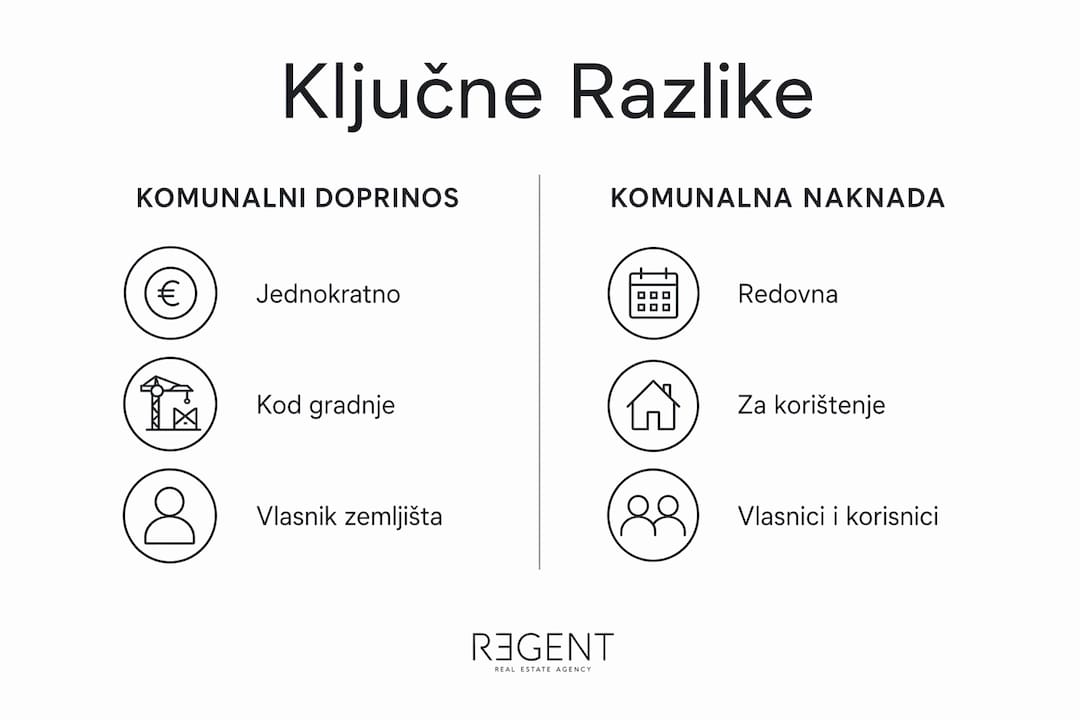
Expert advice: When estimating the total costs of buying a property, always check whether the communal contribution has already been paid and what the current communal fee is for that property. Both pieces of information can be checked in the spatial plan and the competent administrative department.
Examples of Amounts in Zagreb and Split
Specific amounts of communal contribution and communal fee differ between cities, but also within the same city depending on the zone. Examples from Zagreb and Split show that communal contribution is calculated according to zones and the type or volume of the building, while communal fee varies depending on the area and purpose of the object.
Zagreb: Zones and Indicative Amounts
Zagreb is divided into several zones, with the first zone covering the narrow city center, and each subsequent zone carrying a lower amount of communal contribution.
For a family house with a volume of 600 m³ in the third zone of Zagreb, the communal contribution can range between 3,000 and 6,000 euros, while the same object in the first zone can exceed 10,000 euros.
Apartments in new construction in the first zone have a communal contribution that the investor incorporates into the price, which is one of the reasons why apartments in the center are proportionally more expensive than those on the periphery.
The communal fee in Zagreb for an average apartment of 70 m² in the second zone is approximately 200 to 350 euros annually.
For a commercial space of the same area in the first zone, the amount can be triple, as the purpose coefficient for commercial spaces significantly increases the calculated amount.
Split: Specifics of a Coastal Location
Split has its own decision on communal contribution that reflects the attractiveness of its coastal location. The first zone includes the historic core and its immediate surroundings, where the communal contribution amounts are among the highest in Dalmatia.
For an apartment of 80 m² (volume around 240 m³) in the first zone of Split, the communal contribution can range between 4,000 and 8,000 euros, depending on the current local decision and the year of construction.
The communal fee in Split for a residential space of 60 m² in the second zone typically ranges between 120 and 250 euros annually.
Tourist apartments and commercial spaces have significantly higher purpose coefficients, which can multiply the annual obligation.
Practical Tips for Cost Estimation
When planning to buy or build a property, follow these steps for accurate estimation of communal obligations:
- Check the current decision on communal contribution on the website of the competent city or municipality
- Determine which zone the property or building plot is located in
- Calculate the volume of the planned building in cubic meters
- For communal fee, request information on the current amount of the fee for the specific address
- Check if there are conditions for exemption or reduction of the fee
Differences in zones mean that the same building can have a significantly different communal contribution value depending on the micro-location and local decision. Therefore, checking the zone is a crucial step that many investors skip, and which can result in unexpected costs of several thousand euros.
Law Changes from 2026
With new legal changes from 2026, the possibility of deferring the payment of communal contribution for illegally built structures has been abolished.
Payment must follow immediately upon the finality of the decision, without exception. This change directly affects the liquidity of owners who planned to legalize properties, as they can no longer spread this cost over a longer period.
For all those who have illegally built structures undergoing legalization, this is critical information requiring timely financial preparation.
Key Insights
Communal contribution is a one-time payment
Paid once, during construction or legalization, and is a condition for issuing the construction act.
Communal fee is periodic
Paid quarterly or annually for every property in use, regardless of construction.
Amount depends on the zone. The same building in the first zone can have a communal contribution many times higher than in a peripheral zone.
The 2026 law abolishes deferral
Communal contribution for legalized structures must be paid immediately upon the finality of the decision.
Verification is mandatory
Local decisions vary, so checking with the competent administrative department is essential before any investment.
Expert Review by Regent Team: Why You Must Not Neglect Communal Obligations
From experience working with buyers and investors in Croatia, Regent witnesses a frequent mistake: buyers of new construction assume that all communal costs are included in the price per square meter, and owners of older properties neglect to check the communal fee when estimating total ownership costs.
Communal contribution is a condition for issuing a building permit, meaning that a project without paid contribution cannot formally advance.
In practice, Regent advises all buyers to request sight of the communal contribution decision and payment confirmation before signing a contract.
That document speaks more about the legality of the project than any marketing material from the investor.
The 2026 law, which abolishes the possibility of deferring payment for legalized structures, is particularly relevant for buyers of properties on the Dalmatian coast, where the number of illegally built structures undergoing legalization is extremely high.
Owners who have not timely secured funds for communal contribution now face an urgent financial obligation.
We recommend monitoring legal changes affecting the real estate market, as every amendment can directly impact the value and legality of your investment.
— Regent
Find Your Property with Expert Support from the Regent Team
Planning communal contribution and communal fee costs is just one part of the overall picture when buying property in Croatia.
The Regent team provides full support to buyers and investors, from verifying the legality of the object and communal obligations to finding a property that matches your budget and location preferences.
Our database includes apartments, houses, land, and commercial spaces across Croatia, with detailed information on all relevant costs.
Browse current properties for sale and contact our team for a free consultation on communal and other costs of your future property.
FAQ
What is communal contribution and when is it paid?
Communal contribution is a one-time monetary levy that the landowner or investor pays when building, reconstructing, or legalizing a property, and the obligation arises from a decision by the competent local self-government in accordance with the Act on Communal Services.
How is communal contribution calculated?
Communal contribution is calculated by multiplying the volume of the building in cubic meters by the unit value of the zone in which the property is located, with the value of the first zone not exceeding 10% of the average construction costs per cubic meter in Croatia.
Who pays the communal fee?
The communal fee is paid by property owners and users regularly, most often quarterly or annually, and the amount depends on the area, zone, and purpose of the property according to local decision.
Can communal contribution be deferred?
According to legal amendments from 2026, the possibility of deferring communal contribution payment for illegally built structures has been abolished, so payment must follow immediately upon the finality of the decision.
Are there exemptions from the communal fee?
Local self-governments can exempt or reduce the communal fee for social welfare recipients, persons with disabilities, and owners of properties not in use, with conditions varying from city to city.
Recommended
- First Property Tax Refund: First Payments Already Started!
- Property Valuation: What Market, Mortgage, and Tax Value Mean for Buyers and Sellers?
- Real Estate Taxes in Croatia and Europe: Where Are We Now and What Awaits Us?
- Affordable Rent Program Begins: What Does the New State Measure Bring?