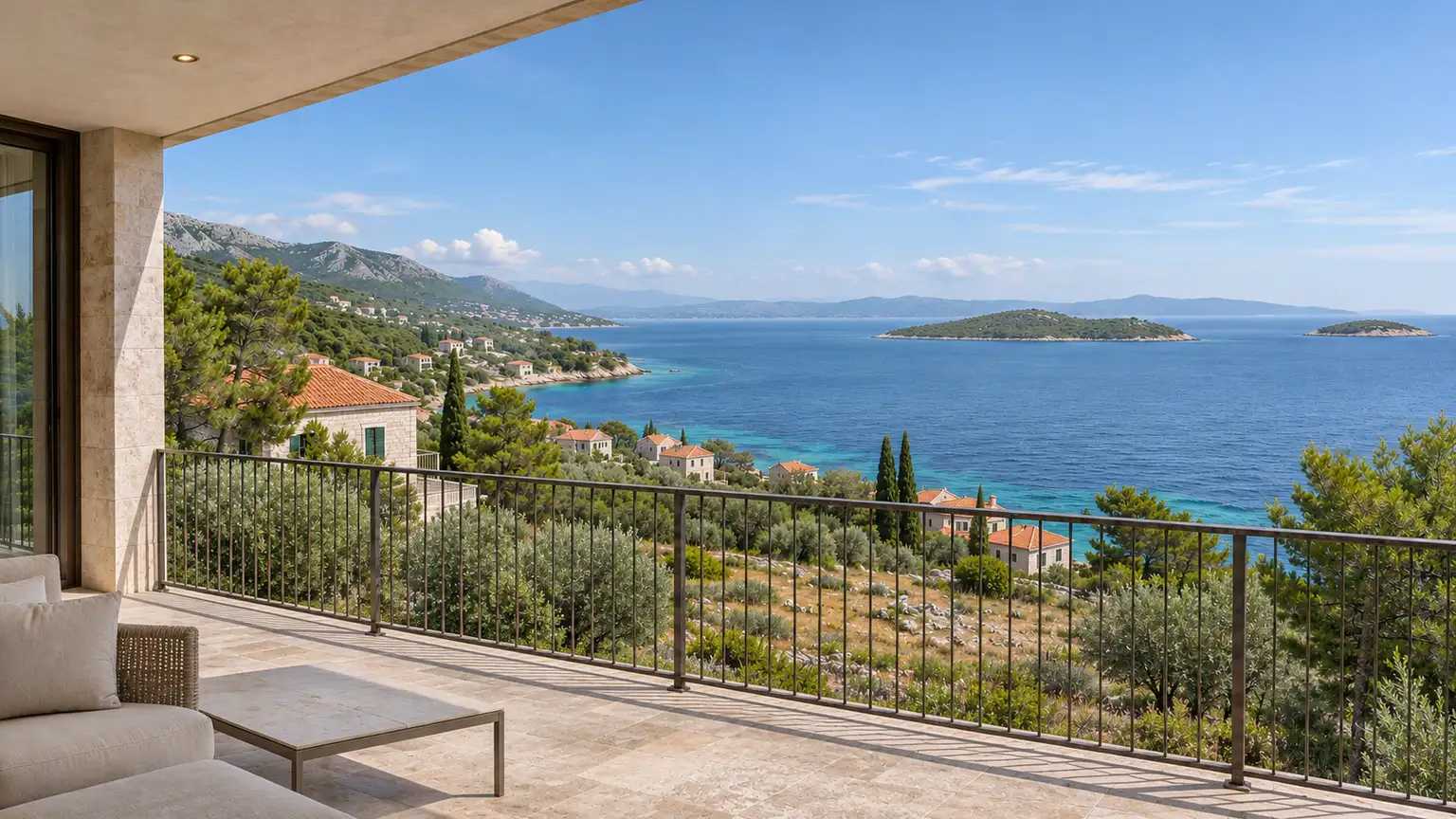
Summary
A premium for a sea view when buying a property only makes sense if the view is permanent, and permanence cannot be assessed from the balcony, but rather in the spatial plan, land registry, and coastal building regulations. Before buying, check with a location information document what can be built on the plots in front, where the maritime domain begins, and whether you are within the restricted area of a protected coastal zone. Neighbors who directly border the construction site are parties in the building permit issuance procedure, but the owner of an apartment across the road or two plots away is usually not. The view can only be legally secured by an easement registered in the land registry.
Key facts
- A premium only makes sense for a view that is made permanent by the spatial plan and ownership relations.
- Location information shows the purpose and building conditions on the plots in front of the apartment.
- The maritime domain is a public good on which ownership cannot be acquired.
- In the restricted area, the law prohibits a series of interventions that could harm the coast.
- The parties in the building permit procedure are neighbors who directly border the construction site.
- A view is legally secured only by an easement recorded in the land registry.
When you pay more for an apartment with sea-facing windows than for the same apartment with courtyard-facing windows, you are paying for something that is not within the apartment itself. A view cannot be created afterward, nor can you preserve it yourself: it depends on neighboring properties, coastal space, and decisions of other owners and authorities. The premium for a sea view when buying a property is therefore essentially the price of an assumption, and that is that the space in front of you will remain open.
This guide therefore does not deal with the question of how much a view is worth, but how safe it is.
Sea view premium: what you are actually paying for
The light over the sea changes from hour to hour, but the frame of the view changes only when something is built between you and the sea. This is the only issue that makes a view premium risky. In practice, a view can be divided into two types. The first is a view protected by the space itself: in front of the building there is a public area, a park, a promenade, steep terrain, or maritime domain where construction is not allowed. The second is a view that exists only because the plot in front is currently undeveloped or has a low-rise house. The first type remains, the second lasts until the owner of the neighboring plot or the spatial plan changes.
Floor and orientation are part of the same calculation. A higher floor usually leaves more space for future construction in front without losing the view, and an apartment facing south or west offers different light and a different summer stay on the terrace than an apartment facing east. We write more about how floor and orientation affect daily life in an apartment in the guide on the orientation, floor, and layout of an apartment.
Professional advice: Standing on the terrace, write down the cadastral parcels located between the apartment and the sea; then check these same parcels in the spatial plan and the land registry.
Spatial plan: what is allowed to be built in front of you
The most important document for assessing the longevity of a view is not an advertisement, but the spatial plan. As of January 1, 2026, the new Spatial Planning Act (NN 155/25) is in force, which replaced the previous act from 2013.
According to this law, you can find out the purpose of the space and the construction conditions on a certain land through a location information document. It can be generated electronically through the spatial planning information system. For an area for which a new generation spatial plan has not yet been adopted, the administrative body issues it upon request of an interested person within 15 days, and the request can cover a maximum of five cadastral parcels. The location information contains provisions for the implementation of interventions from valid spatial plans at all levels, but construction cannot be based on it.
For a buyer with a view, it answers a specific question: is the parcel in front within the construction area, what is its purpose, and how high can it be built. If there is an undeveloped parcel in front of you in a construction area with an allowed height higher than your floor, the view depends on someone else's decision to build.
Spatial plans change. Before adoption, the draft plan goes for public inspection lasting 30 days, and amendments for a maximum of 30 and a minimum of 15 days, with exceptions prescribed by law. Participants in the public discussion can submit written proposals and objections within the timeframe and manner specified in the announcement. We write more about how to read a spatial plan in the guide on checking the spatial plan.
Professional advice: Request location information for the parcels in front of the apartment before signing the pre-contract and ask the municipality or city if changes to the spatial plan for that area are underway.
First row to the sea and maritime domain
The first row to the sea is the safest form of view because there is no other building in front. The reason for this is not only the location but also the law. According to the Maritime Domain and Seaports Act (NN 83/23), the maritime domain is a general good of interest to the Republic of Croatia, is in common use by all, and is outside legal transactions. Ownership or other real rights cannot be acquired over it, and legal transactions concluded contrary to this are null and void.
The land part of the maritime domain is a strip of land along the sea used for ordinary use of the sea, and is at least six meters wide from the line of mean higher high waters, measured horizontally. The maritime domain also includes the coastline, beaches, promenades, and ports. For a property in the first row, this means two things: the sea view in front of it cannot be obstructed by private construction on the maritime domain, but also the property owner cannot consider the coast in front of the house as their own.
The Maritime Domain Act also explicitly stipulates that no one can invoke trust in the land registry regarding a property that is maritime domain. If part of the parcel you are buying extends into the maritime domain, the entry in the land registry does not protect you.
Construction behind the coastline also has restrictions. The Spatial Planning Act prohibits construction at a distance of less than five meters from the boundary of the maritime domain in the construction area of settlements, except in already built-up areas where distancing would disrupt the existing building line.
Professional advice: For a house or apartment in the first row, check whether the boundary of the maritime domain on that part of the coast has been established and how it relates to the parcels you are buying.
Protected coastal area and restricted area
The Spatial Planning Act treats the coast as a protected coastal area of the sea, an area of special interest to the Republic of Croatia. Within it, a special regime is prescribed for the restricted area, which includes a strip of land and islands 1000 meters wide from the coastline and a strip of sea 300 meters wide.
In the restricted area, the law prohibits the planning and approval of a series of interventions. These include the exploitation of mineral raw materials, wind farms and solar power plants (except photovoltaic panels integrated on buildings and parking lots under prescribed conditions), waste disposal, and interventions that change the coastline, with exceptions in port areas and for the arrangement of beaches, promenades, and walkways within settlements. In separated construction areas outside settlements, construction is not allowed closer than 100 meters from the boundary of the maritime domain, or from the coastline if the boundary is not established, unless otherwise provided by law.
The law also limits the expansion of construction along the sea. In the restricted area, new settlements cannot be established, nor can new separated parts of settlement construction areas be planned, and existing separated parts cannot expand within a 100-meter strip from the coastline. Outside the construction area, construction can only be planned in cases explicitly stated by law.
These rules do not stop construction within existing construction areas of settlements, where the spatial plan dictates. But the further away from settlements and closer to the sea, the narrower the legal space for new construction.
Professional advice: In the location information, check whether the property and the land in front of it are located within the construction area of a settlement or outside it, as construction restrictions along the coast differ significantly.
New construction in the neighborhood: who has the right to participate
When someone decides to build on the parcel in front of you, the question is whether you will even find out in time. The new Building Act (NN 155/25), in force from January 1, 2026, determines who is a party in the procedure for issuing a building permit.
For a less complex building, a party, in addition to the investor, is the owner and holder of other real rights on the property directly bordering the building plot, if it is located at a distance less than half the height of the new building's facade, measured from the facade. For multi-apartment buildings and other structures, parties are the owners and holders of other real rights on properties directly bordering the parcel on which construction is taking place. For properties bordering the maritime domain, the Republic of Croatia, represented by the competent state attorney's office, is also a party.
The construction authority is obliged to allow parties to inspect the case file before issuing the permit. If more than ten parties participate in the procedure or the building borders more than ten properties, the invitation for inspection is published publicly on the electronic bulletin board.
If your apartment does not directly border the parcel on which construction is taking place, for example, if there is a road or another parcel between you, according to these rules, you are not a party to the procedure. The view is then only protected by what the spatial plan allows on that parcel.
Professional advice: If you are buying in a building that directly borders an undeveloped parcel, check that your OIB is also registered with your ownership after purchase; the law delivers the invitation for inspection of the file, among other things, to the user's inbox of the party who has a registered OIB.
Easement of view: how to legally secure a view
There is only one way for a view to become a right, not just a circumstance. The Law on Ownership and Other Real Rights (NN 91/96, 68/98, 137/99, 22/00, 73/00, 114/01, 79/06, 141/06, 146/08, 38/09, 153/09, 143/12, 152/14, 81/15 — consolidated text, 94/17 — correction, 52/25) recognizes real easements by which the owner of a neighboring property must tolerate actions that they would otherwise be allowed to do.
The law explicitly states as examples of such easements the obligation for the neighbor not to raise their house and not to deprive the dominant building of light, air, or view. An easement is tied to the property, not to a person: it passes to every subsequent owner of the dominant property and burdens every subsequent owner of the servient property.
The right of easement on a property is established by registration in the land registry as an encumbrance on the servient property. A verbal promise from a neighbor or seller that nothing will be built in front does not have such an effect. An easement is agreed upon with the neighbor, and it is good to entrust the contract to a lawyer or public notary.
Professional advice: If the seller claims that the view is guaranteed, request an extract from the land registry for the parcel in front and check if an easement is registered; if not, the guarantee has no legal effect.
How Regent can help you
Regent mediates in the purchase, sale, and lease of residential and commercial properties and new construction throughout Croatia and works with foreign buyers. We help you find a property that suits your needs and verify its legal status, including land registry status and encumbrances, before any payment. For interpretation of the spatial plan, contracting easements, and construction issues, we refer you to an authorized engineer or architect, lawyer, or public notary. Contact us or view properties on offer.
Frequently Asked Questions (FAQ)
Can someone build a building in front of my apartment and block my view?
Yes, if the spatial plan allows construction on that parcel and if there is no registered easement prohibiting it. The view is protected only where it is protected by the plan, maritime domain, or an easement in the land registry.
How can I check what is allowed to be built on the parcel in front?
With location information. It contains provisions of valid spatial plans for the mentioned parcels, and in an area without a new generation plan, the administrative body issues it within 15 days for a maximum of five parcels.
Can I buy a part of the coast in front of the house?
You cannot. Maritime domain is outside legal transactions; ownership cannot be acquired over it, and a legal transaction concluded contrary to this is null and void.
Will I be informed if a neighbor applies for a building permit?
Yes, if your property directly borders the parcel on which construction is taking place and meets the conditions of the Building Act. In that case, you are a party to the procedure and have the right to inspect the file before the permit is issued.
Is there a legal right to a sea view?
Not by itself. The view can be protected by an easement of view or a prohibition on raising a neighboring house, but only if that easement is registered in the land registry.
What is the restricted area?
It is part of the protected coastal area of the sea that includes a strip of land and islands 1000 meters wide from the coastline and a strip of sea 300 meters wide. In it, the law prohibits a series of interventions and restricts the expansion of construction along the sea.
Recommended
- Buying land in Croatia: how to check the spatial plan and avoid mistakes
- Apartment orientation, floor, and layout: quality of living
- How to check the building, neighbors, and surroundings before buying
- Location and building permit: the difference