Summary
Buying a home for a large family isn't just a matter of square footage — equally important are a smart layout that allows multiple people to coexist, a location that supports family life (schools, safety, amenities), and a realistic budget that includes not only the price, but also the ongoing costs of a larger home. A large family needs space that functions in the daily life of a multi-member household and that withstands changes over the years as children grow. The best decisions stem from the family's real needs and a long-term perspective, not just from the current size. In this guide, we walk you through space, location, and budget when buying a home for a large family.
Key facts
- For a large family, both the floor area and a clever layout are important, not just the size.
- A good layout enables both togetherness and privacy for household members.
- For a family, location implies schools, safety, amenities, and good connectivity.
- Outdoor space is of great value to a family with children, but it needs to be sustainable.
- The budget must include not only the price, but also the ongoing costs of a larger home.
- The best decisions stem from actual needs and a long-term perspective of family growth.
For a large family, a home is more than just a place to live — it's the stage for the daily life of a multi-member household, a space where everything from morning chaos to shared meals and evening peace unfolds. Buying a house for such a family is, therefore, a more layered decision than buying an apartment for an individual or a couple: it needs to meet the needs of multiple people of different ages, withstand the daily dynamics of a large household, and, ideally, adapt to changes over the years as children grow.
It's easy to reduce this decision to one thing — "we need something bigger" — but square footage is only part of the story. A large family equally needs a smart layout that allows for both togetherness and privacy, a location that supports family life, and a budget that is realistic not only for purchase but also for the ongoing maintenance of a larger home. In this guide, we break down the key dimensions of that decision — space (how much and what kind), location (what the family needs around them), and budget (price plus ongoing costs) — with an emphasis on the real needs of a large family and a long-term perspective.
More than square footage: how much and what kind of space
It's natural to start the house-buying process for a large family with the thought, "we need more space," but square footage alone doesn't guarantee that a home will function well. A large house with a poor layout can be less functional for a family than a smaller, but smartly organized one. What a large family truly needs is space that supports the real life of a multi-member household — enough rooms, but also space for togetherness, the possibility of privacy, and a layout that withstands daily dynamics. That's why it's worth starting the decision by asking how the family actually lives: how many members, what ages, what habits, how much space is needed for shared life, and how much for individual privacy.
When asking "how much is enough," the goal is balance — enough for everyone to be comfortable, but not so much that the space becomes a burden to maintain and an expense. Too little space means crowding, lack of privacy, and tension; too much space means unnecessary heating, cleaning, and maintenance costs, and rooms that are rarely used. For a large family, a sufficient number of bathrooms is particularly important (crucial for morning dynamics) and a well-sized common area for meals and socializing, as this is where the daily life of the household takes place. Sufficient and well-arranged almost always outweighs mere bigness.
Professional tip: Before you start searching, list how your family truly lives — number and age of members, needs for togetherness and privacy, a typical day — and search accordingly, not just by square footage; pay special attention to a sufficient number of bathrooms and common areas, as these are where daily congestion is created or resolved.
Layout: togetherness and privacy
For a large family, layout is as important as size, because a good home must enable two seemingly opposite things — togetherness and privacy. On one hand, the family needs spaces that bring them together: a living room, dining room, and kitchen large enough to handle family dynamics, places where everyone can gather. On the other hand, in a multi-member household, the ability to retreat is equally important — private rooms, quiet corners, a space where one can be alone.
A good layout establishes this balance. Zoning the home — separating quieter, private parts (bedrooms) from lively, common ones (living areas) — helps a multi-member household function without constant tension, and in multi-story houses, floor-by-floor layout can naturally separate these zones. It's also worth considering practical spaces that make life easier for a large family: ample storage, a practical kitchen, space for daily activities. A layout that simultaneously fosters togetherness and allows for privacy is the foundation of harmony in a large family, more so than square footage alone.
Professional tip: Look for a layout that separates common from private zones — places where the family gathers and places where everyone can retreat; in a multi-member household, this balance makes the difference between harmony and constant tension.
Location for family life
For a large family, location carries specific priorities related to daily life with children. Schools and kindergartens are usually first on the list — their proximity and quality significantly ease daily life and long-term shape the family's life. In addition, the safety of the environment (especially for children), proximity to family amenities (playgrounds, sports and recreation facilities, healthcare, shops), and good transport links are important, as a large family means many daily journeys.
It's worth viewing the location through the actual rhythm of family life: the commute to school, to work, to facilities the family uses. A quiet, safe environment with proximity to what the family needs daily is a great value, while a location that doesn't offer this complicates daily life. For a family, location often means a compromise — a larger house at a more accessible price is often further from the center, so you need to weigh space against location and accessibility. The key is that the location supports, rather than hinders, the daily life of a multi-member household.
Professional tip: Evaluate the location through the family's daily rhythm — the commute to school, kindergarten, work, and the facilities you actually use; for a large family, proximity to schools and a safe environment often outweigh extra square footage, so weigh this compromise consciously.
Outdoor space and garden
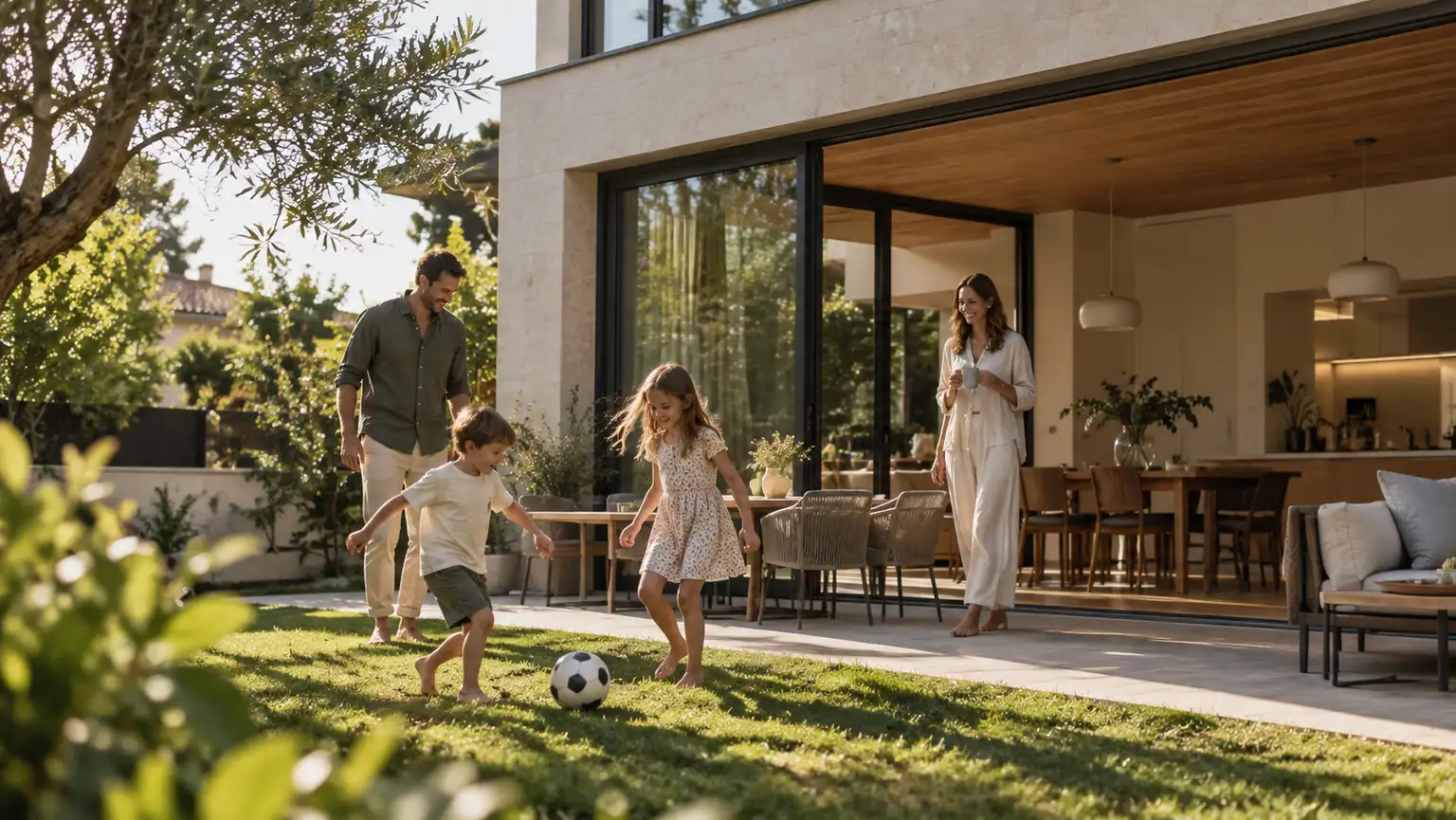
For a family with children, outdoor space is often one of the greatest values of a house compared to an apartment, so it deserves special attention. A garden, yard, or surrounding property provides children with a safe space for play and outdoor activities, gives the family a place for socializing and shared time, and adds an extra quality to daily life that indoor space can hardly replace. For many families, outdoor space is the main reason for choosing a house over an apartment.
However, it's worth realistically considering the other side — outdoor space requires maintenance, so you need to assess how much the family wants and can maintain it. An oversized garden that no one has time to maintain becomes a burden instead of an asset. For a family, the ideal outdoor space is often one that is sufficient for play and socializing, and sustainable in terms of maintenance, rather than maximally large. In addition to the garden itself, it's worth considering the safety of the outdoor space for children and its functionality in daily life.
Professional tip: Choose outdoor space based on how much you can actually maintain, not how large it is — for a family with children, a sufficient, safe, and sustainable garden is more valuable than a spacious property that becomes a burden.
Budget and financing
The budget for a large family home must be realistic and comprehensive — not just the purchase price, but also the ongoing costs that a larger home inevitably incurs. A larger house means higher heating and cooling costs, more utilities, greater maintenance (both of the property and the garden), and more space to clean and decorate. A comprehensive budget therefore includes three layers: the purchase price (and buying costs), ongoing usage and maintenance costs, and a reserve for unforeseen expenses, as a larger home also carries greater potential repairs. A house that seems affordable in price but carries high ongoing costs can burden the family budget in the long run, so cost-effectiveness is viewed holistically — over the entire ownership period. Energy efficiency plays a large role here as it directly affects ongoing costs, which we discuss in the guide on real estate energy ratings.
If the purchase is financed by a housing loan, the terms of the loan and repayment ability are factored in, which for a large family must be realistically assessed in the context of all other costs of a multi-member household. It is crucial that the monthly burden is sustainable not only today but also over the years, with all the needs of growing children. As with any credit purchase, it is important to look at the total cost — not just the monthly installment, but also the total burden and a reserve for the unforeseen — so it's wise to plan conservatively. Check current lending conditions directly with banks, as interest rates and conditions vary and change; we write about loan types and conditions in the guide on housing loans.
Professional tip: Include the ongoing costs of a larger home in your budget — heating, utilities, property and garden maintenance — not just the purchase price and installment; for a large family, a house must be sustainable in the long run, so an energy-efficient home with lower utility bills is often a smarter choice than a cheaper but expensive-to-maintain one.
A house that grows with the family
A special value when buying a house for a large family is thinking ahead — about how needs will change over the years. Children grow, and with them their needs for space and privacy; the family can also change in size. A house bought only for current needs can quickly become unsuitable, while one chosen with an eye to the future remains a true home longer. That's why it's worth considering not only what the family needs today, but also over the next few years.
This forward-thinking can refer to a sufficient number of rooms for growing children who increasingly need their own space, to the adaptability of space that can change with needs, and even to the potential for future home adaptations. A house with a certain flexibility — space that can be repurposed as the family grows — is more valuable in the long term than one perfectly tailored only for the present moment. Investing in a home with a view to the future prevents the need for a new move as soon as needs change, making a long-term perspective one of the most important, yet often overlooked, factors.
Professional tip: Choose a house with the next few years in mind, not just the present moment — a home with enough rooms and adaptable space remains suitable longer, saving you from a new move as soon as needs change.
How Regent can help you
Buying a house for a large family is a complex decision that combines space, location, and budget with a long-term perspective. As a real estate agent, we help you find a house that meets your family's actual needs — with a smart layout, a location that supports family life, and a sustainable budget — to verify its legal status, and to assess its long-term suitability as the family grows. The goal is for you to find a home that serves the life of a large family well, today and in the years to come.
For advice tailored to your family, see what buying with Regent looks like or contact us.
Frequently Asked Questions (FAQ)
What should you pay most attention to when buying a house for a large family?
To three key dimensions: space (both square footage and a smart layout that allows for togetherness and privacy), location (schools, safety, amenities, connectivity), and budget (price plus ongoing costs of a larger home). In addition, the long-term perspective is important — how the family's needs will change over the years as children grow.
Is square footage most important for a large family?
Not by itself. A large house with a poor layout can be less functional than a smaller, but smartly organized one. For a large family, a layout that allows for both togetherness and privacy, a sufficient number of bathrooms, and a well-sized common area are equally important. Square footage is a means, and the goal is a home that serves the family's real life well.
Which location should a large family choose?
One that supports daily family life — with proximity and quality of schools and kindergartens, a safe environment, proximity to family amenities, and good transport links. The location should be assessed through the family's actual rhythm (commute to school, work, amenities). It is often a compromise between space and location that needs to be consciously weighed.
How important is outdoor space for a family?
For a family with children, outdoor space is often one of the greatest values of a house — a safe space for play, outdoor activities, and socializing. However, it's worth choosing a garden that is sufficient and safe, and sustainable in terms of maintenance, as an oversized property that no one can maintain becomes a burden. Quality and functionality outweigh mere size.
What costs should be included in the budget besides the price?
The ongoing costs that a larger home entails: heating and cooling, utilities, maintenance of the property and garden, and a reserve for unforeseen repairs. For a large family, these costs can be significant, so the house must be sustainable in the long run, not just affordable at the time of purchase. Energy efficiency plays a large role here as it directly affects ongoing costs.
Should I consider the family's future when buying?
Yes, this is one of the most important factors. Children grow and increasingly need their own space, and the family can change, so a house bought only for current needs can quickly become unsuitable. A home with enough rooms and adaptable space remains the right choice longer and saves you from the need for a new move as soon as needs change.
Recommended
- Apartment or house: a comparison
- Real estate valuation: market, mortgage, tax
- How the real estate buying and selling process works in Croatia — step by step
- Real estate energy rating