Summary
Properties resistant to summer heat are becoming increasingly important as buyers more frequently seek flats, houses, and apartments that are comfortable to live in without constant reliance on air conditioning. The quality of living in summer depends on orientation, shade, natural ventilation, insulation, windows and doors, shutters, awnings, pergolas, and material selection. A well-designed property heats up slower, is easier to ventilate, and allows for lower cooling costs. When buying, it is important to check how the space performs during the hottest part of the day, whether it has sun protection, what the insulation of the roof and facade is like, and how truly usable the terrace, balcony, or garden are in summer.
Key facts
- Air conditioning is not the only solution; the most important thing is to prevent spaces from overheating before the heat enters the interior.
- The orientation of an apartment or house strongly affects summer comfort, especially for south and west-facing rooms.
- External blinds, shutters, awnings, and pergolas are more effective than internal curtains because they stop the sun before it enters the space.
- Natural ventilation, especially the possibility of cross-ventilation, is a great advantage during summer.
- Thicker walls, good insulation, quality carpentry, and light-colored materials can reduce the need for cooling.
- A terrace, balcony, or garden only has real value if it provides shade, privacy, and usability during warm days.
- For top-floor apartments, roof insulation should be specifically checked, as such spaces can heat up more intensely.
- When buying a new build, buyers should check the energy class, technical description, sun protection, carpentry, and heating/cooling system.
Properties resistant to summer heat are becoming an increasingly important topic in the Croatian real estate market, especially on the coast, in larger cities, and in new constructions.
Ever warmer summers are changing the way buyers view apartments, houses, and holiday homes. Air conditioning is no longer the only answer to high temperatures. More and more buyers are paying attention to orientation, shade, ventilation, the quality of joinery, wall thickness, shutters, awnings, pergolas, and material selection. In other words, they are looking for properties that are comfortable to live in even before cooling is turned on.
In this guide, we explain how architecture and design can reduce the need for cooling, why passive solutions are important for living quality, and what buyers should pay attention to before purchasing a property that needs to function well during the summer.
Table of Contents
- What does a summer heat-resistant property mean
- Why air conditioning is not the only solution
- Apartment or house orientation as the primary comfort factor
- Shade, pergolas, awnings, and shutters
- Natural ventilation and opening layout
- Wall thickness, insulation, and materials
- Outdoor space that remains usable in summer
- New construction and passive cooling
- What buyers should pay attention to
- How Regent can help you
- Frequently Asked Questions
- Recommended
What does a summer heat-resistant property mean
A summer heat-resistant property is not a space that never heats up. It is a property designed or arranged to overheat more slowly, ventilate more easily, and allow for a comfortable stay with less reliance on air conditioning.
Such a space uses a combination of architectural and technical solutions. These can include proper orientation, quality external sun protection, natural ventilation, good thermal insulation, quality joinery, light facades, natural materials, covered terraces, and greenery.
In houses and villas on the coast, this is often seen through pergolas, deep covered terraces, stone walls, shutters, shading devices, and well-positioned openings. In city apartments, the most important factors are orientation, building quality, apartment position, joinery, shutters, ventilation possibilities, and the amount of direct sun during the day.
Professional advice:
When buying a property in summer, pay attention to how the space behaves during the hottest part of the day. If the apartment is extremely hot upon entry, check if there is a possibility for shading, ventilation, and improved insulation.
Why air conditioning is not the only solution
Air conditioning can quickly cool a space, but it doesn't solve all overheating problems. If a property is poorly oriented, lacks sun protection, has poor quality joinery, or inadequate insulation, cooling will be more expensive, less efficient, and less comfortable.
A well-designed space first reduces heat entry, and only then uses active cooling systems. This means that external shades, shutters, awnings, and pergolas can be just as important as the air conditioner itself. If the sun is stopped before it enters through glass surfaces, the space will heat up significantly more slowly.
For long-term living, this affects utility costs, comfort, and daily routine. For tourist rentals or holiday homes, it also affects the user experience, as guests increasingly notice whether the terrace can be used during the day, whether the bedroom is comfortable at night, and how quickly the space heats up.
Apartment or house orientation as the primary comfort factor
Orientation is one of the most important factors in protection against summer heat. South and west orientations can bring a lot of light and an attractive view, but without quality sun protection, they can cause strong overheating of the space, especially in the afternoon.
East orientation is often more comfortable because the space gets morning sun, while heating up less during the hottest part of the day. North orientation can be cooler and quieter, but it's important to check if there is enough natural light, especially in apartments in dense urban areas.
For houses, the relationship to the terrain, garden position, neighboring objects, and dominant winds is additionally important. A house that uses natural shade, views, and air currents can be significantly more comfortable than a house of the same square footage that is completely exposed to the sun.
Professional advice:
When viewing a property, ask at what time of day the sun enters the main rooms most. Especially check the living room, kitchen, bedrooms, and terrace, as these are the most used spaces..webp)
Shade, pergolas, awnings, and shutters
Shade is one of the simplest and most effective ways to reduce overheating. Quality shading allows the space to remain bright, but prevents direct sunlight from entering through large glass surfaces.
External shutters, blinds, traditional "škure", awnings, and pergolas are more effective than internal curtains because they stop solar heat before it enters the space. Internal curtains can soften glare and create a more pleasant ambiance, but they cannot as effectively prevent glass and interior heating.
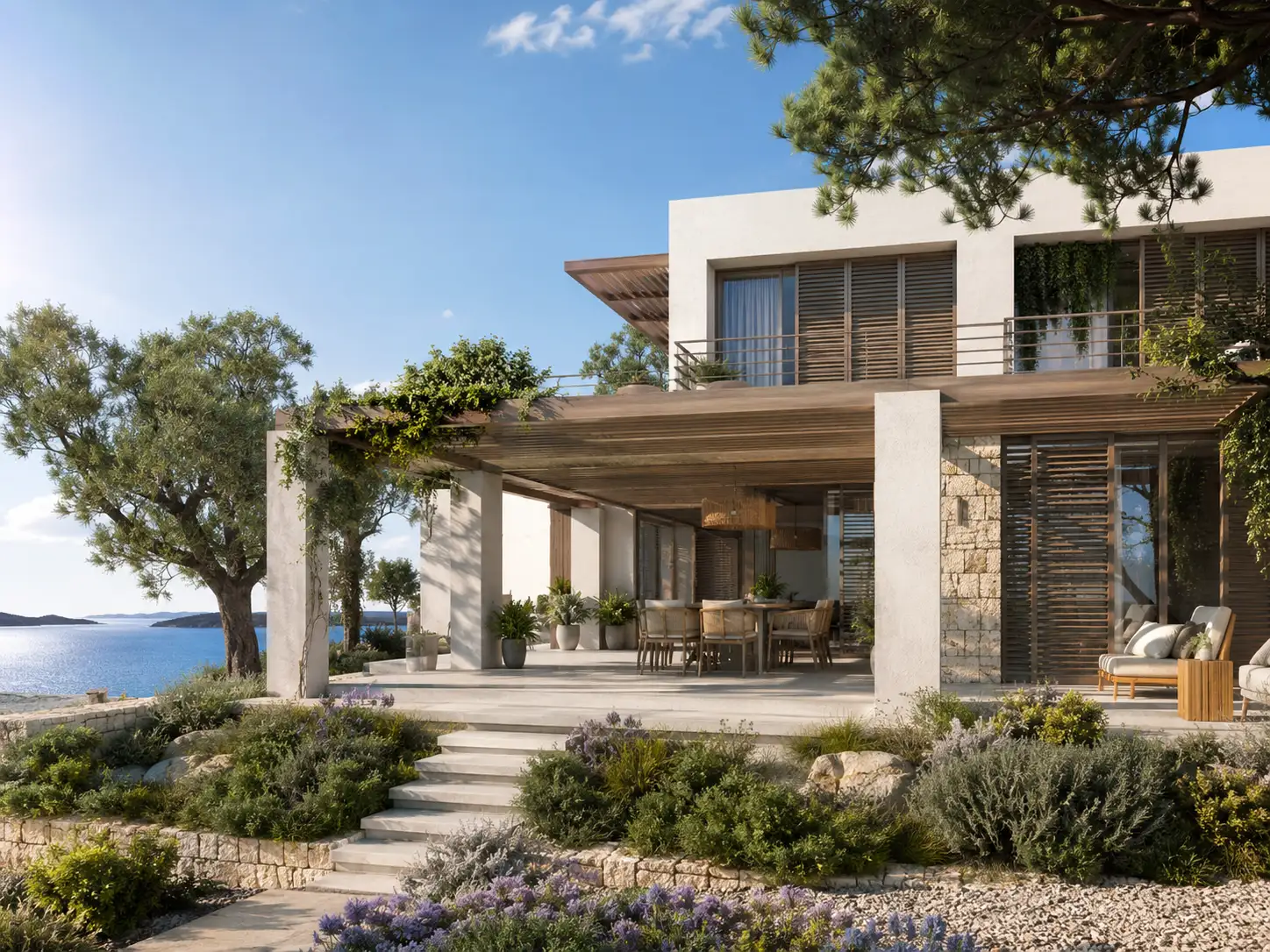
Pergolas are especially important for houses, villas, and apartments with larger terraces. They create a transition between the interior and exterior and allow the outdoor space to be used even during warmer days. In Mediterranean architecture, covered terraces and shaded zones often make the crucial difference between a space that looks good and a space that is actually used.
Natural ventilation and opening layout
Natural ventilation can significantly affect the comfort of a space. An apartment or house that can be ventilated from two sides cools down more easily in the evening and morning. Cross-ventilation is particularly valuable in coastal areas, where natural air currents can be utilized.
In apartments with single-sided orientation, ventilation is more limited, especially if all openings face the same side of the building. Such apartments can be comfortable if they have good joinery, shading, and air conditioning, but natural cooling will be weaker.
The layout of rooms also plays an important role. Bedrooms exposed to strong western sun all day can be uncomfortable in the evening, while a living space without ventilation possibilities may require more frequent use of air conditioning.
Professional advice:
When buying an apartment, check if multiple windows can be opened on different sides of the space. If cross-ventilation is possible, it is a great advantage for summer comfort.
Wall thickness, insulation, and materials
Materials have a great impact on how a space behaves during hot weather. Older stone houses often have thick walls that transmit heat more slowly, but they can have other challenges such as moisture, poorer roof insulation, or outdated installations. Therefore, with such properties, it is important to look at the entire system, not just one element.
In new construction, quality thermal insulation, joinery, protection against thermal bridges, roof insulation, and the selection of finishing materials are important. A well-insulated building can be more comfortable both in summer and winter, with lower energy costs.
Light facades, natural materials, wood, stone, ceramics, and quality floor coverings can contribute to a more pleasant feeling in the space. Dark materials on heavily sun-exposed surfaces can heat up strongly, especially on terraces, roof surfaces, and facade elements.
Outdoor space that remains usable in summer
A terrace, balcony, loggia, garden, or roof terrace can be a great advantage, but only if they are truly usable during the summer. An outdoor space without shade, without ventilation, and without protection from views often looks good in photos, but in practice, it is used very limitedly.
The highest quality outdoor spaces have at least a shaded part, seating possibilities, good connectivity to the living room or kitchen, and sufficient privacy. For houses, an outdoor shower, summer kitchen, greenery, trees, and materials that do not overheat are additional advantages.
On the coast, the outdoor space is often one of the most important elements of a property. Buyers want a terrace where they can have breakfast, relax, and stay in the evening, not just a surface that is exposed to the sun all day.
Professional advice:
When evaluating a terrace, don't just look at the square footage. Ask when the terrace is in the sun, whether it's possible to install an awning or pergola, and how protected it is from neighbors' views.
New construction and passive cooling
In new construction, buyers increasingly expect the project to be energy-efficient and functional throughout the year. This means it's not enough to just list the heating and cooling system; it's important to understand how the building is designed: apartment orientation, terrace depth, joinery quality, insulation, ventilation, and shading possibilities.
Good projects increasingly use passive solutions: properly positioned openings, covered loggias, external blinds, pergolas, green areas, quality facades, and systems that reduce overheating. Such solutions increase living comfort and can be an important selling point.
For top-floor apartments, roof insulation should be particularly checked, as these apartments often heat up more intensely. For ground-floor apartments, shade, garden, privacy, and moisture are important. For apartments with large glass walls, the type of sun protection is crucial.
What buyers should pay attention to
Before purchasing a property that needs to function well during the summer, buyers should check several elements. The first is the orientation of the main rooms. The second is the quality of shading. The third is the possibility of natural ventilation. The fourth is the condition of insulation, roof, joinery, and facade.
For older properties, it is additionally necessary to check for moisture, the condition of installations, the possibility of installing air conditioning, the condition of the roof, and any renovation restrictions, especially if the property is located in a protected zone or old town center.
For new construction, a technical description of the equipment should be requested, checking the energy class, joinery, heating and cooling system, shutters or blinds, roof and facade insulation, and details of outdoor areas. If the terrace, garden, or roof terrace is an important part of the price, their usable value should be clearly understood.
How Regent can help you
Regent Real Estate can help buyers to not only look at square footage, location, and price when choosing a property, but also at the actual quality of living throughout the year. For properties on the coast, in new construction, and in larger cities, it is increasingly important to understand how the space behaves in summer.
We can help buyers compare apartments, houses, and villas based on orientation, outdoor space, building quality, equipment, rental potential, and long-term usable value. We can help sellers properly highlight advantages such as shaded terraces, pergolas, good layout, natural ventilation, quality joinery, and energy efficiency.
For investment properties, it is especially important to recognize solutions that reduce maintenance costs and increase user satisfaction, whether for long-term rental, tourist rental, or a second home.
Frequently Asked Questions
What does a summer heat-resistant property mean?
It is a property that heats up more slowly, ventilates more easily, and allows for a comfortable stay during the summer with less need for constant cooling. Key elements are shade, orientation, ventilation, insulation, quality joinery, and material selection.
Is air conditioning enough for a comfortable apartment in summer?
Air conditioning helps, but it is not enough if the space is poorly designed or without sun protection. The best result comes from a combination of good shading, insulation, ventilation, and an efficient cooling system.
What is the best apartment orientation for summer?
There is no universally best orientation. East orientation is often comfortable as it brings morning sun, while west can be challenging due to afternoon heating. South orientation requires quality sun protection.
What is better: shutters, awnings, or a pergola?
It depends on the space. External shutters and blinds are very effective for windows and glass walls, awnings are good for balconies and terraces, and pergolas are particularly useful for larger outdoor spaces and houses.
What to look out for when buying a top-floor apartment?
One should check the quality of roof insulation, orientation, air conditioning, joinery, and whether there is sun protection. Top-floor apartments can be very attractive, but without good insulation, they can heat up more intensely.
Are old stone houses more comfortable in summer?
They can be, especially due to thicker walls, but that does not mean they are automatically energy efficient. One should check for moisture, roof, insulation, joinery, installations, and renovation possibilities.
Can a terrace increase the value of a property if it has no shade?
A terrace can be an advantage, but its real value depends on its usability. A terrace without shade or privacy has less functional value than a terrace that is protected, well-connected to the interior, and comfortable to use.
Recommended
Mediterranean style in contemporary architecture: why buyers love it so much
Energy class of a property: what do A-G labels mean and how they affect value and costs
Apartment orientation, floor, and layout: what affects living quality and property price
Holiday home: how to choose a location according to lifestyle