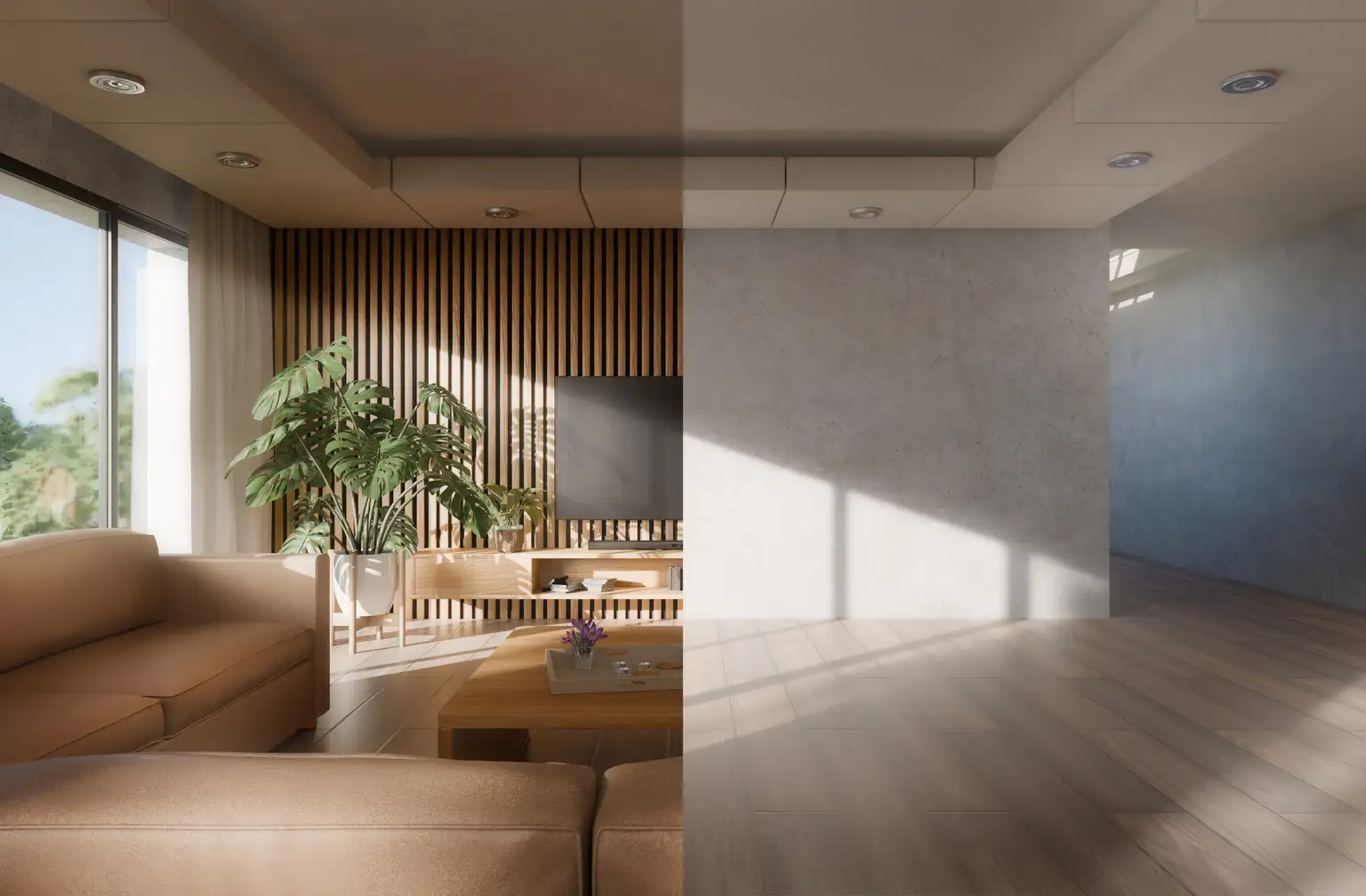
Converting commercial space to residential is an increasingly common undertaking in Croatian cities, especially in urban centers where residential properties command high prices, and commercial spaces remain empty.
This process offers interesting opportunities – whether you are looking for a home in the very heart of the city or planning an investment – but at the same time presents a series of legal, technical, and financial challenges that you should not underestimate.
The process requires obtaining appropriate permits, compliance with the spatial plan, and, in the case of buildings with multiple owners, the consent of co-owners — which can be one of the most demanding steps in the entire process.
What exactly do you need to know before you start?
Prerequisites and preparations for conversion
Before you start converting commercial space into residential space, several key prerequisites must be met. If you skip this phase, you may encounter costly delays or even a ban on further work.
Basic documentation to obtain:
- Certificate of ownership and extract from the land registry
- Location information from the competent spatial planning office
- Consent of building co-owners (if the space is in a multi-apartment building)
- Existing technical documentation of the building
According to the regulations on commercial spaces in buildings, the consent of unit owners is often a mandatory step that investors underestimate.
A significant role in the entire process is played by the surveyor — a specialist who prepares the cadastral survey necessary for registering the change of purpose in the cadastre.
Without this survey, legalization of the conversion is not possible.
In practice, thorough documentation preparation shortens the entire process by several months — which brings us to the specific steps of the process itself.
Step-by-step guide to conversion
Once the prerequisites are met, the conversion of space proceeds according to a clearly defined sequence of steps.
Each step has its purpose – skipping it means risking going back to the beginning.
Basic steps of the procedure
- Gathering documentation – location information, copy of the cadastral plan, and existing technical documentation of the building
- Developing a conceptual design – an authorized architect creates a project that proves the technical feasibility of housing
- Obtaining co-owner consent – especially important when it comes to conversion conditions in a partitioned building, where the consent of more than 50% of co-owners is often required
- Submitting an application for change of purpose – to the competent administrative department for spatial planning
- Registration and supervision of construction works – along with the final technical inspection
Without valid documentation and co-owner consent, no application for a change of purpose will be approved.
In practice, the duration of the entire process ranges from several months to a year, depending on the complexity of the intervention and the workload of the competent services.
More details on program conditions and advice are available through official sources.
When the procedural framework is clear, the next logical step is to understand the financial side of the entire process.
Costs associated with conversion
One of the first questions owners ask is – how much does the entire conversion process actually cost?
The answer is not simple because costs vary depending on the location, size of the space, and the scope of construction work.
Typical costs include:
- Architectural project and conceptual solution – depending on complexity, the price ranges from a few thousand to tens of thousands of euros
- Administrative fees and utility contributions – determined locally, but often overlooked in the initial calculation
- Construction and installation works – adaptation of heating, ventilation, and sanitary systems
The question of why HEP change of category comes up here – a change in the purpose of the space automatically changes the tariff group of the electricity consumer, which has administrative and financial consequences.
In practice, the total conversion costs can easily exceed initial estimates by 20–30%.
Good financial preparation is key – but legal limitations, which we will discuss in the next chapter, are equally important.
Legal and regulatory obstacles
In addition to the costs we have already discussed, owners also face less tangible but equally challenging obstacles – legal and regulatory barriers. These can significantly prolong the entire process, and sometimes even halt it completely.
The application for the conversion of commercial space goes through several regulatory layers.
Local spatial plans often define the purpose of zones, so a change is not always legally permitted without amending the plan itself. This is the most time-consuming scenario.
Additionally, the documentation for conversion must comply with the valid Construction Act and the Spatial Planning Act.
Incomplete or incorrect documents are the most common reason for rejection of applications.
Key obstacle that many underestimate: consent of building unit owners is necessary when changing the purpose of common space or facade.
Understanding these obstacles raises the question – is it even worth going through this process?
We discuss the advantages and disadvantages of conversion in the next chapter.
Advantages and disadvantages of conversion
After discussing the costs of conversion and legal obstacles, it is worth pausing and considering the bigger picture – what does the owner actually gain, and what might they lose with this intervention?
Key advantages
- Increased market value of the property, as residential spaces generally achieve a higher price or rent than commercial ones
- A wider circle of buyers or tenants – demand for apartments is more stable than demand for offices
- The possibility of using incentive measures intended for the residential sector
- Solving the problem of empty, unused commercial spaces
Potential disadvantages
- Space conversion - the cost can be high, especially if extensive construction interventions are required
- Long-term process of obtaining permits
- Restrictions from neighboring co-owners or the building community
In practice, the decision to convert is worthwhile when the ratio of investment to expected property value is favorable. It is worth emphasizing, however: conversion costs alone are not the only financial factor to consider – there are also local charges, which deserve special attention.
Impact of conversion on local taxes and fees
When the advantages and disadvantages are clear, many owners forget one practical aspect – how converting commercial space to residential changes tax obligations and utility fees. And a change in the purpose of the space almost always means a change in fiscal obligations.
The utility fee is one of the first costs that changes.
Commercial spaces typically have a higher utility fee rate than residential ones, which means conversion can result in lower annual costs. However, it is worth checking local decisions as each local self-government unit determines its own coefficients.
In addition to the utility fee, the property tax also changes, and if necessary, utility infrastructure connections.
Conversion conditions in certain cities may also include a one-time administrative fee or utility contribution.
Changing the purpose of space is not just an architectural decision – it is also a financial decision with long-term tax consequences.
For the theory to come to life, it is useful to look at concrete examples from practice.
Conversion examples and scenarios in practice
Theory is one thing, but concrete scenarios help understand how conversion works in real circumstances. Consider a few typical situations that owners regularly encounter.
Scenario 1
– former office in a residential building: The owner wants to convert 60 m² of commercial space in the city center into an apartment.
The space has natural lighting and a separate entrance.
Since the technical conditions are met, obtaining a building permit proceeds relatively quickly, but the consent of the building co-owners is required.
Scenario 2
– ground floor location without windows: The space does not meet the minimum lighting requirements.
Conversion is not possible without an expensive construction intervention – making the project unprofitable.
Successful conversions almost always have a common denominator: good documentation preparation and realistic cost assessment in advance.
As can be seen through the previous aspects – from taxes to legal obstacles – every detail plays a role.
Precisely because of this, owners often ask the same questions, which we will answer below.
Frequently asked questions about converting commercial space to residential
Through the scenarios and examples described above, it is clear that conversion raises a series of practical questions.
Here are the answers to those that appear most often.
Is a new occupancy permit required?
Yes. Every conversion requires obtaining a new occupancy permit that confirms the space meets the conditions for housing.
How long does the entire process take?
In practice, from the initial application to moving in, the process takes between six months and two years, depending on the local administration and project complexity.
Can I rent out the apartment immediately?
After obtaining the occupancy permit and changing the purpose in the cadastre – yes.
Do the same rules apply to all municipalities?
No. Each local self-government unit has specific spatial plans that can further restrict or facilitate conversion.
Understanding these questions makes preparation of higher quality – and more on the key steps for successful implementation below.
Key information for successful conversion
Converting commercial space into an apartment is a complex process that requires patience, good preparation, and knowledge of regulations.
A few key points are worth keeping in mind before even starting the procedure.
Documentation is the foundation of everything.
Without proper technical and legal documentation, there is no progress — each step depends on the previous one.
Check the certificate of ownership, existing purpose in the spatial plan, and the building permit.
In a partitioned building, special attention should be paid to co-owner consent and rules for managing common parts. In practice, this step often surprises investors who have underestimated the importance of agreements with neighbors.
Good preparation and timely consultation with experts shorten the implementation time and reduce the risk of costly mistakes.
Successful conversion opens the door to another important question – how does the change of purpose affect the market value of the property itself.
How does the conversion of commercial space to residential affect the market value of the property?
Conversion can significantly increase the market value of the property – but the outcome is not always clear-cut.
Residential space in urban centers achieves a significantly higher price per square meter than commercial space with comparable characteristics. This is precisely the key economic logic behind the increasingly popular conversion.
The value after conversion depends on several factors:
- Location and purpose according to the spatial plan – properties in zones with high demand for apartments achieve better prices
- Quality of performed works – the standard of adaptation directly affects the perceived value
- Area and functional layout – larger and clear floor plans attract a larger number of buyers
A well-executed conversion can increase the value of the property by up to 30–40% compared to its previous commercial purpose.
However, poor execution or disharmony with the surroundings can have the opposite effect.
It is worth noting that even after the conversion is completed, certain challenges remain – from technical to administrative. The next chapter discusses what most often slows down or blocks the entire process.
What are the most common obstacles in the process of converting commercial space to residential?
Even with good preparation, conversion rarely goes without challenges.
Knowing the typical obstacles in advance can save weeks – even months – of lost time.
Most common obstacles include:
- Spatial plans that do not allow residential use – if the spatial planning law and local spatial plan do not foresee housing in that location, the procedure fails at the first check
- Technical shortcomings of the space – insufficient ceiling height, poor natural ventilation, or inadequate lighting often require expensive construction interventions
- Co-owner consent – in mixed residential-commercial buildings, other co-owners can block or slow down the entire process
- The lengthiness of the bureaucratic procedure – issuing permits sometimes takes longer than six months
Successful conversion requires patience and flexibility – even a well-planned project can encounter an unexpected obstacle at the last minute.
It is worth noting that the financial implications do not end with obtaining permits – changing the purpose of the space directly affects utility fees and local taxes that you will pay for years to come.
How does conversion affect utility fees and other local taxes?
Converting commercial space to residential brings concrete financial changes that owners often underestimate.
The utility fee directly depends on the purpose of the space – residential units typically pay a lower rate than commercial spaces, which means successful conversion can reduce regular costs.
After the main project receives confirmation and the space is registered as residential, the basis for calculating the utility fee, property tax, and utility contribution also automatically changes.
Local self-government units adjust the decisions according to the new purpose in the land registry.
Changing the purpose in the cadastre and land registry is a prerequisite for all tax and administrative corrections – without updated registration, old obligations remain in force.
Brief overview of changes:
- Utility fee – usually lower for apartments
- Property tax – depends on local decision
- Utility infrastructure connection costs – possible additional costs
Conclusion: Is converting commercial space to residential worthwhile?
Converting commercial space to residential can be an extremely profitable move – whether you want to increase the value of your property, achieve higher rent, or convert unused space into a functional home. However, as we have stated, it is a process that requires detailed planning, quality documentation, and a good understanding of all legal, technical, and financial aspects.
From checking the spatial plan and obtaining co-owner consent, through developing project documentation, to obtaining permits and carrying out works – each step plays a crucial role in successful realization.
Precisely because of this, before entering into the project, it is important to conduct a realistic assessment of profitability and consult with experts who will guide you through the process.
If you are considering converting commercial space into an apartment or want to assess the market potential of your property before investing, our expert team can help you make an informed decision and avoid costly mistakes.
Contact us and find out how to maximize the value of your property with expert guidance, market assessment, and individual investment advice.