Summary
The luxury home of the future will not be defined by the costliness of materials, but by the integration of technology, sustainability, and well-being — and the directions are already visible in today's trends. Instead of a mere "smart home," it is shaped by flexible spaces that adapt to needs, artificial intelligence that predicts and manages the home, wellness as an integrated part of life, energy self-sufficiency, and the growing importance of privacy, security, and the home's connectivity to services. These are emerging trends, not certain predictions. In this guide, we break down the directions in which luxury housing is moving and what they mean for property values.
Key facts
- Luxury is redefined from the opulence of materials to the quality of life that a home provides.
- Flexible spaces that adapt to needs replace fixed room functions.
- Artificial intelligence moves the home from "smart" to one that anticipates and self-manages.
- Wellness and energy self-sufficiency become built-in, expected parts of a premium home.
- Privacy and security are increasingly valuable, almost a new definition of luxury.
- These are emerging trends, not certain predictions of the future.
The luxury home of the future will not be defined by the costliness of materials, but by the integration of technology, sustainability, and well-being — and the directions are already visible in today's trends. Instead of a mere "smart home," it is shaped by flexible spaces that adapt to needs, artificial intelligence that anticipates and manages the home, wellness as an integrated part of life, energy self-sufficiency, and the growing importance of privacy, security, and the home's connection to services. These are emerging trends, not certain predictions. In this guide, we break down the directions in which luxury housing is moving and what they mean for property values.
To imagine what a luxury home will look like in a decade means observing the direction in which premium housing is already moving today. The definition of luxury is changing: while it once primarily meant lavish materials and size, it increasingly means the quality of life that a home enables — comfort, health, safety, efficiency, and harmony with technology and nature. The luxury home of the future will not only be beautiful and expensive, but intelligent, adaptable, and focused on the well-being of those who live in it. Before we begin, an important caveat: no one can predict the future with certainty, so this text is not a prophecy, but a consideration of emerging trends and a reasonable projection of where they are heading. Technology and preferences may surprise, but the directions we are discussing — from artificial intelligence and energy self-sufficiency to wellness and privacy — are already shaping premium properties today. In this guide, we break down these directions: flexible spaces, the role of artificial intelligence, wellness, energy independence, privacy and security, and connecting the home with services — and what they mean for the future of luxury living.
Contents
- Luxury redefined: from lavishness to quality of life
- Flexible spaces that adapt
- Artificial intelligence: a home that anticipates
- Wellness as an integrated part of the home
- Energy self-sufficiency and sustainability
- Privacy and security as the new luxury
- Home connected to services
- What this means for property values
- Frequently Asked Questions
Key Insights
- Luxury is being redefined from lavish materials to the quality of life the home provides.
- Flexible spaces that adapt to needs are replacing fixed room uses.
- Artificial intelligence moves the home from "smart" to one that anticipates and self-manages.
- Wellness and energy self-sufficiency are becoming integrated, expected parts of a premium home.
- Privacy and security are increasingly valuable, almost a new definition of luxury.
- These are emerging trends, not certain predictions for the future.
Luxury redefined: from lavishness to quality of life
The first and most important change is not technical, but conceptual: the very meaning of luxury is changing. Traditionally, a luxury home meant expensive materials, size, and lavishness — marble, large square footage, a prestigious address. These elements do not disappear, but increasingly give precedence to another type of value: the quality of life the home provides. Contemporary and future luxury is increasingly measured by comfort, health, safety, efficiency, and harmony, and not just the price of built-in materials. This change explains all subsequent trends. Artificial intelligence, wellness, energy independence, privacy — all respond to a new understanding of luxury as quality of life, not mere possession of expensive things. The luxury home of the future will be luxurious in how one lives in it: how comfortable, healthy, safe, and adapted it is to its inhabitants, how much it simplifies daily life and enhances well-being. Lavishness becomes the backdrop, while experience and quality of life come to the forefront.
Professional tip: When considering a premium property as an investment in the future, look beyond materials and square footage — value is increasingly carried by the quality of life, technology, and sustainability the home offers, as this is precisely what defines the luxury the market is moving towards.
Flexible spaces that adapt
One of the most pronounced trends is the shift from rooms with a fixed, single purpose to flexible spaces that adapt to changing needs. The way we use our homes is changing — working from home, evolving family needs, the desire for the same space to serve different purposes at different times — and the home of the future responds to this with spaces not confined to a single function. A room that is an office today, tomorrow is a guest room or a workout space; open areas divided and connected by partitions and movable elements as needed. This flexibility responds to a reality where living patterns change faster than before. Working from home has made a workspace essential, but not necessarily permanent; families expand and change; people want a home that grows and changes with them, not one that forces them to move as soon as needs change. In the luxury segment, this means thoughtfully designed, adaptable spaces and solutions that give a single home more "life" over time. Adaptability becomes a form of luxury because it extends the usefulness and relevance of the home.
Professional tip: When evaluating a premium property for the future, pay attention to how adaptable the space is — a home whose rooms can be repurposed without major interventions retains value and utility longer than one locked into fixed, single-purpose rooms.
Artificial intelligence: a home that anticipates
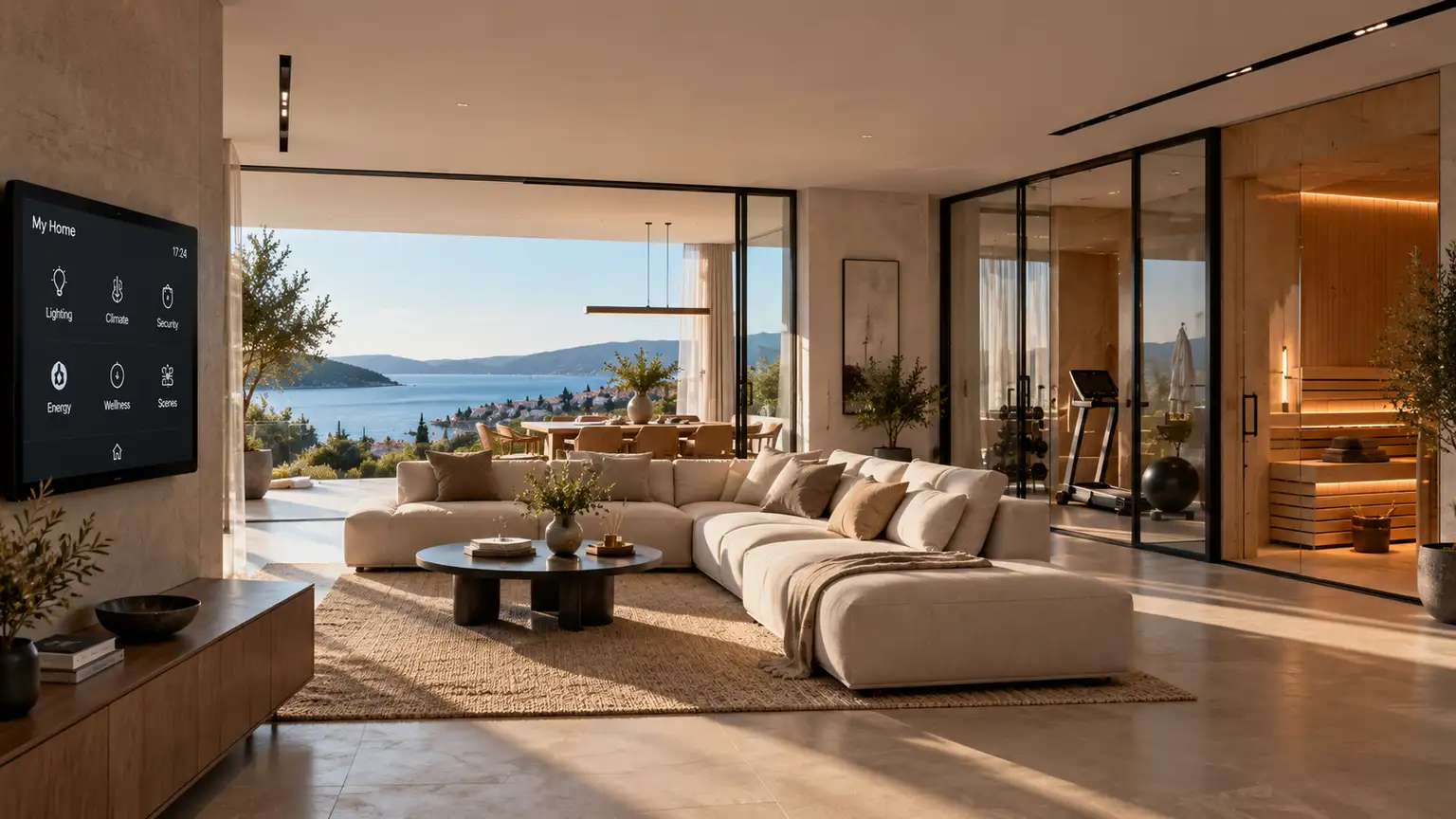
The concept of a "smart home" is already familiar, but the trend goes a step further — from a home that is controlled to a home that anticipates and adapts itself. Until now, a smart home primarily meant remote control of devices; artificial intelligence moves it towards a home that learns its occupants' habits and proactively responds to them. Instead of a person adjusting temperature, lighting, or systems, the home anticipates and adjusts itself, based on patterns and context. In practice, this can mean a home that learns the rhythm of life and adjusts climate, light, and systems in advance; that manages energy optimally; that connects security, wellness, and daily functions into one intelligent system. This is a direction already emerging in technology development, although it is impossible to precisely say how far it will go in a decade. For a luxury home, this means a shift from a collection of devices to integrated intelligence that makes life easier and more comfortable, almost imperceptibly. The key value is not technology itself, but the comfort and simplicity it brings.