Summary
Saunas, spa areas, and private pools are increasingly moving from hotels and wellness centers into private homes — part of a growing trend in which the home is transforming into a place of rest and self-care. It is driven by lifestyle changes: working from home, a greater valuing of health and privacy, and the desire not to have to "seek out" relaxation outside the home. For the real estate market, this means that wellness amenities are becoming a recognizable feature of premium villas and new constructions, which increases their value and desirability. In this guide, we explain why the trend has emerged, which wellness zones are most commonly installed, and what you need to know before incorporating them into your own home.
Key facts
- Home wellness is a growing trend driven by working from home and valuing health and privacy.
- Sauna, spa area, and private pool are the most common elements of home wellness.
- A well-designed wellness zone requires consideration of space, installations, and atmosphere, not just the equipment.
- Wellness facilities are becoming a distinguishing feature of premium villas and new constructions.
- High-quality wellness facilities increase the value and desirability of the property, as well as demand.
- Before installation, technical, spatial, and cost requirements should be taken into account.
Saunas, spa areas, and private pools are increasingly moving from hotels and wellness centers into private homes — they are part of a growing trend in which the home is transformed into a place of rest and self-care. This is driven by changes in lifestyle: working from home, greater appreciation for health and privacy, and the desire to not have to "seek" relaxation outside the home. For the real estate market, this means that wellness facilities are becoming a recognizable characteristic of premium villas and new constructions, which increases their value and desirability. In this guide, we explain why the trend occurred, which wellness zones are most commonly integrated, and what you need to know before introducing them into your own home.
Until recently, a sauna after a workout, relaxing in a spa area, or swimming in a pool were activities one went out for — to a hotel, a wellness center, or on vacation. Today, more and more people want these amenities at home, accessible daily, without reservations, crowds, or travel. Wellness at home has ceased to be an eccentric luxury reserved for the few and has become a recognizable aspiration in the design of modern premium homes. This shift is not accidental but a reflection of deeper changes in how we live and what we expect from a home. Home is no longer just a place to live, but also for work, recovery, health care, and an escape from everyday stress — all under the same roof. In this guide, we examine why saunas, spa areas, and private pools have become part of this story, which wellness zones are most commonly introduced into homes, how they are well-designed, and what this trend means for the value and desirability of properties, especially luxury villas and premium new constructions.
Table of Contents
- Why wellness has entered the home
- Sauna as a central element of home wellness
- Spa zones: from bathtub to complete oasis
- Private pool: indoor and outdoor
- How to properly design a wellness zone
- Wellness and property value
- What to consider before installation
- Frequently Asked Questions
Key Insights
- Home wellness is a growing trend driven by remote work and the appreciation of health and privacy.
- Sauna, spa area, and private pool are the most common elements of home wellness.
- A well-designed wellness zone requires thoughtful consideration of space, installations, and atmosphere, not just equipment.
- Wellness amenities are becoming a recognizable characteristic of premium villas and new constructions.
- High-quality wellness amenities increase property value, desirability, and demand.
- Before installation, technical, spatial, and cost requirements should be considered.
Why wellness has entered the home
The shift of wellness into private homes is the result of several simultaneous changes in lifestyle. The first is the rise of working from home, which has blurred the line between work and home and increased the need for the home to also be a place of recovery, not just an extension of the office. When more time is spent at home, the desire grows for the house to provide what one used to go out for — relaxation, recreation, self-care. The second change is the increasingly pronounced valuing of health and mental well-being, where regular body care and relaxation cease to be an occasional luxury and become part of a daily routine. The third driver is privacy and comfort. For many, the value of home wellness lies precisely in its privacy, availability at all times, and without the limitations of public spaces — no opening hours, crowds, or sharing space with strangers. Additionally, technological advancements have made wellness facilities more accessible and adaptable to the home than before, from compact saunas to pools adaptable to various spaces. The sum of these changes has transformed home wellness from a rare extravagance into a recognizable aspiration of modern living.
Professional advice: If you are considering home wellness amenities, start by thinking about how you actually live — a sauna or pool makes sense when it fits your daily routine and habits, not when it's just a status symbol rarely used.
Sauna as a central element of home wellness
The sauna is often the first and most recognizable element of home wellness, as it combines proven benefits with relatively accessible installation. The warmth of a sauna is associated with muscle relaxation, a feeling of recovery after exertion, and a calming ritual at the end of the day. Unlike a pool, a sauna requires less space and can be placed in a dedicated room, next to a bathroom, or as part of a wellness zone, making it feasible even in homes without space for larger interventions. There are several types, and the choice depends on preferences and space. A classic Finnish (dry) sauna operates at high temperatures and low humidity, while an infrared sauna uses a lower temperature and a different heating principle, making it more comfortable for some and easier to install. A steam sauna, on the other hand, offers moist heat. Each type has its characteristics, requirements, and experience, so the choice is adapted to both personal taste and the technical possibilities of the space. Materials, especially quality wood, and the feeling a sauna creates are part of its value as much as its function itself.
Professional advice: Before choosing a sauna type, try different kinds (Finnish, infrared, steam) where you can — the experience varies significantly, and a sauna you truly love to use is a much better investment than one that technically fits but isn't comfortable for you.
Spa zones: from bathtub to complete oasis
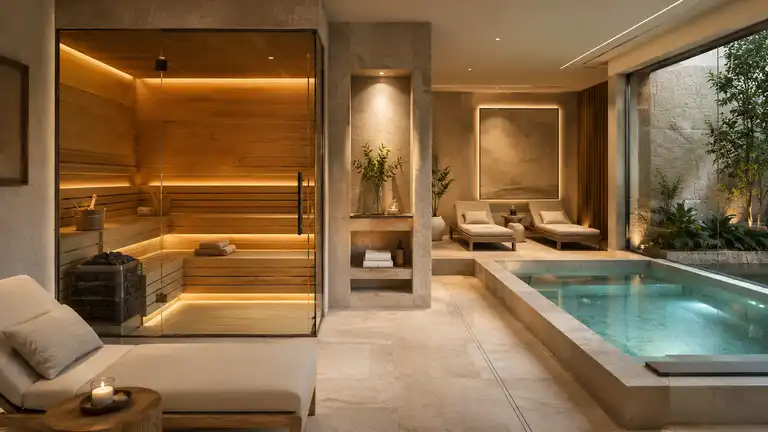
A spa zone is a broader concept that encompasses a range from simple to fully equipped solutions, adapting to both space and budget. At the simpler end is a luxurious bathroom transformed into a place of relaxation — a freestanding bathtub, pleasant lighting, quality materials, and a carefully designed atmosphere that elevates an ordinary bathroom into a small private spa. Such a solution is available without major construction work and is for many the first step into home wellness. At the more elaborate end are true spa zones that combine multiple amenities — a sauna, steam bath, hydromassage tub or jacuzzi, experience showers, and a relaxation area. In such zones, atmosphere and completeness are key: subdued lighting, natural materials (stone, wood), calming colors, and thoughtful illumination transform a series of devices into a true oasis. It is this sense of wholeness that distinguishes a spa zone that functions as a luxurious retreat from one that is merely a collection of expensive gadgets. A good spa zone is designed as an experience, not a list of equipment.
Professional advice: Invest in the atmosphere as much as in the equipment — light, materials, and a holistic experience are the difference between a spa zone that feels like a true retreat and an expensive bathroom full of gadgets that don't create a sense of relaxation.
Private pool: indoor and outdoor
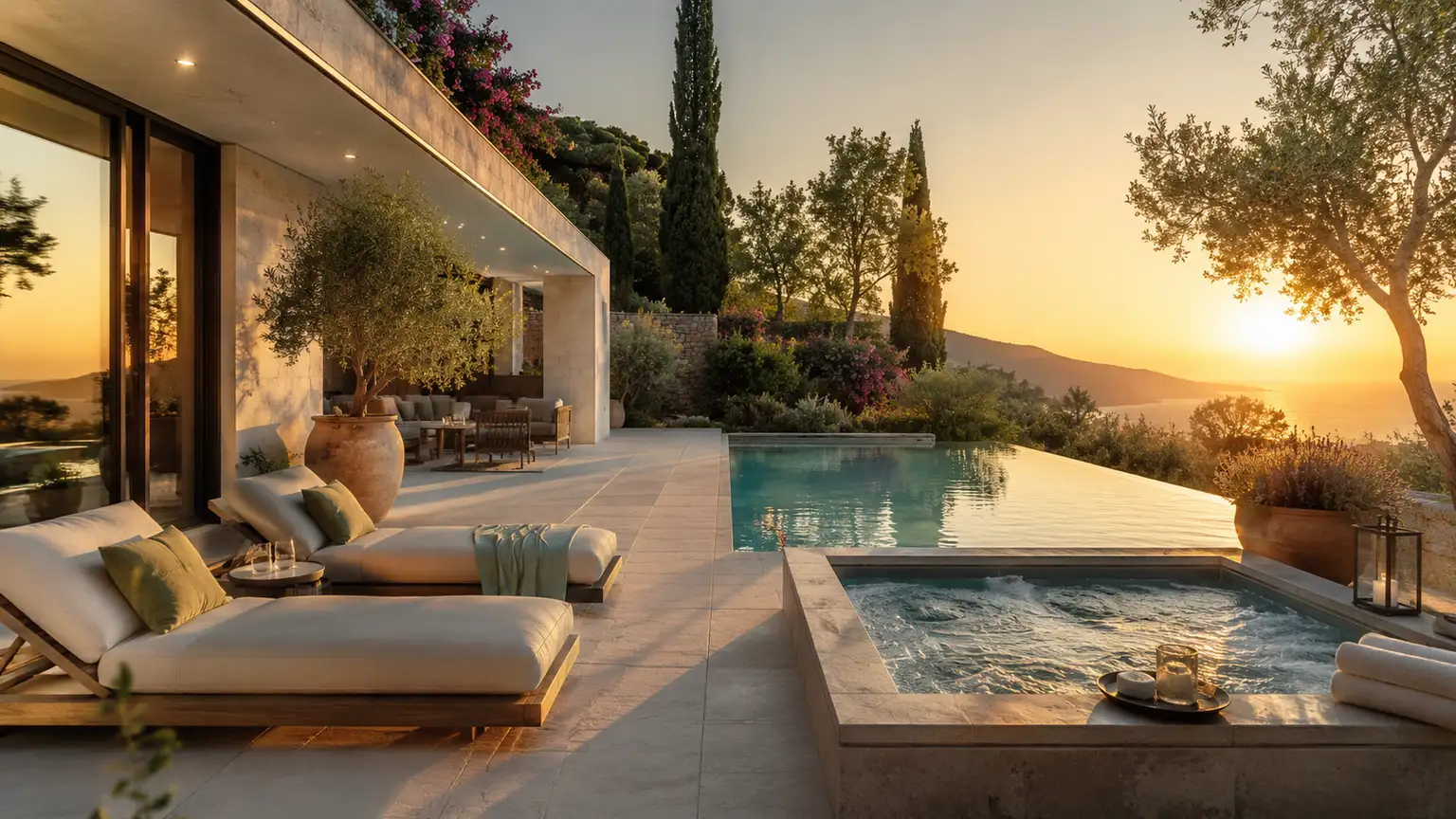
A private pool is the most ambitious and recognizable element of home wellness, coming in two basic variants with different characteristics. An outdoor pool naturally fits the Mediterranean context — in the garden or on the terrace of a villa, connected to outdoor living, sun, and views, often the heart of summer outdoor living. In addition to refreshment, it is also a visual and social focal point of the space, a gathering place, and an extension of daily outdoor life during warmer months. An indoor pool, on the other hand, offers year-round use regardless of weather and season and greater privacy, but requires significantly more in terms of space, construction, and maintenance, including humidity and climate control of the area. There are also more compact solutions, such as smaller pools or pools with counter-currents for swimming in place, which bring part of the experience into a smaller space. Regardless of the type, a pool is the largest intervention in home wellness — it most enhances the experience and value, but also demands the most in planning, execution, and maintenance. Technical and spatial planning requirements for pool construction, necessary permits, and installations should be checked with the competent authorities before the intervention, as they vary from case to case.
Professional advice: When it comes to pools, realistically assess not only the construction cost but also ongoing maintenance and consumption — a pool that is used and maintained is a pleasure and a value, while a neglected one becomes a burden; therefore, plan it according to your actual usage.
How to properly design a wellness zone
A successful wellness zone is not just the sum of purchased equipment, but a thoughtfully designed space, so good planning begins before purchasing any device. It is crucial to think about the whole: where the zone is placed in relation to the rest of the home, how it is accessed, how the rooms within it flow into one another (for example, from the sauna to the shower to the relaxation area). A wellness zone functions best when it is somewhat separated from the daily hustle and bustle of the home, as a place one "enters" for relaxation, rather than a casual space. In addition to the layout, the atmosphere and technical foundation are crucial. The atmosphere is built by natural materials, subdued and warm lighting, calming colors, and sound insulation that separates the relaxation zone from noise. The technical foundation — installations, ventilation, humidity control, heating, and cooling — is invisible but crucial, as wellness facilities create humidity and heat which, if poorly managed, damage the space. Therefore, a serious wellness zone is designed with experts who understand both the aesthetic and technical side, ideally already in the house design phase, not as a subsequent addition.
Professional advice: Plan your wellness zone as early as possible, preferably during the house design phase — subsequent installation of a sauna, spa zone, or pool into an existing space is almost always more expensive and technically more demanding than a solution planned from the outset.