Buying a property is one of the most important financial decisions in your life — and the legal security of that decision depends on documents that many buyers only glance at. The property ownership certificate (vlasnički list), the land registry and the cadastre are not mere administrative formalities; they are the foundation on which every property title in Croatia rests.
In practice, a lack of understanding of these documents can cost a buyer far more than any difference in the asking price. Discrepancies between the cadastral and land registry records, a hidden mortgage or an unregistered easement — these are all risks that remain invisible to those who do not know where and what to look for.
According to the Ministry of Justice of the Republic of Croatia, land registry books are public records in which real rights over properties are entered, ensuring transparency and protection for all parties involved in legal transactions.
This guide walks you through everything you need to know — from how to find and read a property ownership certificate and understand the difference between the land registry and the cadastre, to correcting discrepancies and avoiding the most common mistakes.
How to Find and Read a Property Ownership Certificate
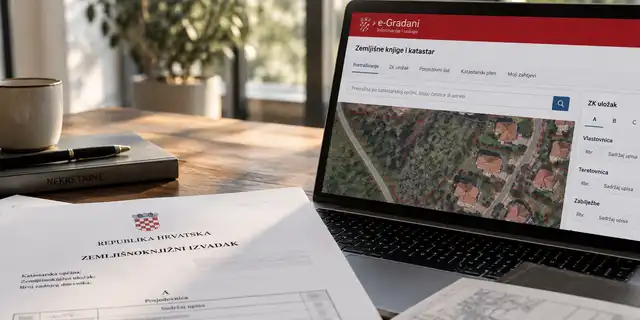
The property ownership certificate online is available to everyone — completely free of charge. The fastest way to access it is through the Uređena zemlja online portal, where you can review the land registry without visiting a court or waiting in line. All you need is the cadastral municipality name and the plot number of the property you are interested in.
What to look for when reading it?
The property ownership certificate is structured into three key sections:
- Section A — contains cadastral data about the property: area, type and location of the plot
- Section B — lists the owner or holder of the property title
- Section C — shows encumbrances, mortgages and restrictions on the property
In practice, buyers most commonly make mistakes here — they check Section B but overlook Section C. Any registered encumbrance can significantly affect the value or free disposal of the property. It is worth familiarising yourself with the key terms before reading the document for the first time.
The legal status of a property is always what is recorded in the land registry — without exception.
Understanding how the land registry functions as the foundation of legal security throughout the entire property purchase process in Croatia is essential for every serious buyer.
The Role of the Land Registry in Legal Security
The property ownership certificate is a window into the land registry — and the land registry itself is the cornerstone of legal security in every property transaction in Croatia. Without it, buying and selling property would be a game of chance.
According to the Ministry of Justice of Croatia, entry into the land registry is the only legally recognised way of acquiring ownership of a property. Ownership does not arise from signing a contract, but from the moment of entry into the public register — this is the so-called principle of constitutive registration. The practical conclusion: a buyer who is not registered in the land registry is, technically, not yet the owner.
How to check who owns a property in Croatia? The answer is always the same — in the land registry. The cadastre provides a physical description of the plot, but ownership and legal relations are governed exclusively by the land registry. Both systems together form a complete picture of any given property.
Checking encumbrances on a property is one of the most important steps in a thorough review of documentation.
Registration protects you from:
- Double selling — the seller cannot sell the same property to two buyers
- Hidden encumbrances — mortgages, easements and enforcement proceedings are visible to all
- Inheritance disputes — registration resolves unclear co-ownership arrangements, and understanding how co-ownership works legally is worth doing already at the negotiation stage
The land registry is a living document — it is updated continuously, so always request a current extract, no older than 30 days. The next step in understanding a property lies in the cadastre, which adds a physical and spatial dimension to that legal picture.
The Croatian Cadastre: What You Need to Know
While the land registry — colloquially also known as the gruntovnica — records the legal relations tied to a property, the cadastre deals with something entirely different: the physical and technical data about land and buildings. These are two separate but interconnected systems that together provide a complete picture of every property.
The cadastre records:
- Cadastral plots — exact boundaries and area of the parcel
- Land use — whether the land is designated for construction, agriculture or forestry
- Building data — floor plan, type and area of structures
In practice, property buyers often overlook the cadastre and focus exclusively on the ownership certificate. This is a mistake. Discrepancies between cadastral and land registry records are common, especially with older properties, and can significantly slow down or even block the registration of ownership. You can read more about how physical and legal data must be aligned in our guide.
Property legalisation is another aspect that concerns the cadastre — unlegalised structures, so-called properties without papers, cannot be properly recorded, which directly affects the possibility of sale. Detailed information on why legalisation matters is available separately.
It is precisely to better connect these two systems that an integrated digital tool was developed to facilitate their simultaneous verification — which is what the next section covers.
The Joint Information System of Land Registry Books and Cadastre (ZIS)
The Joint Information System of Land Registry Books and Cadastre (ZIS) is a platform that brings together data from both registers in one place, making the verification of a property before purchase faster and more transparent than ever — and completely free of charge.
How does ZIS work in practice?
Through the online property search portal, you can access key data in just a few steps:
- Land registry extract — legal status of the property, owner, encumbrances and restrictions
- Possession sheet — cadastral data on area and land use
- Copy of the cadastral plan — a graphic representation of the plot
The system is available 24/7, without the need to visit a court or cadastral office, which is particularly valuable when making an initial assessment of a property — even before engaging a legal adviser.
The digital integration of the land registry and cadastre significantly reduces the risk of hidden legal encumbrances — provided that you always request an up-to-date extract immediately before signing any contract.
The legalisation status of a structure, which can affect the validity of registration, is worth checking separately — insufficiently documented properties can be a source of costly surprises. That is precisely why knowing how to accurately compare data between the land registry and the cadastre is essential.
How to Compare Data Between the Land Registry and the Cadastre
Understanding the difference between the two systems is only half the work — the key practical question is: what exactly is being compared and how do you identify discrepancies?
The comparison rests on several concrete checkpoints:
- Cadastral plot — the number and area must be identical in both systems
- Ownership data — the name of the registered owner in the land registry must match the cadastral records
- Land designation and type — the classification (construction, agricultural, forestry) must be consistent
Special attention should be paid to the posjedovnica (possession sheet) — a cadastral document describing the physical characteristics of the plot. If the data in the possession sheet differs from the land registry extract, that is a clear warning sign.
In practice, discrepancies arise due to delayed registrations, inherited changes or illegally carried out works. Data inconsistency is one of the most common reasons for delays or the collapse of property transactions.
For a quick check, the integrated Uređena zemlja platform is recommended, where both registers are available in one place. For more complex situations, professional assistance with documentation can save considerable time and prevent costly mistakes.
When discrepancies are discovered — what next? That is what the following step covers.
The Process of Resolving Discrepancies Between the Land Registry and the Cadastre
When a data comparison reveals a discrepancy, the next logical step is to initiate a correction procedure. In practice, this process is not always quick, but it is structured and predictable if you know the order of steps.
Who initiates the procedure? The initiative can be taken by the property owner, but also by the competent court or cadastral office if they discover a discrepancy themselves. The owner listed in the ownership section (Section A of the land registry entry) must be consistent with the cadastral records — any difference creates legal uncertainty.
The correction steps typically look like this:
- Identification of the problem — establishing whether the discrepancy relates to area, boundaries, cadastral classification or ownership data
- Geodetic survey — a licensed surveyor prepares a survey report which is submitted to the cadastre
- Cadastre update — the cadastral office updates the data and issues a confirmation
- Entry into the land registry — on the basis of cadastral documents, a proposal is submitted to the court for registration of changes in the land registry
The procedure can take anywhere from a few weeks to several months, depending on the complexity of the case and the workload of the competent offices. It is important to know that discrepancies do not resolve themselves — ignoring a problem today can significantly complicate the sale or mortgaging of a property in the future.
One of the particularly sensitive cases requiring thorough examination is the inheritance of property — a subject with its own specific considerations in terms of title registration.
Inheriting Property and Registration in the Land Registry
If you are buying a property whose current owner inherited it, or if you yourself are going through an inheritance process, this chapter is particularly relevant to you. The probate proceedings before a court or notary public are just the beginning — the key step that many people forget is the registration of ownership rights on the basis of a final and binding inheritance decision.
A final inheritance decision does not automatically transfer ownership in the land registry. The heir must submit a registration proposal to the competent land registry court, attaching the decision and a certificate of finality. According to guidance from the Ministry of Justice, proof of payment of the court fee must also be included with the proposal.
Particular attention should be paid to the encumbrance section — the third section of the land registry entry. Through inheritance, all registered mortgages, pledges or real easements are also assumed. In practice, it is not unheard of for an heir to become the owner of a property burdened with the deceased's loan — without being aware of it.
Key steps when inheriting a property:
- Obtain the final and binding inheritance decision
- Submit a registration proposal to the land registry court
- Check the encumbrance section for any liabilities or obligations
- Align the data with the cadastral records
For those who wish to avoid administrative pitfalls, professional assistance with registrations can significantly speed up the entire process. Just as we described in the section on correcting discrepancies, here too precise documentation determines the outcome — and the mistakes that are commonly made are the subject of the next chapter.
Common Mistakes When Checking the Property Ownership Certificate and Cadastre
Although the previous chapters have covered verification and correction procedures in detail, property buyers in Croatia repeatedly encounter the same, predictable mistakes. Knowing these pitfalls can save you a great deal of time — and money.
The most common mistakes to avoid:
- Checking only one document — many buyers review the ownership certificate but neglect to compare it with the cadastral data or the possession sheet, which shows who is actually using the land
- Relying on outdated extracts — a land registry extract older than 30 days may be out of date; always request a current one
- Ignoring encumbrances and restrictions — mortgages, easements and annotations hidden in Section C often go unnoticed
- Skipping the cadastre check — discrepancies between the registered and actual area of a property can cause serious legal complications
- Overlooking illegal construction — properties without papers or illegally extended structures can block the entire purchase process
Even seemingly minor discrepancies between documents can block registration and delay a purchase by months. Another common mistake is accepting verbal assurances from the seller instead of independently verifying the documentation — the buyer trusts that "everything is in order", only to discover an annotation of a legal dispute on the property after signing the contract.
For a reliable and thorough verification of all aspects of a property, the professional assistance of experienced advisers can make the difference between a secure purchase and a costly problem.
Buying property without reviewing the ownership certificate, the land registry and the cadastre is like signing a contract with your eyes closed.
If you are unsure, our team is here to guide you through every step.